
A battery buyer looking at XPeng’s new flying car headline is not really asking whether a 25C battery sounds impressive. The real question is whether a similar battery strategy makes sense for your own drone battery, UAV battery, FPV battery, or robotic battery program without creating hidden thermal, lifecycle, or certification problems. That decision is difficult because the attractive numbers, 25C max discharge and 360 Wh/kg energy density, only matter if they hold up under real mission profiles, low-temperature conditions, abuse testing, and pack consistency screening. This article uses XPeng’s production milestone as a decision case, then breaks down what technical buyers should actually evaluate before approving any high discharge battery or high energy density battery for industrial air and robotics platforms.
Why XPeng’s battery milestone matters to battery buyers
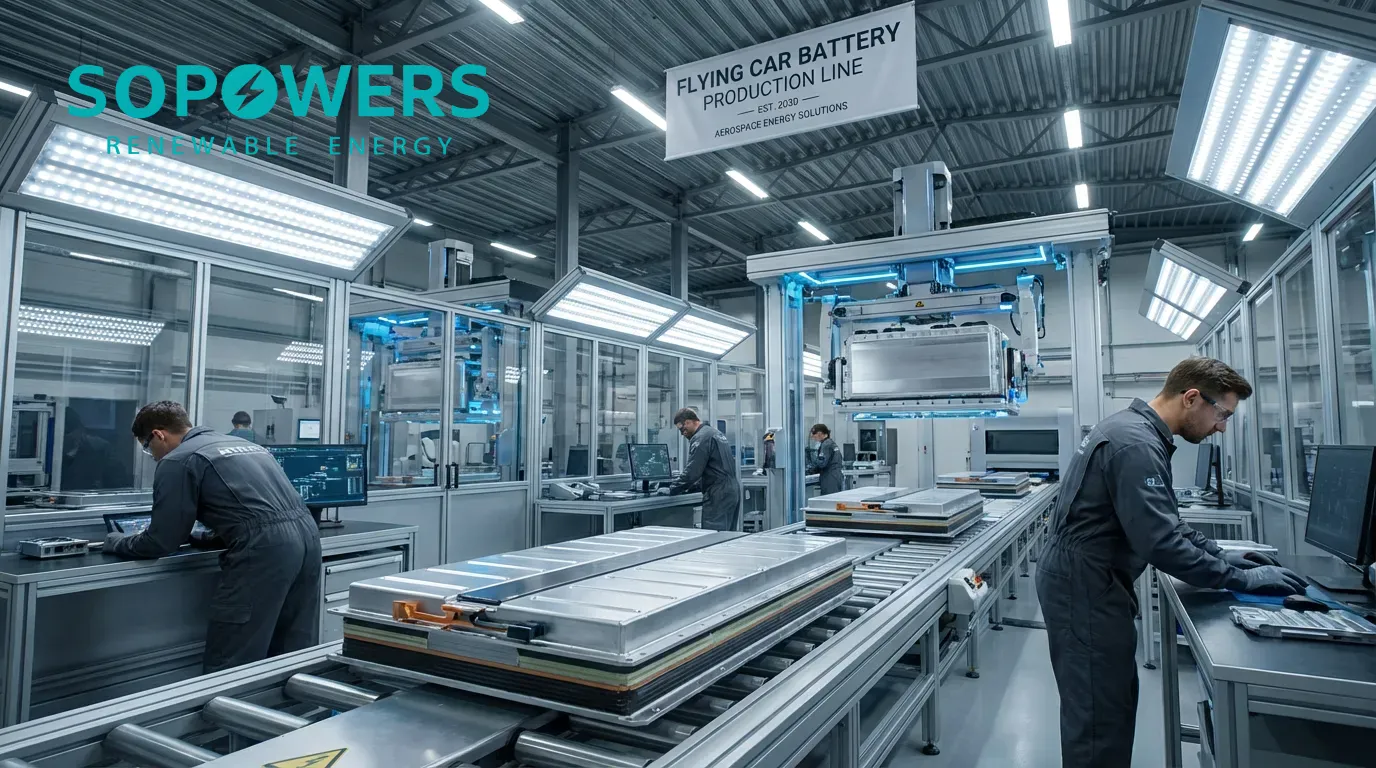
On March 27, Zhongchuang Aerospace announced that the core power system for the XPeng Huitian X3-F flying car rolled off the production line at its Chengdu factory on March 25. According to the public reports provided in the research brief, this custom battery was designed specifically for flying car use and combines three claims that normally fight each other in the same pack: a 25C max discharge rate, about 360 Wh/kg energy density, and a four-layer safety architecture.
That combination is why this battery story matters far beyond eVTOL headlines. For procurement teams working on drone battery, lipo battery, li-ion battery, or defense drone battery projects, it is a useful stress test for supplier logic. It shows what happens when a pack must deliver very high burst power for vertical takeoff and landing while still protecting flight range, mechanical integrity, and thermal safety.
Open coverage supports the broader XPeng X3 concept, including the modular land-air design, while the more detailed battery figures in this case come mainly from company statements and Chinese-language reports cited in the research brief. Even with that limitation, the engineering message is clear: if a supplier promises both very high discharge and very high energy density, buyers should immediately ask what was sacrificed and how the risks were controlled.
What buyers usually miss is that “25C” alone says almost nothing without test conditions. For a 100 Ah pack, 25C means a theoretical 2,500 A peak. But the useful question is not whether that current can be reached for an instant. It is whether the pack can survive repeated high-load duty without unsafe temperature rise, severe voltage sag, or rapid capacity loss. In practical sourcing, that is the line between a real high discharge battery and a marketing label.
What XPeng’s battery reveals about battery performance trade-offs
The reported XPeng battery uses high-silicon, high-nickel cells. That chemistry direction makes sense if the design target is high energy density battery performance at battery-pack level. Silicon helps raise anode capacity, while nickel-rich cathodes support higher specific energy. But both moves tighten the engineering window.
Here is the buyer-relevant trade-off behind the headline numbers:
| Performance target | What improves | What gets harder |
|---|---|---|
| Higher C-rate | VTOL thrust, burst response, voltage stability under load | Heat generation, cycle life, busbar and connector stress |
| Higher Wh/kg | Flight time, payload efficiency, system weight reduction | Thermal margin, mechanical robustness, abuse tolerance |
| Lower pack weight | Aircraft efficiency, reserve margin | Structural protection, spacing, impact resistance |
| Aviation-style safety | Risk control, qualification readiness | Cost, design complexity, validation time |
This is why XPeng’s reported 360 Wh/kg matters. Typical EV packs often sit around the 170 to 190 Wh/kg range at pack level, while many industrial UAV battery packs are commonly closer to 180 to 220 Wh/kg. Moving to 360 Wh/kg while still claiming 25C max discharge is not a small step. It is a fundamentally different design challenge.
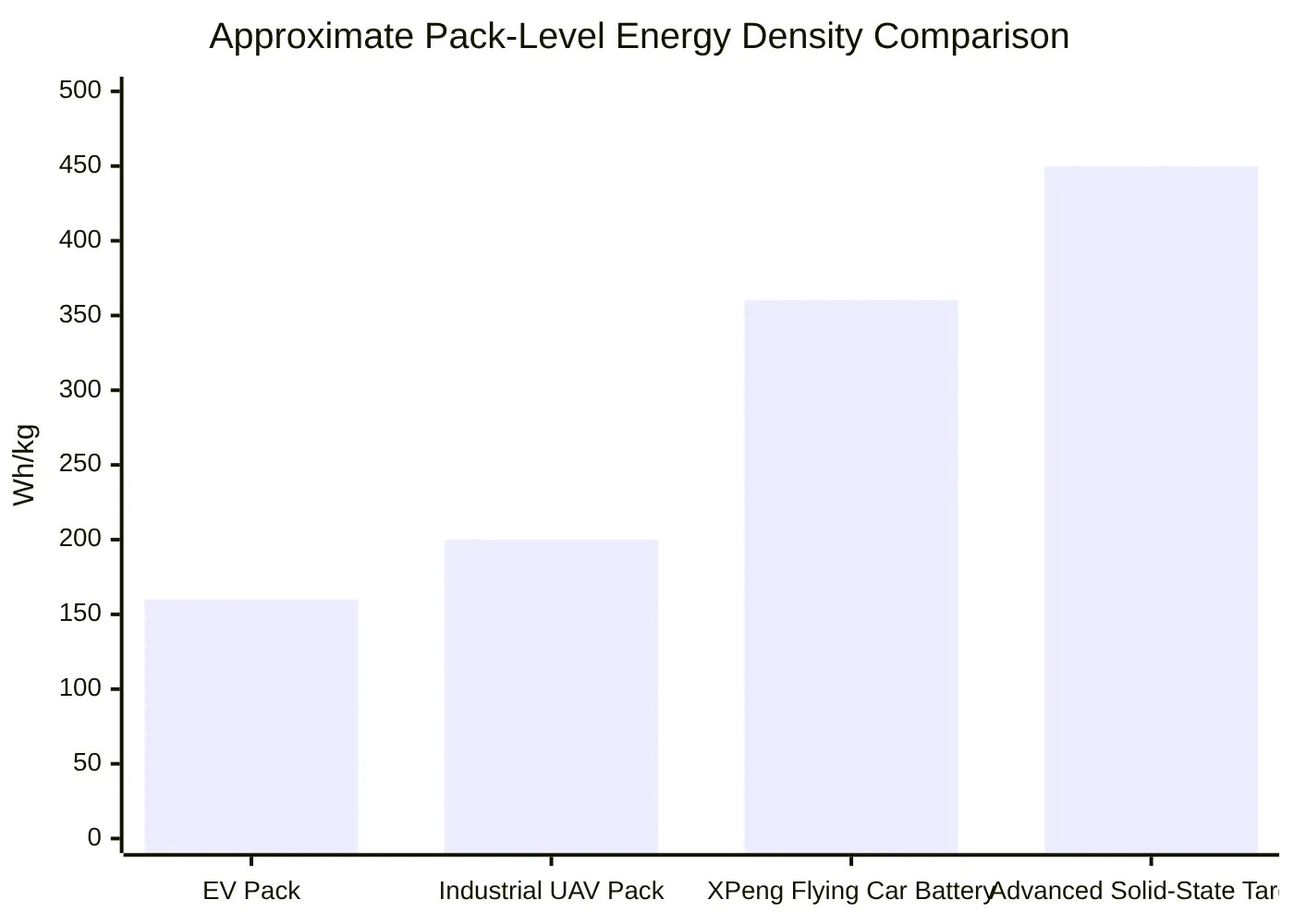
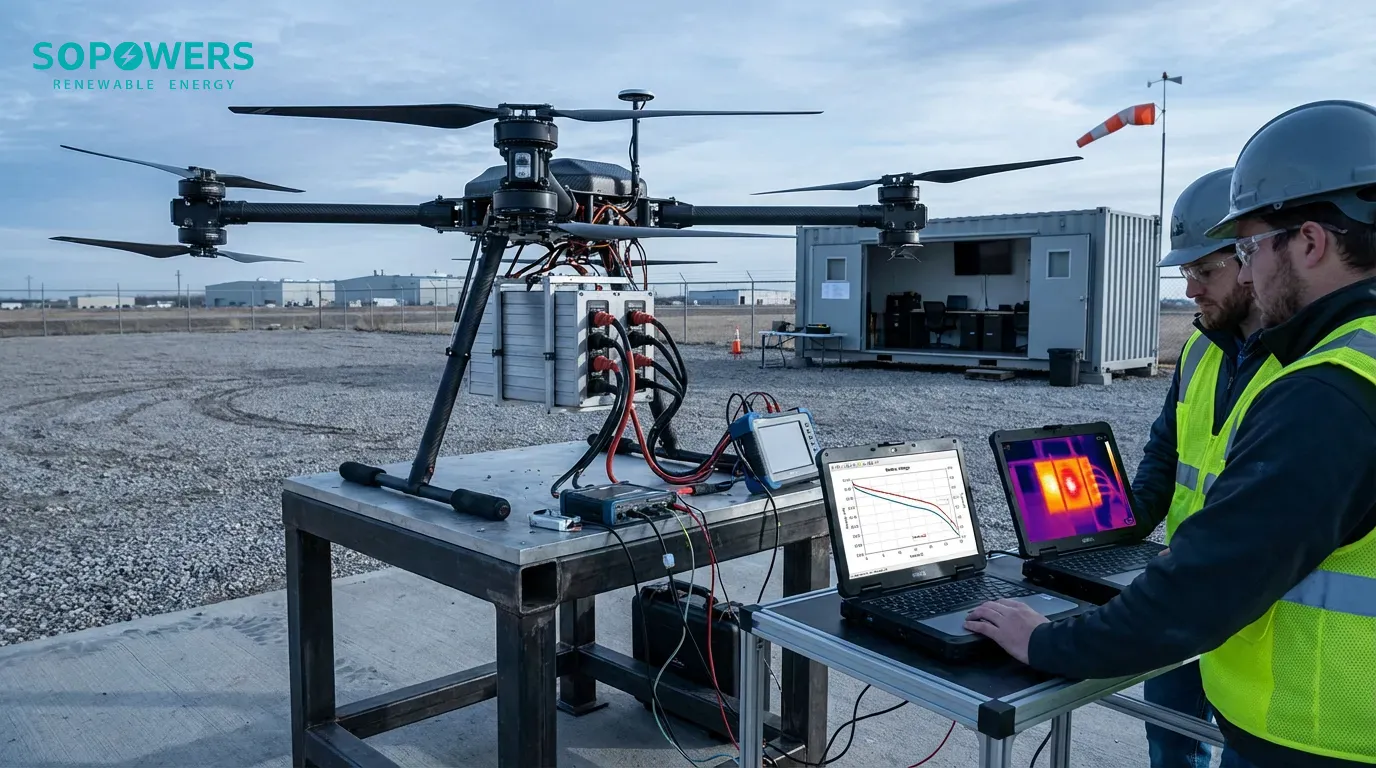
For a technical buyer, the practical lesson is simple. If a supplier offers drone battery or lithium ion battry solutions that seem to approach this frontier, ask what test discipline sits behind the claim. At minimum, you want discharge curves, thermal rise data, cycle-life data under realistic load, and abuse-test summaries. If those are missing, the spec is not decision-grade.
Sopowers’ own application approach is relevant here because it starts with solution matching, not just catalog values. Before delivery, the team confirms application scenario, required capacity, voltage, power rating, and feasibility. That matters because the wrong pack architecture can make even a good cell perform badly in field conditions. Buyers looking at High energy density battery solutions or discussing a custom project through Contact Us should push for this mission-based review first.
How battery safety changes when battery performance targets rise
The XPeng battery story is not just about output. It is also about safety architecture. The research report describes a four-tier safety system spanning cell, module, system, and full aircraft, along with a reported 15.2-meter drop test and broad cell-level validation under extreme conditions.
That safety logic is more important than the headline C-rate. A buyer approving a UAV battery or robotic battery should think in layers, not single features. A BMS alone does not make a pack safe. A stronger enclosure alone does not solve propagation risk. Safety has to be designed from chemistry selection through mechanical layout, wiring, sensing, and platform integration.
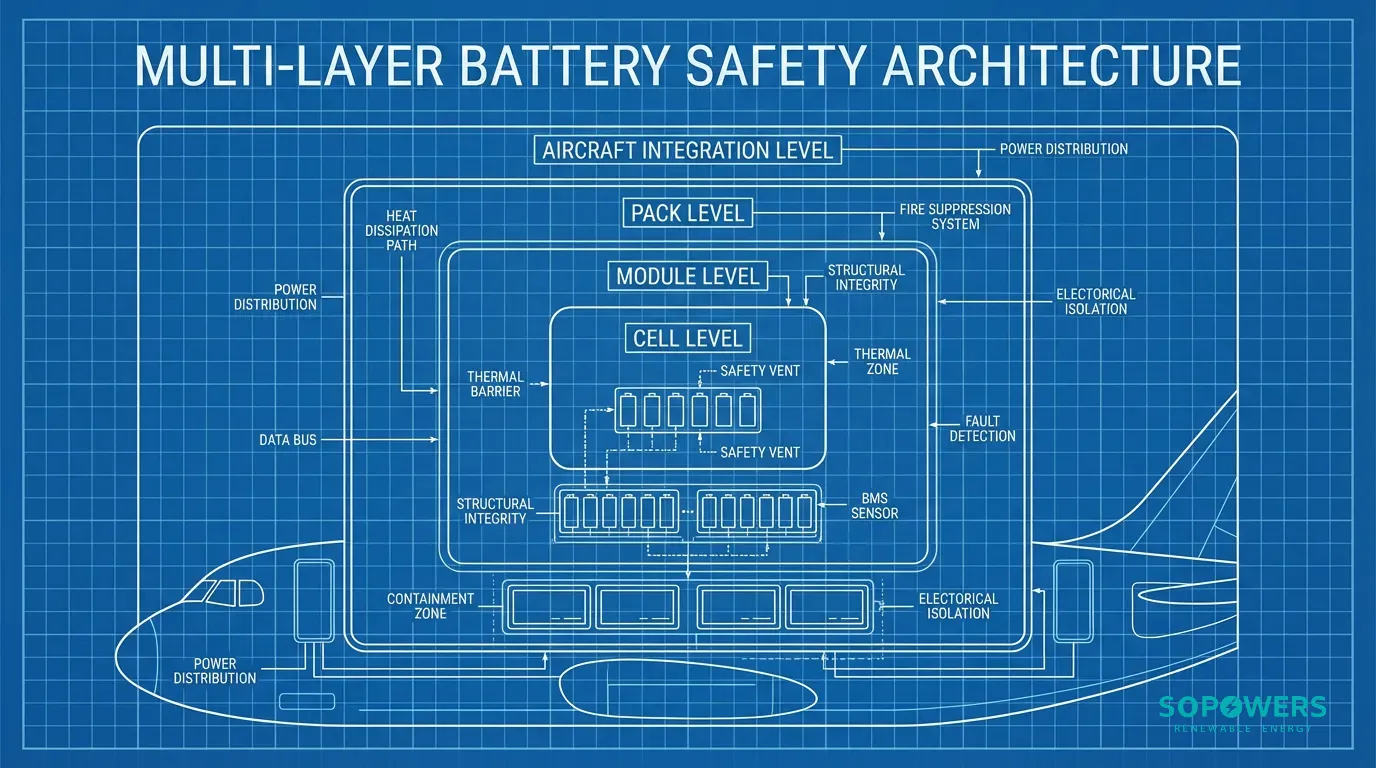
A useful buyer framework looks like this:
| Safety layer | What to evaluate |
|---|---|
| Cell level | Chemistry choice, lot traceability, capacity matching, internal resistance spread |
| Module level | Spacing, fuse strategy, compression design, vent path management |
| Pack level | BMS logic, temperature sensing, short-circuit protection, connector reliability |
| Platform level | Mounting, crash path, thermal isolation, airflow, maintenance access |
| Operational level | Charging rules, cold-start protocol, inspection, field troubleshooting |
This is where many teams get misled. They compare only nominal specs, such as 6s1p vs 6s2p, or 21700 battery vs 26650 battery, without asking how the pack handles drop, puncture, vibration, or propagation. XPeng’s reported drop-test claim is a reminder that high-performance battery design is really mechanical and thermal engineering as much as electrochemistry.
Sopowers’ production model aligns well with this kind of buyer requirement. During delivery, all batteries undergo factory testing and consistency screening to ensure stable performance. That is especially important in fleets where one weak pack can create voltage sag, early landing, or unpredictable behavior. Buyers evaluating low temperature battery options or broader product configurations should focus on documented screening discipline, not just pack claims.
How to evaluate battery specs for drone battery and UAV battery projects
If XPeng’s battery sets a frontier benchmark, most commercial buyers still need a more realistic spec window. Chasing flying-car-level numbers too early can create more risk than value.
Here is a more practical decision table by application:
| Application | Realistic pack energy density | Realistic continuous discharge target | Main decision priority |
|---|---|---|---|
| FPV battery, 6s1p or 6s2p | 150 to 220 Wh/kg | 20C to 40C | Burst power, low sag, manageable heat |
| Industrial drone battery | 180 to 240 Wh/kg | 5C to 15C | Endurance, consistency, safe thermal margin |
| Robotic battery | 140 to 220 Wh/kg | 2C to 10C | Stability, safety, service life |
| Low temperature battery | Depends on chemistry and insulation strategy | Derated by ambient conditions | Cold-start reliability, usable capacity retention |
| Defense drone battery | Often biased toward robustness over max Wh/kg | Mission dependent | Environmental reliability, traceability, support |
The battery format also matters. A 21700 battery can be a strong fit for endurance-focused li-ion battery packs. A 26650 battery may offer useful thermal headroom in higher-load scenarios. A 46950 battery becomes more relevant at larger platform scale. A 26105 battery can be attractive for industrial UAV and specialized high-power applications where energy and power need to be balanced carefully. Sopowers’ product ecosystem explicitly includes 26105 Battery Pack.
What to ask the supplier before approval:
- How is C-rate defined?
- Peak or continuous?
- At what ambient temperature?
- For how many seconds or minutes?
- At what cut-off voltage?
- What mission profile was actually tested?
- Hover current
- Climb bursts
- Landing reserve
- Payload condition
- Repeated cycle loading
- What thermal data is available?
- Surface and core temperature rise
- Cooling assumptions
- Hot-weather and low-temperature derating
- What abuse tests were performed?
- Drop
- Vibration
- Short-circuit
- Overcharge
- Propagation control
- What consistency controls are used?
- Cell matching
- Factory screening
- Lot traceability
- Pack-to-pack variance limits
This is where buyer discipline pays off. A supplier that cannot answer these questions clearly is usually selling a number, not a dependable battery system.
Where battery projects fail when teams chase headline specs
The XPeng battery example is useful partly because it exposes the mistakes buyers often make when they try to copy frontier specs without frontier validation.
Common mistakes include:
Mistake 1: Treating peak battery specs as continuous battery capability
A pack may survive a short 25C burst but fail badly if the real duty cycle repeatedly drives it near that level. This is common in FPV battery and rc battery sourcing where labels look generous but thermal data is thin.
Mistake 2: Buying for energy density first and field survivability second
A compact high energy density battery may look excellent on paper, then suffer from impact sensitivity, swelling stress, or poor long-term stability under rough handling.
Mistake 3: Ignoring low-temperature battery derating
Below freezing, internal resistance rises, voltage sag gets worse, and effective current capability falls. Buyers who overlook this often discover that a pack specified at room temperature becomes unreliable at altitude or in winter. Sopowers covers this issue in its related article on what low-temperature batteries are and how they work and supports dedicated low-temp product options through its low temperature battery pages.
Mistake 4: Underestimating post-delivery troubleshooting
Many failures are not caused by the cell alone. They come from mismatch between the pack and the platform: connector losses, enclosure heat buildup, actual current spikes, or unrealistic reserve settings. That is why after-delivery technical support matters. Sopowers explicitly supports root-cause analysis and optimization after shipment, which is a meaningful differentiator for distributors and integrators.
A practical buyer checklist:
- Confirm mission current, not just average power.
- Size continuous battery performance with headroom.
- Ask for voltage sag curves, not only nominal voltage.
- Verify low-temperature data under your real load.
- Check pack consistency screening method.
- Request documentation before volume commitment.
- Confirm who supports troubleshooting after deployment.
If your team is still narrowing battery architecture, related Sopowers reading can help frame the sourcing decision: How to choose drone battery, What is drone battery, and How to troubleshoot drone battery issues.
How Sopowers approaches battery projects that need real validation
For buyers who need more than generic battery cataloging, the most relevant takeaway from this XPeng case is process discipline. Sopowers does not need to claim flying-car-level figures to be useful. Its value is in helping buyers avoid predictable sourcing mistakes.
That process includes:
- Pre-delivery solution matching and technical confirmation based on application scenario, capacity, voltage, power rating, and feasibility.
- During-delivery factory testing and consistency screening for stable performance.
- After-delivery technical support, troubleshooting, and root-cause analysis for real operating issues.
This matters for drone battery, lipo battery, high discharge battery, low temperature battery, and high energy density battery projects because the real risk usually appears at the interface between spec and operation. Buyers sourcing for industrial fleets, urban deployments around Downtown Dubai, Business Bay, Marina, or advanced demonstration environments near the Museum of the Future need packs that perform predictably, not just impress on paper.
If you want to compare product routes, start with the Jump to Product Page. If your project involves a custom UAV battery, FPV battery, 21700 battery, 26105 battery, or low temperature battery requirement, the faster path is to Send Inquiry with your mission profile and target load case.
In short, XPeng’s new battery milestone does not mean every buyer should chase 25C and 360 Wh/kg. It means serious battery sourcing now requires sharper questions. The buyers who get better outcomes will be the ones who evaluate thermal margin, safety layering, consistency control, and field support as carefully as they evaluate headline battery performance.


