
Industrial and commercial drone fleets are growing fast, and the drone battery is increasingly the limiting factor for uptime, safety, and total cost of ownership. Market analysts continue to project strong expansion for UAV batteries alongside broader drone adoption, especially in inspection, mapping, agriculture, and logistics (see the drone battery market outlook from Grand View Research and MarketsandMarkets). For distributors and private-label brands, the main challenge is not finding a spec sheet, it is finding performance you can trust across batches, plus documentation that clears customs and compliance reviews.
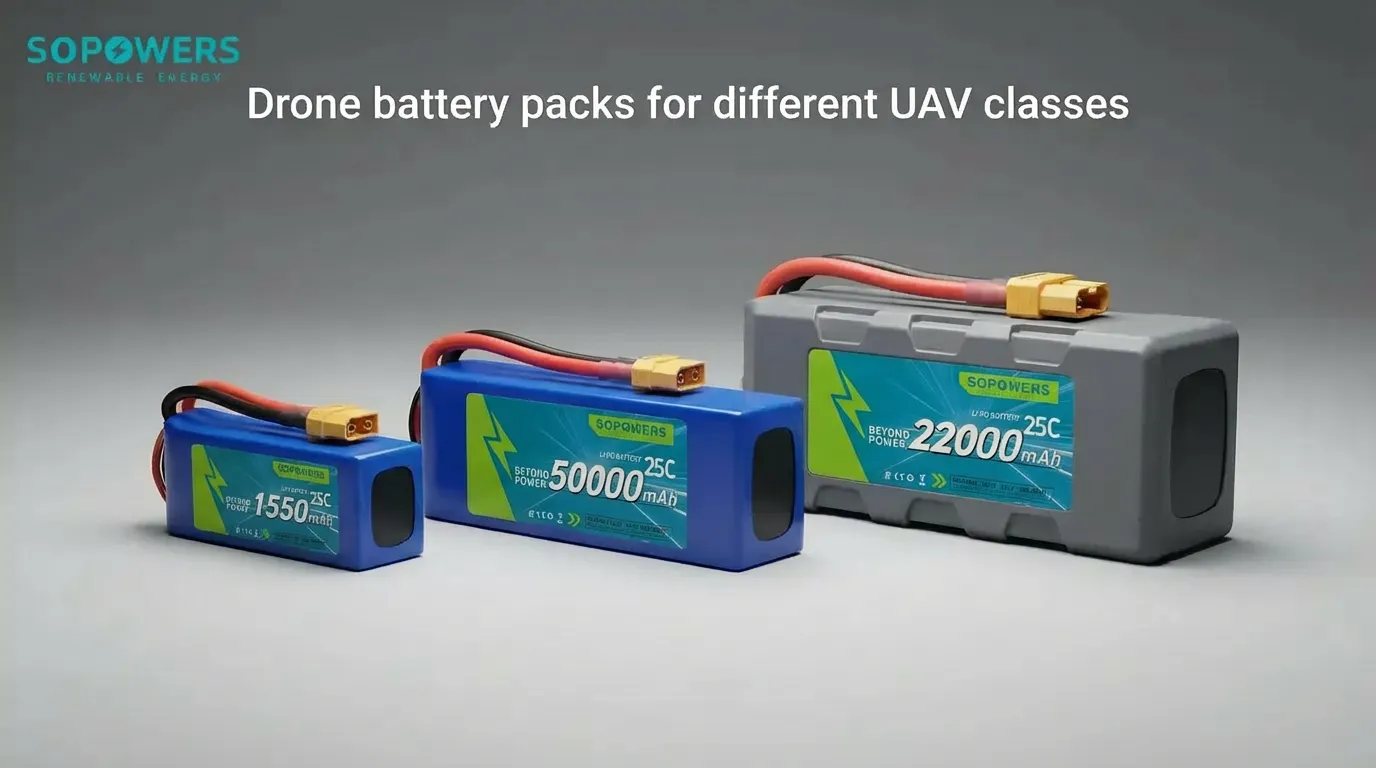
Why drone battery selection is harder than it looks (and where buyers get burned)
Even experienced buyers run into the same three failure modes:
- Specs that do not translate to flight performance. In the field, discharge claims (C-rating) are often not comparable across suppliers. Independent FPV educators repeatedly warn that headline C numbers can be overstated and that load behavior matters more than marketing (example explainer: YouTube: how to choose a LiPo battery).
- Environmental mismatch. Cold weather raises internal resistance and reduces available capacity; high heat accelerates aging. Commercial UAV operators note performance and lifecycle penalties outside typical operating bands (discussion: Commercial UAV News).
- Compliance friction. Export and distribution require transport testing and region-specific documentation. Air-transport rules and UN38.3 requirements are tightening further (overview: Jauch on UN38.3 and air transport updates), while Europe is also moving forward with new obligations under the EU Battery Regulation (high-level summary: DEKRA).
Sopowers addresses these risks with a process built for B2B buyers: pre-delivery solution matching and technical confirmation, factory testing and consistency screening during delivery, and post-delivery technical support and troubleshooting to help distributors stabilize real-world outcomes across customer applications.
Drone battery technology basics: LiPo, Li-ion, and high energy density options
Most professional discussions come down to selecting the right balance of power, energy, weight, and lifecycle.
Common chemistries used in drones
| Chemistry | Best fit | Strengths | Trade-offs |
|---|---|---|---|
| LiPo (Lithium Polymer) | Multirotors, FPV, many industrial UAVs | High power output, flexible pack design | Cycle life can be lower under aggressive discharge, more sensitive to poor charging/storage |
| Li-ion (typically NMC) | Long-endurance, fixed-wing, long-range builds | Higher energy density, often better cycle life | Lower peak discharge vs. high-performance LiPo |
| LiFePO4 | Safety-critical, long cycle use cases | High thermal stability, long cycle life | Lower energy density (more weight for same Wh) |
| High energy density variants (e.g., advanced NMC classes) | Endurance/payload optimization | More Wh per kg potential | Often requires tighter thermal and charge management |
For general orientation on UAV battery configurations and use cases (S-count ranges, UAV pack design considerations), a solid neutral reference is the guide from Unmanned Systems Technology.
The four parameters that determine whether a pack is “right”
- Voltage (S-count): Pack voltage is proportional to cells in series. Your powertrain (ESC/motors) defines the allowable voltage range.
- Capacity (mAh/Ah) and energy (Wh): Energy is what drives endurance.
- Formula: Wh = V × Ah
- Discharge capability (C-rating): Determines whether the pack can deliver current without excessive voltage sag and heat.
- Energy density (Wh/kg): Matters when weight is the constraint (endurance drones, payload-limited missions).
From specs to real flight performance: a distributor-grade selection checklist
The goal is not “maximum everything.” The goal is a battery pack that repeatedly meets mission requirements with controlled heat, stable voltage under load, and consistent batch behavior.
Step 1: Confirm voltage and power headroom first
- Lock the S-count to what the aircraft supports (do not “upgrade” voltage without a system-level review).
- Estimate required current under the worst case (takeoff, acceleration, payload lift, wind margin).
- Make sure connectors, wiring, and thermal paths match the intended continuous load.
Step 2: Size energy for mission time without overweighting the aircraft
Adding capacity adds weight, and the extra weight can reduce efficiency. For many multirotors, there is a point where more mAh yields diminishing real flight-time gains. A practical approach:
- Define required minutes on-station plus reserve.
- Convert to Wh requirement (from flight logs when available).
- Select a pack that meets Wh with acceptable weight and thermal behavior.
Step 3: Treat C-rating as a starting point, not proof
Because C numbers are not consistently measured across brands, validate performance using:
- Voltage sag under a representative load
- Temperature rise during the mission profile
- Pack-to-pack consistency (variance matters for fleets)
Field-focused explainers emphasize this “behavior under load” mindset rather than trusting the label alone (example: YouTube: C-rating and LiPo selection).
Practical spec ranges by application (starting point)
| Use case | Typical voltage (S) | Typical capacity band | What matters most |
|---|---|---|---|
| FPV / high-thrust builds | 4S to 6S | ~1000 to 2000 mAh | High discharge behavior, low sag, low weight |
| Cinematic / inspection multirotors | 4S to 6S (platform-dependent) | ~3000 to 10000 mAh | Stable voltage, safety margin, predictable cycle aging |
| Mapping / survey endurance | 6S to 12S+ | ~10 Ah to 30 Ah+ | Energy density, consistency, lifecycle cost |
| Agriculture / heavy-lift operations | 12S+ common in larger systems | high capacity packs | Heat management, fast turnaround, cycle strategy |
To connect this to how professional operators think about endurance, power options, and operational constraints, see the industry overview at Commercial UAV News.
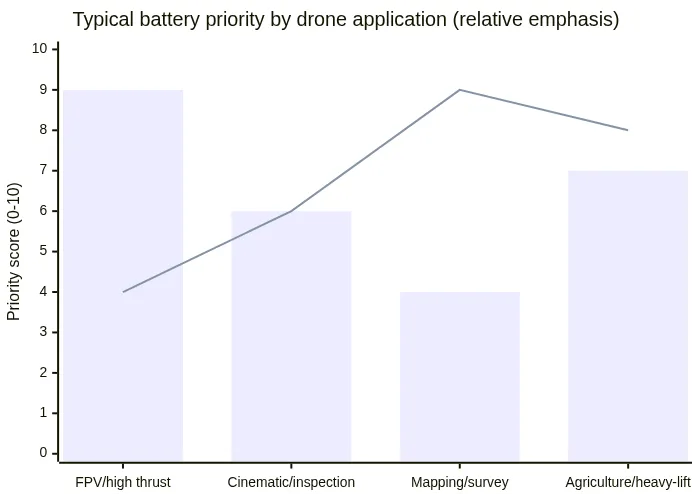
How to read: the bar approximates power/discharge emphasis, while the line approximates energy/endurance emphasis. Use it to sanity-check whether your pack choice is aligned with the mission.
Low temperature battery and hot-climate operations: what changes in the real world
Temperature is not a footnote, it changes internal resistance, usable capacity, and long-term degradation.
Cold operations (sub-zero planning)
In cold weather, batteries deliver less usable energy and less peak power because internal resistance rises. Professional guidance commonly recommends planning for performance loss and using operational strategies (pre-conditioning, insulation, reduced peak loads) rather than assuming nameplate capacity (context: Commercial UAV News).
Cold-weather checklist for distributors specifying packs:
- Define minimum ambient and whether packs start cold-soaked.
- Require a validation plan: representative load profile at temperature, not just room-temperature discharge.
- Confirm the customer’s charging process (charging cold packs is a common cause of damage).
Hot environments and urban heat
High ambient temperatures and solar load accelerate aging and can push internal temperatures beyond safe limits during high-current segments. This matters for demanding urban operations, including high-heat missions around Downtown Dubai, the Museum of the Future, Business Bay, and the Marina, where heat soak and turnaround speed can stress packs.
Hot-climate checklist:
- Avoid aggressive fast-charging strategies that raise cell temperature repeatedly.
- Ensure airflow/thermal paths are not blocked by tight airframes or payload mounts.
- Use conservative limits when the mission includes long hover (higher continuous current vs. forward flight in some platforms).

Certifications, export documentation, and how to evaluate a supplier beyond marketing claims
For distributors, the “best” drone battery is the one you can repeatedly import, stock, and support with minimal surprises.
Documentation buyers commonly need
Use this as a practical request list during sourcing and onboarding:
- UN38.3 transport test evidence and required summaries for lithium batteries (air-transport rules overview: Jauch).
- SDS/MSDS and transport classification alignment (UN 3480/3481 handling is often reviewed by logistics teams).
- EU readiness signals for European distribution, especially as the EU Battery Regulation expands obligations over time (overview: DEKRA).
- Region and customer-specific compliance requests (a neutral perspective on choosing the right battery and compliance considerations: Xponential Europe).
Supplier evaluation checklist (focused on performance truth)
| What to verify | What to ask for | Why it matters |
|---|---|---|
| Real discharge behavior | Load profile test approach, sag/temperature limits | Prevents customer complaints and early failures |
| Batch consistency | Consistency screening method and acceptance criteria | Fleet reliability depends on low variance |
| Factory testing flow | What is tested during delivery (OCV/IR/capacity/aging as applicable) | Reduces DOA and drift across shipments |
| Pre-sales engineering support | How requirements are translated into a pack spec | Avoids mis-sizing and mismatch to mission |
| Post-delivery support | Root-cause analysis process and response time | Protects your brand when field issues happen |
How Sopowers supports distributors end-to-end (process, not slogans)
Sopowers is structured to reduce the exact risks B2B buyers face:
- Before delivery: solution matching and technical confirmation based on your application scenario, including assessments of capacity, voltage, power rating, and feasibility for the mission.
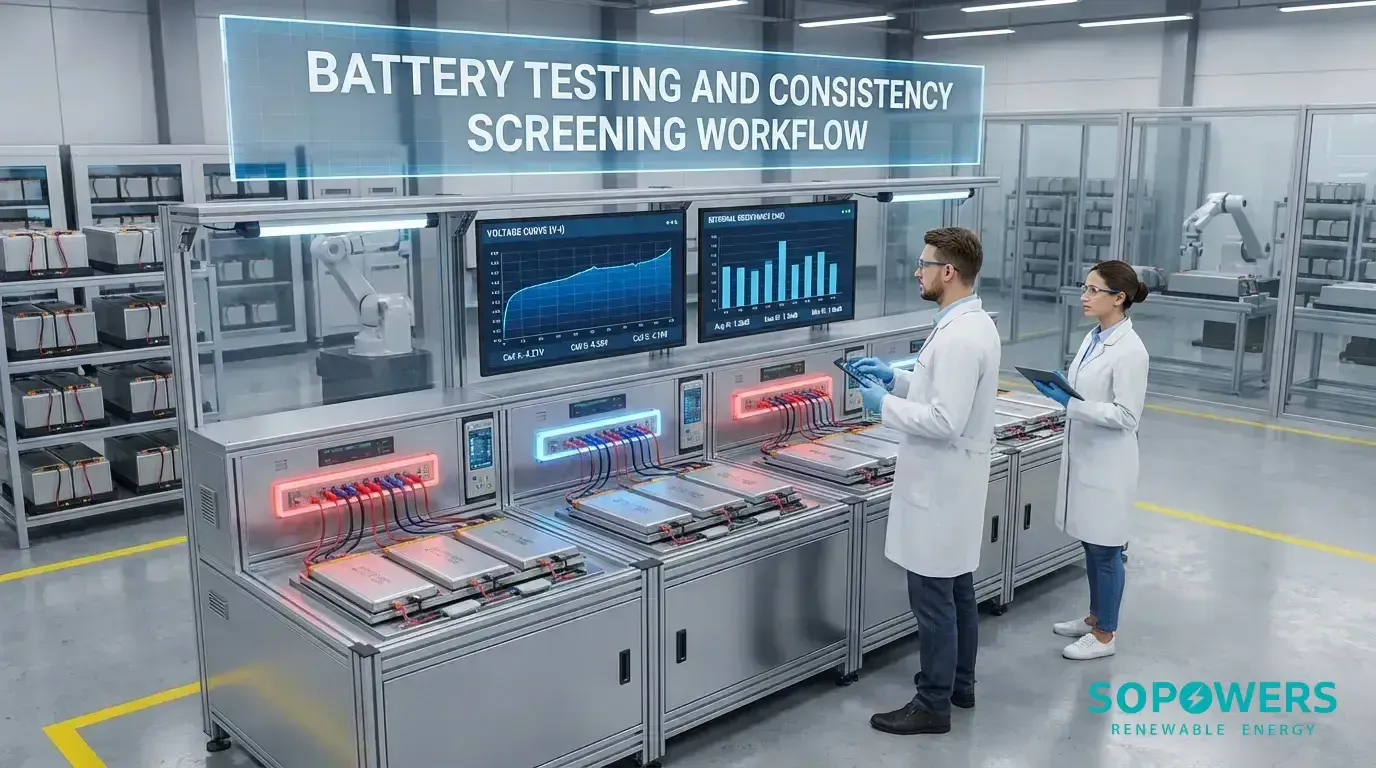
- During delivery: batteries undergo factory testing and consistency screening to ensure stable performance.
- After delivery: technical support and troubleshooting assistance, including root-cause analysis and recommendations to improve system performance in real use.
Quick FAQs (for fast buyer alignment)
What type of battery do drones use most often?
Many drones use LiPo because it balances power and energy well for multirotors. Long-endurance platforms may use Li-ion packs where peak discharge demands are lower (see Unmanned Systems Technology).
How should drone batteries be stored to maximize lifespan?
A widely recommended approach is storing at partial state of charge and using disciplined inspection and maintenance routines (maintenance best practices: Heliguy).
What changes for agricultural fleets with frequent cycling?
Cycle strategy, turnaround, and heat management dominate cost outcomes. Practical battery management guidance for agriculture emphasizes disciplined handling and operational controls (see DronesprayPro).
Next steps: shop or spec a drone battery with verified performance
If you already know your voltage, capacity target, mission profile, and operating temperatures, you can move directly to sourcing. If not, treat selection as an engineering exercise: match the battery to the aircraft and mission, then validate under realistic load and temperature.


