
By 2026, the drone battery is no longer a commodity component. It is a performance limiter, a reliability risk, and often the deciding factor behind mission success for inspection, mapping, agriculture, logistics, and advanced FPV use-cases. Market outlooks also reflect that importance: multiple industry analyses project strong growth for drone battery demand through 2030, driven by expanding commercial UAV operations and more demanding mission profiles.
For technical buyers and distributors, the real challenge is not finding a battery that “fits.” It is finding a pack that delivers verifiable capacity, discharge capability, and temperature behavior, with documentation that holds up in cross-border shipping.
Why Drone Batteries Matter More Than Ever in 2026
Commercial UAV adoption keeps pushing batteries in three directions at once:
- Higher power (takeoff bursts, VTOL transitions, heavy lift, FPV throttle spikes).
- Higher endurance (more minutes per sortie for mapping, inspection, and logistics).
- More climate resilience (reliable output in winter conditions and predictable behavior in hot environments).
At the same time, B2B buyers face recurring problems:
- Spec inflation: real capacity, real C-rate, and real cycle life often differ from label claims.
- Operational timing: lead times and small-batch availability can decide who wins an account.
- Compliance overhead: frequent SKU changes can trigger retesting and documentation updates.
A practical 2026 buying approach starts by selecting the right battery category for the mission, then demanding evidence (test curves, internal resistance consistency, and traceable documentation).
Drone Battery Technologies: What To Choose and Why
Most drone platforms still rely on lithium-based packs, with two common “families” and a few specialized variants:
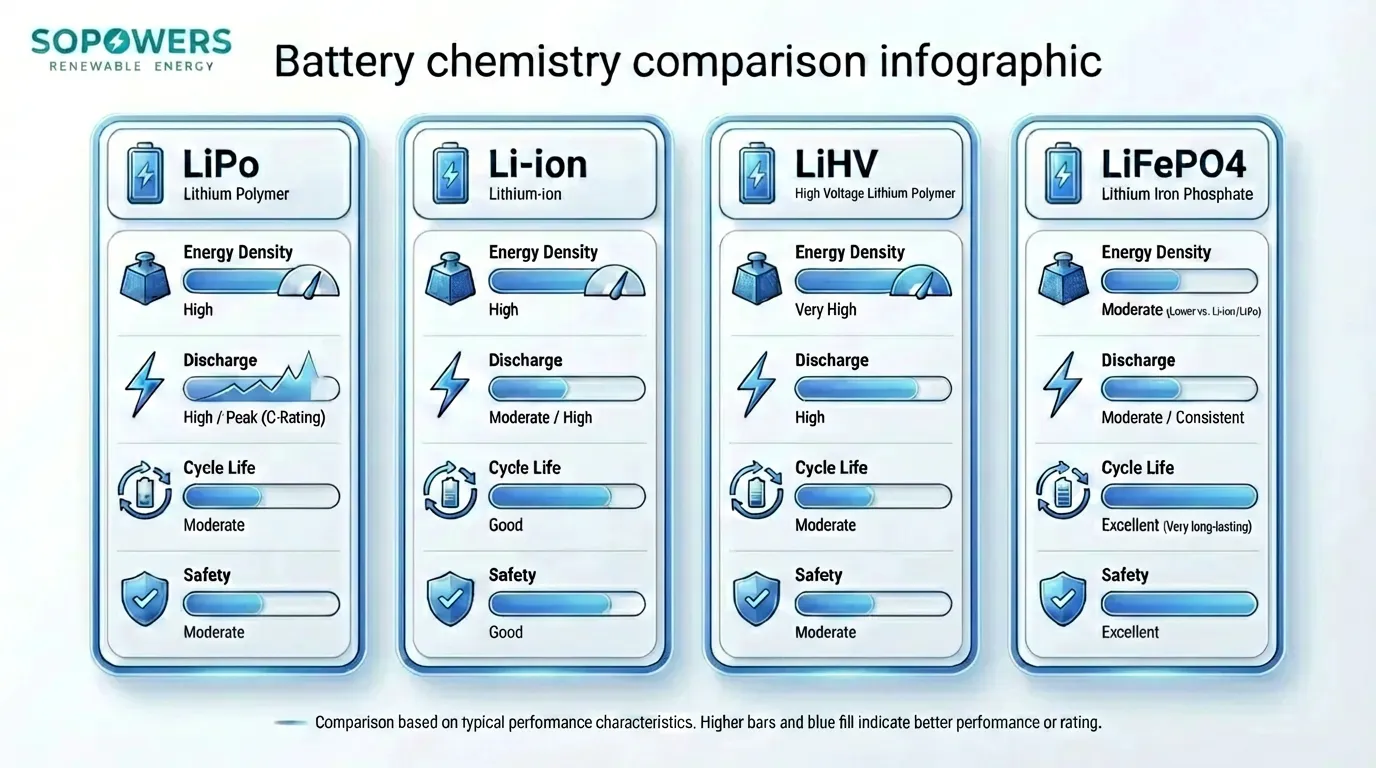
- LiPo (lithium-polymer): widely used in multirotors and FPV because pouch cells support high discharge and flexible shapes.
- Cylindrical Li-ion (often NMC/NCA): often selected when energy density and cycle life matter more than peak current.
- LiHV (high-voltage LiPo): higher charge voltage increases energy per pack, but typically tightens charging requirements and may reduce cycle life.
- LiFePO4: excellent stability and long life, but usually too heavy for weight-sensitive flight platforms.
Quick comparison table (typical pack-level ranges)
| Chemistry (typical UAV use) | Typical energy density (Wh/kg) | Typical continuous discharge (C) | Typical cycle life range | Notes buyers should verify |
|---|---|---|---|---|
| LiPo | 150 to 220 | 25 to 100 (higher in FPV marketing) | 200 to 500 | Verify voltage sag and heating under load |
| Cylindrical Li-ion | 170 to 240 | 3 to 15 (higher with power cells) | 500 to 1000 | Check peak current headroom and pack cooling |
| LiHV | 180 to 240+ | 15 to 70 | 200 to 400 | Confirm charger compatibility and charge limits |
| LiFePO4 | 90 to 140 | 1 to 10 | 1000 to 3000 | Usually niche in drones due to weight |
A buyer’s reality check on “C-rating”
Many guides highlight C-rating, but experienced buyers treat it as a starting point, not proof. Practical indicators are:
- Internal resistance (IR) consistency across cells and across batches.
- Temperature rise under load. Exceeding roughly 60 C internal pack temperature accelerates degradation and increases risk, and charging below 0 C is widely discouraged for lithium packs due to plating risk.
Application-Based Selection: Match the Pack to the Mission
A “best drone batteries” list is not very useful for B2B purchasing because the “best” depends on the load profile and environment. Use the matrix below to shortlist what to test.
| Application segment | What tends to matter most | Common battery direction |
|---|---|---|
| FPV racing / freestyle | Burst power, low voltage sag, low weight | High discharge-focused lithium packs |
| Cinematography | Smooth voltage, predictable runtime, safety features | Higher-capacity packs, often with smart monitoring |
| Industrial inspection / mapping | Endurance, cycle life, documentation | Energy-optimized packs with strong QA and data |
| Agricultural spraying / heavy lift | Sustained current, ruggedness, fast swapping | High power packs and robust assembly |
| Cold-weather operations | Output at sub-zero temps, predictable capacity | Low-temperature-optimized formulations |
| Logistics / long endurance | Wh per kilogram, fleet economics, compliance | High energy density approaches with careful controls |
Cold and heat: do not treat temperature as a footnote
Standard packs often show clear performance drop in cold conditions, and charging below freezing is a known risk area. If your customers operate year-round, ask suppliers for:
- Capacity retention vs temperature (for example at -20 C and below).
- Discharge curves at realistic currents.
- Handling recommendations for preheating, insulation, and cooldown time.
A 2026 Buyer’s Framework: From Mission Profile to Battery Spec
Use this structured flow to reduce costly mis-specification and rework.
Step 1: Convert flight goals into energy (Wh)
Wh is the real “fuel,” not mAh.
- Required Wh ≈ (Average power in W x Flight time in hours) / Usable depth of discharge
Example: 800 W average, 30 minutes (0.5 h), 80 percent usable DoD
Required Wh ≈ (800 x 0.5) / 0.8 = 500 Wh
Step 2: Convert energy into current requirements
- Average current (A) ≈ Average power (W) / Pack voltage (V)
- Peak current must include throttle spikes, takeoff, payload transients, and safety margin.
Step 3: Validate performance claims the right way
Instead of accepting headline specs, request:
- Discharge curves at defined currents and temperatures.
- IR data and matching method.
- Batch-level consistency approach (not a single “hero” test).
A common conservative practice in high-power applications is to treat continuous capability as well below the most aggressive label claims unless the vendor supplies full test conditions and thermal limits.
Step 4: Plan for compliance and shipping early
Most lithium batteries shipped internationally must meet UN38.3 transport testing requirements and provide a test summary. Start your sourcing workflow with documentation, not after the purchase order.
To align internal teams (procurement, quality, logistics), use authoritative references:
- Intertek overview of UN38.3 testing and documentation
- IATA Dangerous Goods Regulations publications page
- IEC webstore for IEC 62133-2 and related lithium safety standards
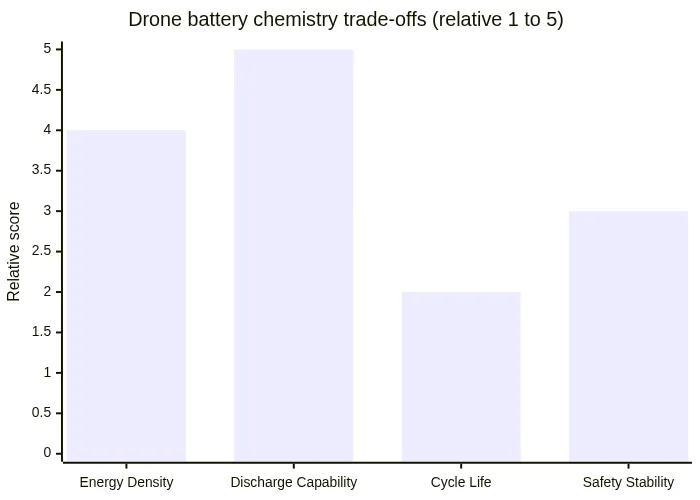
Visual: Chemistry selection priorities (normalized example)
How Sopowers Helps Distributors De-Risk Sourcing
Sopowers focuses on exporting lithium battery solutions for drone applications, with a service model built around reducing the gap between “spec sheet” and “real-world mission.”
1) Pre-delivery: solution matching and technical confirmation
Before production and shipment, Sopowers coordinates on:
- Capacity, voltage, and power rating requirements.
- Feasibility for the application scenario (load profile, expected peaks, operating temperature).
This reduces mis-specified SKUs and shortens the trial-and-error cycle that many distributors face.
2) During delivery: factory testing and consistency screening
All batteries undergo factory testing and consistency screening to improve batch stability, which is critical when your customers scale from samples to repeat orders.
3) Post-delivery: technical support and troubleshooting
If issues appear in real use (unexpected runtime, heating, voltage sag, cold behavior), Sopowers supports root-cause analysis and optimization recommendations, helping distributors protect their brand reputation.
If you want to review available options and start with a shortlist, use the product catalog here: Sopowers product page.

- Jump to Product Page
- Contact Us to validate capacity, voltage, and discharge requirements for your target applications.
- Send Inquiry for samples, documentation coordination, and a sourcing plan.
FAQ for 2026 drone battery buyers (quick answers)
How do I estimate the right battery size for a target flight time?
Use Wh: multiply average power by flight time, then divide by usable depth of discharge. This prevents the common mistake of comparing packs only by mAh.
LiPo vs Li-ion: which is better for commercial drones?
LiPo often wins on discharge capability and flexible pack design. Li-ion often wins on endurance and cycle life. The “best” depends on your peak current and thermal limits.
What certifications matter most for international shipping?
UN38.3 is foundational for transport, and many markets also expect safety standards alignment (often via IEC/EN frameworks) plus correct IATA/IMDG handling.
Summary: What “Best” Means for Drone Batteries in 2026
The best drone battery in 2026 is the one that matches your mission profile with proven data: realistic discharge performance, predictable behavior across temperature, and stable quality from batch to batch. For distributors, the winning strategy is a portfolio that balances high power, cold resilience, and energy-optimized options, backed by documentation and a supplier who supports validation before and after delivery.
For solution matching and technical confirmation, start here: Contact Sopowers.


