
Battery choice is still the fastest, most measurable way to extend flight time. But “longer flight times” can mean 40+ minutes for a camera drone, 20 to 30+ minutes for long-range FPV, or 50 to 90+ minutes for industrial mapping and agriculture platforms. That is why the most credible “best” list is segmented by real use cases, with energy (Wh) and energy density (Wh/kg) as the core benchmarks, balanced against discharge rate and safety margin.
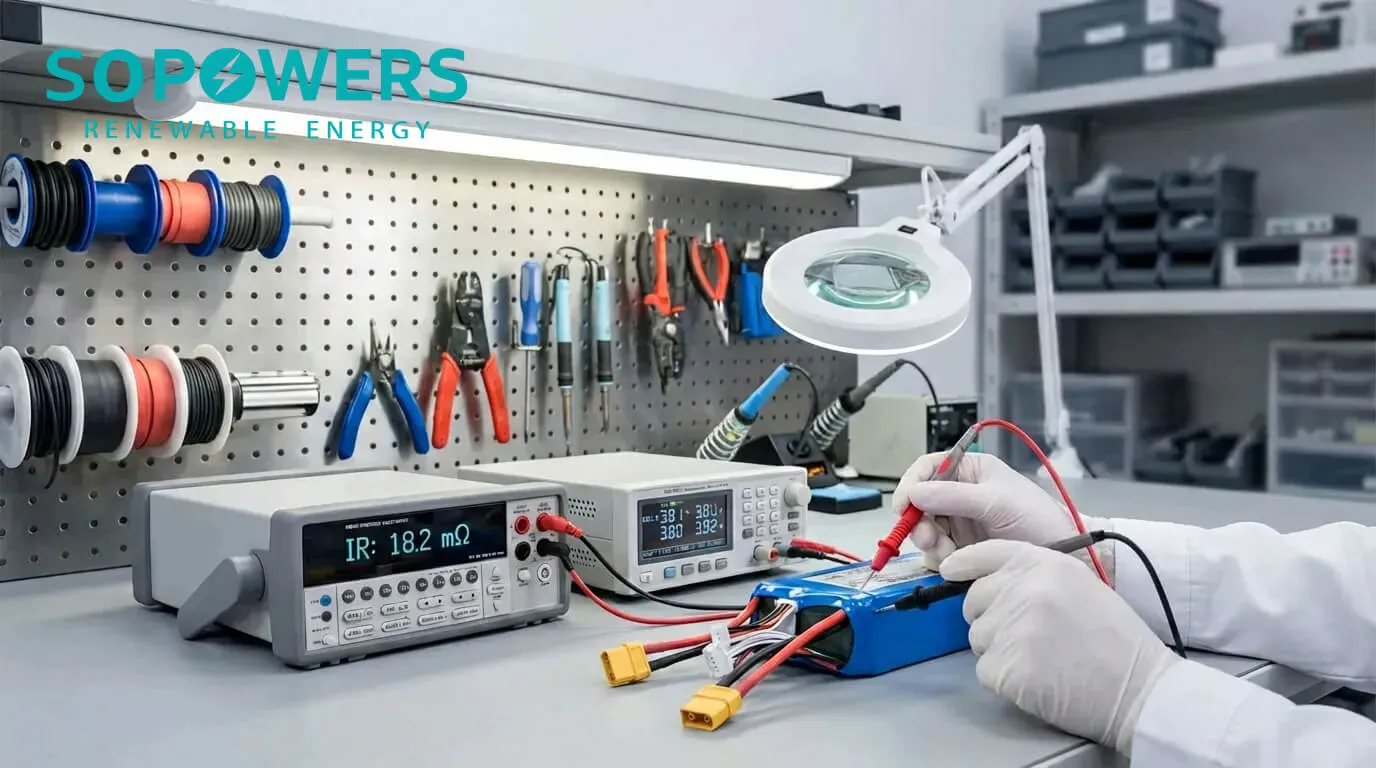
Why flight time gains are hard (and how to measure them honestly)
Most performance disputes happen because teams compare the wrong numbers. Capacity (mAh) alone is not enough; what matters for endurance is total energy (Wh) and how much of that energy is usable under real load and temperature.
A practical way to compare packs across voltages and sizes:
- Energy (Wh) = Voltage (V) × Capacity (Ah)
- Example benchmark: DJI publishes the Mavic 3 battery at 77 Wh, with detailed specs in DJI documentation and product pages (DJI technical specs page, DJI Store product page).
Other factors that can erase “paper” improvements:
- Weight growth: extra Wh helps only if Wh/kg stays competitive.
- Voltage sag under load: high-current platforms need low internal resistance and realistic discharge capability.
- Temperature: cold increases internal resistance and reduces usable capacity; plan for margin and preheating/insulation where relevant.
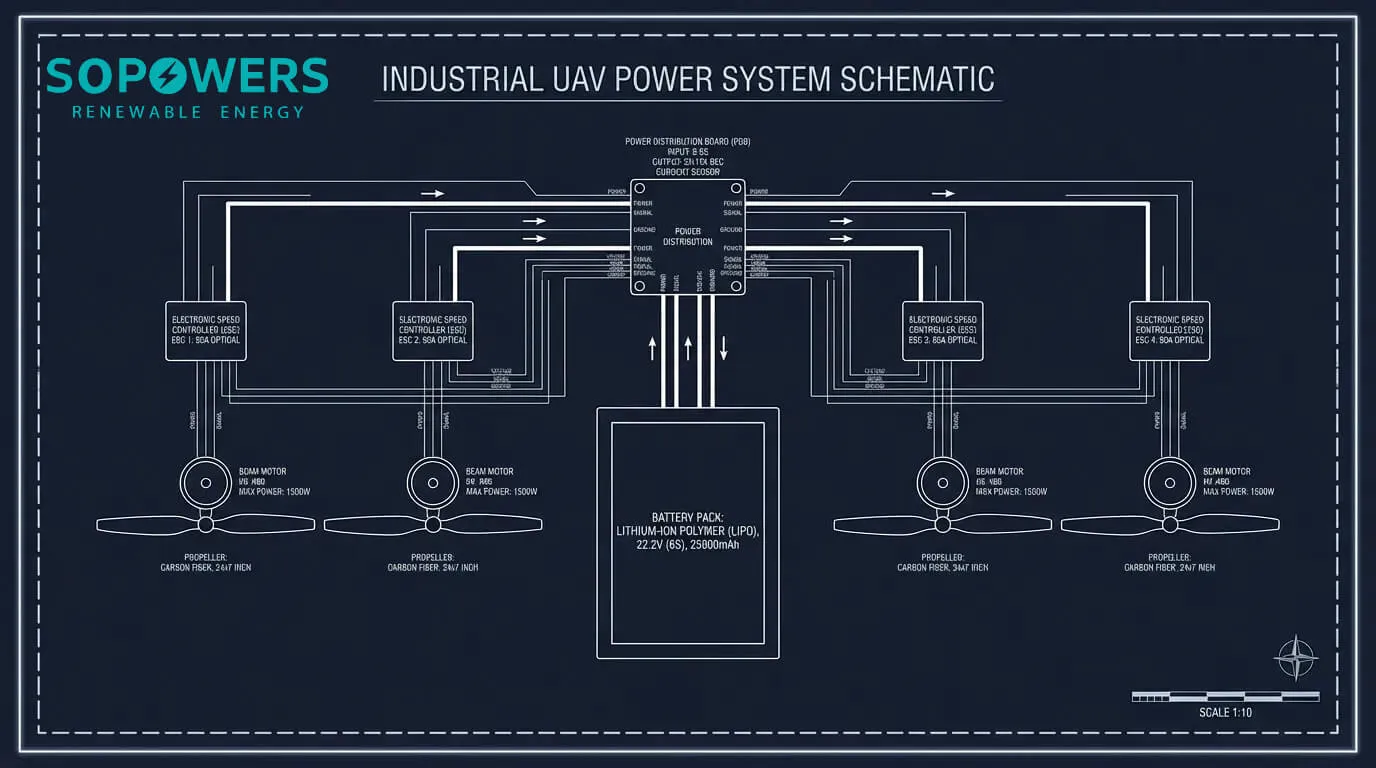
- System efficiency: props, motor KV, ESC efficiency, and payload dominate power draw.
What “best drone battery” means in 2026: chemistry and spec priorities
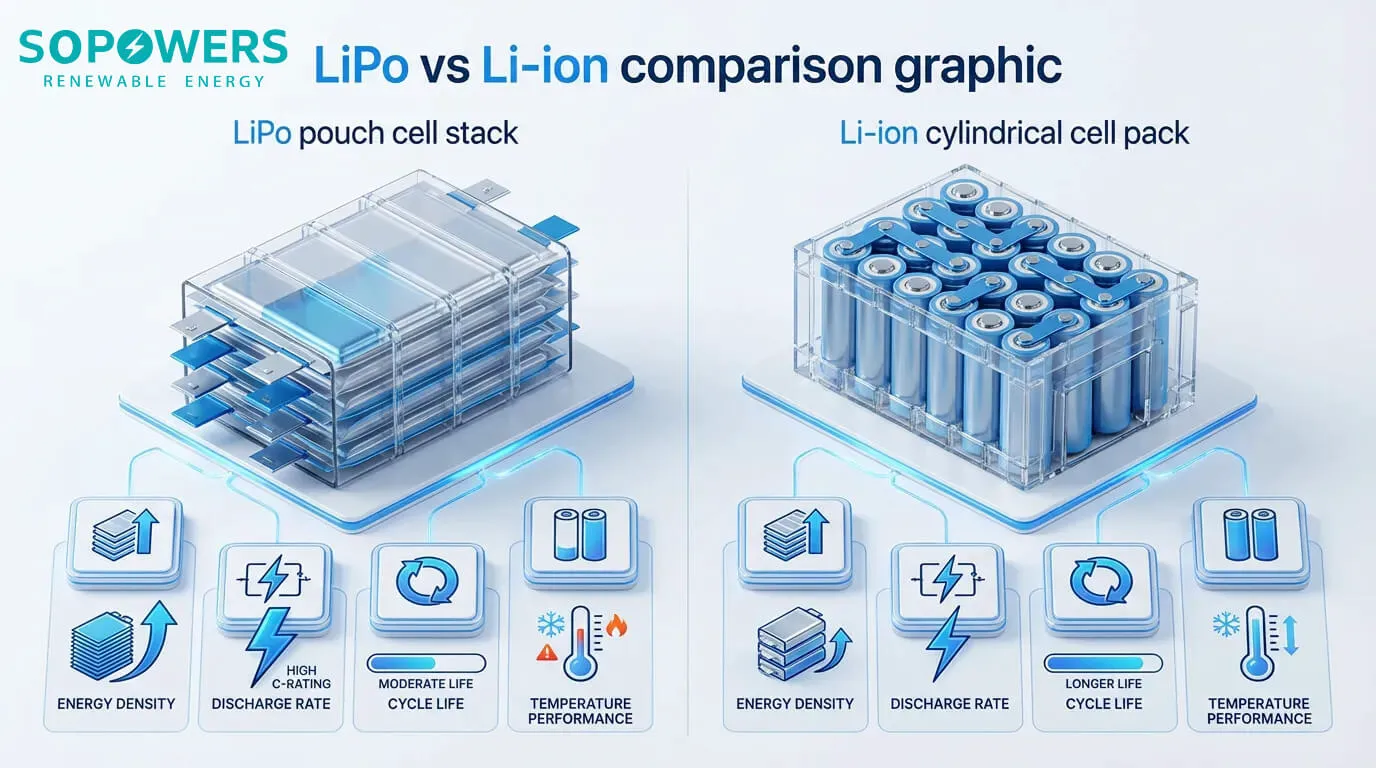
Two chemistries dominate most missions:
- LiPo / LiHV: strong power delivery, common for multirotors and FPV. LiHV can provide modest energy gains versus standard LiPo at the same size.
- Li-ion: typically higher energy density, but lower discharge rates; best for endurance-first designs that do not demand extreme peak current.
For buyers and distributors, the selection checklist that reduces surprises:
- Define mission profile: hover vs cruise, payload, target minutes, ambient temperature.
- Set voltage (S count) based on propulsion and ESC limits.
- Convert flight time targets into Wh using real average power (not maximum).
- Choose discharge capability with margin: do not run continuously near the theoretical limit.
- Verify compliance early (especially for export and air freight): certification alignment reduces rework and delays. For safety standard context, reference IEC 62133-2:2017 listing and third-party testing summaries such as Intertek’s IEC 62133 overview.
The 5 best drone batteries for longer flight times (use-case benchmarks)
Below are five widely referenced benchmarks (consumer and industrial). For industrial categories where multiple manufacturers offer similar classes, treat published specs as manufacturer-stated and validate by sample testing in your airframe.
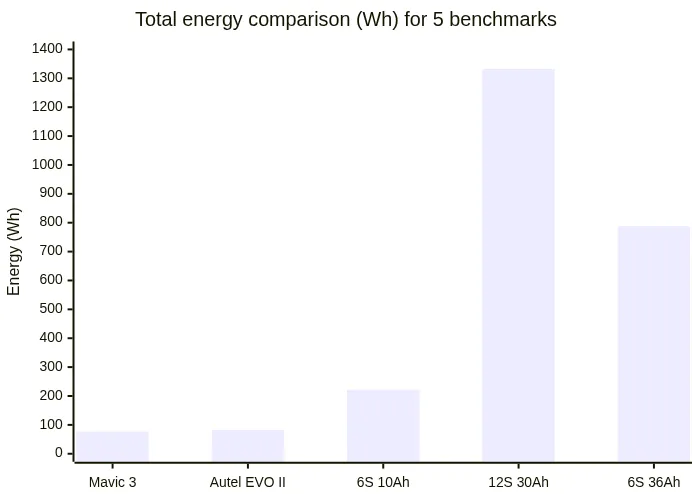
Quick comparison table (focus: Wh and use case)
| Rank | Battery benchmark (category) | Chemistry | Nominal V | Capacity | Energy (Wh) | Best for | Main trade-off |
|---|---|---|---|---|---|---|---|
| 1 | DJI Mavic 3 Series Intelligent Flight Battery | DJI lists as Li-ion 4S | 15.4 V | 5000 mAh | 77 Wh | Camera/inspection drones needing documented reliability | Locked ecosystem form factor |
| 2 | Autel EVO II Intelligent Flight Battery | LiPo 3S | 11.55 V | 7100 mAh | 82 Wh | Camera/inspection platforms targeting long missions | Locked ecosystem form factor |
| 3 | 6S “workhorse” industrial LiPo class | LiPo | 22.2 V | 10000 mAh | ~222 Wh | Mapping/aerial photography multirotors | Heavier per Wh than high-density classes |
| 4 | Semi-solid high energy density class (12S, ~30 Ah) | Semi-solid LiPo class | 44.4 V | 30000 mAh | ~1332 Wh | Maximum endurance industrial UAVs | Lower discharge (often ~5C class), higher cost |
| 5 | Solid-state/high-density class (6S, ~36 Ah) | Solid-state/high-density class | ~21.9 V | 36000 mAh | ~788 Wh | Endurance-focused agriculture/VTOL | Validate real-world sag, thermal behavior |
1) DJI Mavic 3 Series Intelligent Flight Battery (camera/inspection benchmark)
DJI’s Mavic 3 battery is a reference point because the specification and ecosystem behavior are well documented:
- Published energy: 77 Wh (DJI technical spec page)
- DJI advertises up to 46 minutes (platform dependent and “no wind” conditions) (DJI Store product page, DJI Enterprise specs)
Why it ranks for longer flight time: you can reliably estimate mission duration because the pack, BMS behavior, and aircraft power draw are consistent across fleets.
2) Autel EVO II Intelligent Flight Battery (camera/inspection benchmark)
Autel’s EVO II battery is another strong benchmark in the same category:
- Published: 82 Wh, 11.55 V nominal, 7100 mAh (Autel RTK battery specs page, AutelPilot product page)
Why it ranks: slightly higher Wh than many comparable camera packs, plus documented protection features suitable for professional operation.
3) 6S 10000 mAh industrial LiPo “workhorse” class (mid-size multirotors)
This class is common in field-proven mapping and aerial photography multirotors:
- Typical configuration: 6S (22.2 V), 10 Ah, around 222 Wh (V × Ah)
Why it ranks: it balances endurance and discharge capability, and it is compatible with many mid-size industrial powertrains where 6S is a standard.
4) Semi-solid high energy density class (12S, 30 Ah, ~300 Wh/kg class)
For maximum endurance industrial UAVs, semi-solid designs are a key trend:
- Typical published example class: 12S (44.4 V) × 30 Ah = ~1332 Wh
- Typical published density class: ~300 Wh/kg (manufacturer-stated)
Why it ranks: it delivers multi-kWh energy in practical pack sizes, enabling 50 to 90+ minute mission profiles (airframe dependent).
5) Solid-state/high-density class (6S, 36 Ah, ~330 Wh/kg class)
Solid-state/high-density offerings push specific energy higher than conventional LiPo classes:
- Typical published example class: ~21.9 V × 36 Ah = ~788 Wh
- Typical published density class: up to ~330 Wh/kg (manufacturer-stated)
Why it ranks: strong Wh/kg can reduce the “extra capacity equals extra weight” penalty, which is often the limiter on multirotors.
How to choose the right pack for longer flight time (without overbuying)
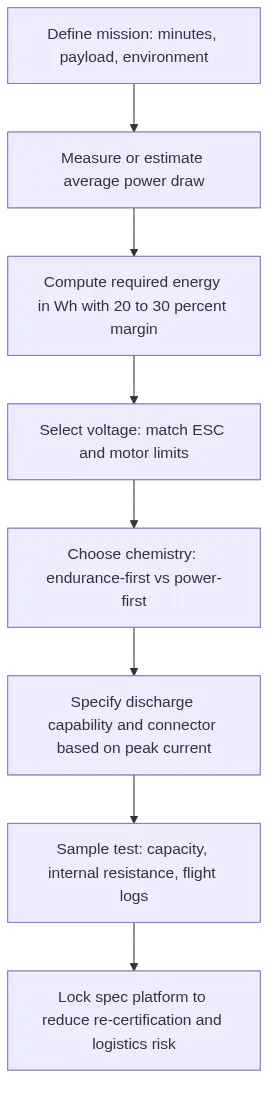
Use this fast, engineering-oriented workflow to shortlist options before sampling:
- Start from real average power, not max power
- Measure or estimate cruise/hover watts.
- Convert your target minutes into Wh with margin.
- Balance energy vs weight using Wh/kg
- If flight time improves only slightly after a heavier pack, you are likely weight-limited.
- Size discharge capability to your platform
- High acceleration, VTOL transitions, and wind gust margin demand higher discharge capability and lower internal resistance.
- Plan for temperature and duty cycle
- If you expect cold operations, reserve additional margin and consider low-temperature optimized cell choices and insulation strategies.
- Do not treat compliance as paperwork at the end
- Align early on the documentation bundle needed for your destination markets and shipping mode. For example, buyers commonly reference IEC 62133-2 concepts (IEC listing) and may request third-party safety testing pathways.
How Sopowers supports distributors: solution matching, screening, and field feedback
Sopowers focuses on export-oriented battery supply for drone applications, including high-discharge designs, low-temperature solutions, and high energy density configurations. The key differentiator is process control across the entire business cycle, so buyers are not forced to “discover the truth” only after they receive stock.
What this looks like in practice:
- Before delivery (solution matching + technical confirmation)
Sopowers aligns the application scenario with capacity, voltage, power rating, and feasibility, so the pack is engineered to the mission instead of chasing headline specs. - During delivery (factory testing + consistency screening)
All batteries undergo factory testing and consistency screening to support stable, repeatable performance across batches. - After delivery (technical support + troubleshooting)
When issues appear in real operations, Sopowers supports root-cause analysis and provides recommendations for optimization (charge profile, operating limits, or system-side adjustments).
This approach is especially valuable for distributors and private-label brands serving demanding commercial districts (for example, dense urban inspection corridors and waterfront environments) where predictable uptime matters more than optimistic datasheets.
FAQ (fast answers for technical buyers)
How long does a drone battery last (cycle life)?
It depends on chemistry, depth of discharge, and temperature. In general, Li-ion tends to deliver more cycles than many LiPo packs when operated conservatively, while high-discharge use accelerates aging.
Can I use a higher mAh battery to get longer flights?
Only if the added energy outweighs the added mass and the pack can still deliver required peak current without excessive voltage sag.
Which matters more: mAh or Wh?
Wh is the correct cross-platform comparison because it accounts for voltage. mAh alone can be misleading across different S counts.
What documents should I request from a supplier for export shipments?
At minimum, align early on the transport and safety documentation expectations, and confirm what test reports or summaries are available for your target markets and shipping routes. Safety testing context is commonly mapped to standards like IEC 62133-2 (IEC listing) and third-party lab guidance (Intertek overview).
If you want, share your platform voltage, target flight time, average power draw, payload, and temperature range, and I will translate that into a practical Wh target and a short battery specification sheet you can send for RFQs.


