
Defense and security UAV programs demand a different class of power system than hobby builds. A defense drone battery is not only an energy source. It is a safety-critical subsystem that must stay predictable under harsh duty cycles, withstand transport and handling constraints, and provide audit-ready documentation for procurement and certification.
Below is a practical, engineering-oriented checklist to help distributors and integrators specify safer packs, reduce re-certification delays, and avoid the industry trap of buying based on headline C-ratings without real validation.
1) What makes a defense drone battery “safety-critical” (5 non-negotiables)
- Consequence of failure is disproportionate
A battery event can cause aircraft loss, ground hazards, or loss of mission equipment. In security operations over infrastructure or populated areas, risk tolerance is fundamentally lower than consumer use. - Duty cycles push packs closer to limits
Long hover segments, heavy payload takeoffs, repeated fast charge cycles, and sustained discharge increase thermal stress and accelerate imbalance if the pack is not well matched. - Environmental abuse is the norm, not the exception
Expect vibration, dust, salt fog, and wide temperature swings. Hot urban environments (for example, Downtown Dubai, Business Bay, Dubai Marina) can amplify motor and battery heating, while cold environments can reduce usable capacity and raise internal resistance. - Traceability and transparency matter as much as performance
Many buyers face exaggerated claims and incomplete test evidence. For safety-critical programs, you need consistent, comparable data: cell screening criteria, pack test records, protection thresholds, and clear transport documentation. - Battery behavior must be measurable and actionable
A smart pack should report what it is doing (cell voltages, temperatures, events), not just deliver watts. This is where smart BMS for UAV deployments becomes part of operational safety, not an optional feature.
2) Standards that reduce risk (and how to use them as a buying filter)
Most project delays and shipping failures happen when standards are treated as paperwork instead of design inputs. Use the matrix below to separate transport compliance, product safety, and system-level qualification.
| Category | Standard / guidance | What it is for | What you should ask suppliers to provide |
|---|---|---|---|
| Transport (mandatory for shipping) | UN 38.3 lithium battery tests | Required for legal transport of lithium cells and packs (T1 to T8 test sequence) | UN 38.3 test report for the exact cell/pack model, plus shipping classification and documentation alignment |
| Air shipment practices | IATA lithium battery guidance | Practical packaging and air-transport constraints implementing UN 38.3 | Evidence the pack configuration and documentation match air freight requirements (including SoC limits where applicable) |
| Product safety | IEC 62133-2:2017 | Cell and battery safety under foreseeable misuse (overcharge, short circuit, thermal, mechanical) | IEC 62133-2 test evidence (cell level and, when relevant, pack level) |
| Aircraft environmental qualification (platform dependent) | RTCA DO-160 | Environmental tests for airborne equipment (temperature, vibration, power input, etc.) | A plan for how the integrated battery system will be qualified on the airframe (not just the standalone pack) |
| Defense-style environment and EMC | MIL-STD-810, MIL-STD-461, MIL-STD-704 | Environmental durability, EMI/EMC behavior, and aircraft power characteristics | Clear test strategy and integration responsibilities: enclosure, cabling, mounting, and EMI controls |
Practical takeaway for distributors: UN 38.3 gets the battery through logistics. IEC 62133-2 helps prove it behaves safely. DO-160 and MIL-STD style testing addresses real operating abuse once the pack is installed.
For reference examples of what “good evidence” looks like, Sopowers publishes cell and pack test discussions such as its 21700 cell complete testing and broader safety engineering practices in its drone battery system safety strategy.
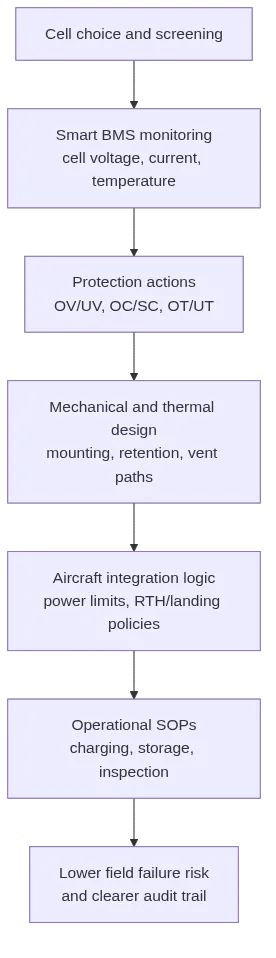
3) Protection architecture: the 6 layers you should require (not just “a BMS”)

Use this list as a specification baseline for military drone battery protection and field reliability.
- Cell-level visibility (per-cell monitoring and balancing)
Per-cell voltage tracking and balancing reduces the chance that one weak cell triggers overdischarge, overcharge, or sudden voltage collapse. - Overcurrent protection designed for real flight loads
Overcurrent thresholds must be tuned to: takeoff peaks, gust response, emergency maneuvers, and worst-case prop or motor faults. Defense-grade thinking uses layered mechanisms: fast electronic cutoff plus a physical fuse path for catastrophic shorts. - Short-circuit response that accounts for connectors and charging hardware
Real incidents often start outside the cells: arcing, poor contact resistance, or damaged connectors. Your pack and charging ecosystem should be treated as one electrical safety system. - Thermal sensing in multiple locations
A single sensor is easy to defeat with thermal gradients. Multi-point sensing improves detection of localized heating near tabs, wiring, or high-current junctions. - Mechanical retention and controlled venting
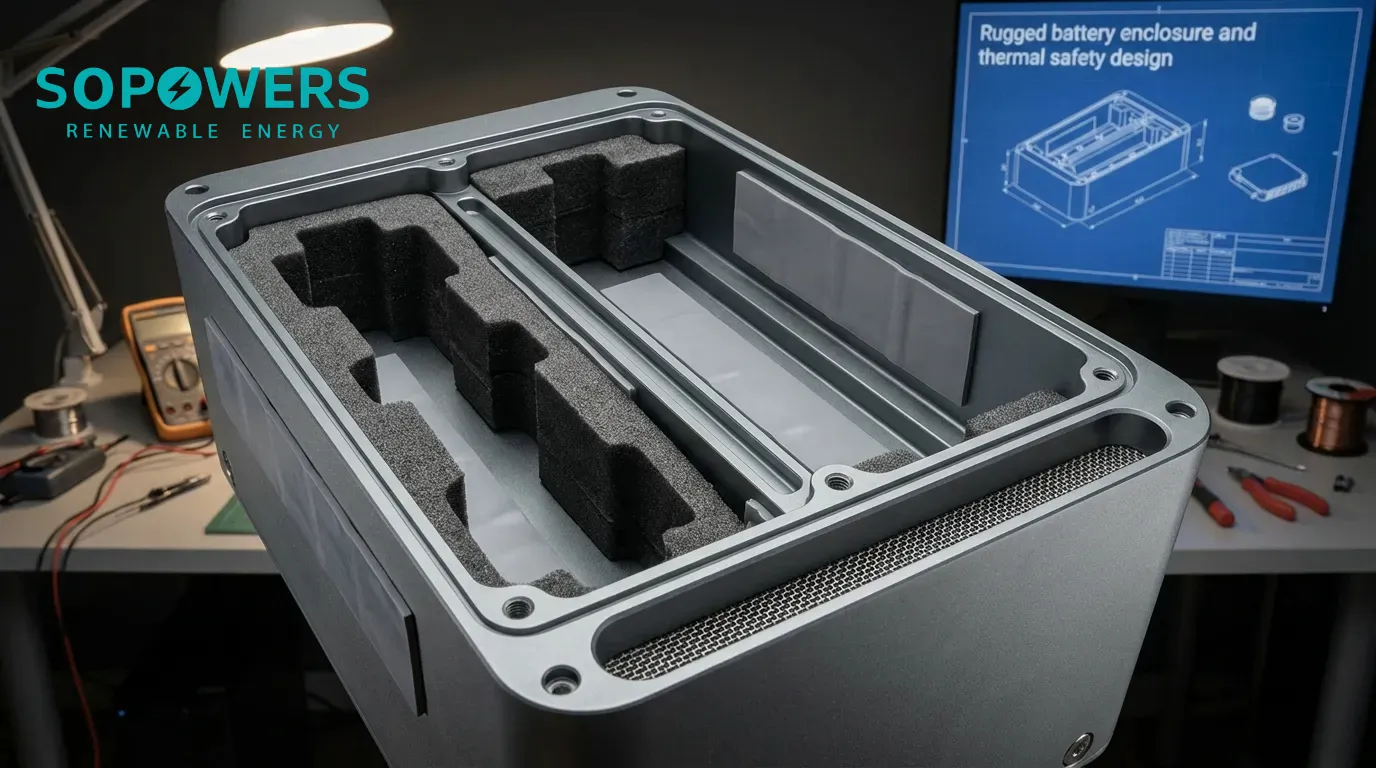
Vibration and shock can loosen internal structures over time. Robust compression, strain relief, and intentional vent paths matter for abuse tolerance and for limiting propagation if a cell fails. - Telemetry and event logging for traceability
For safety drone battery programs, logging is not a luxury. It shortens failure analysis cycles and supports preventative maintenance.
Sopowers summarizes its smart pack and control approach on its BMS and PCM technology page, including monitoring, protection, and data-oriented features intended for UAV packs.
4) Chemistry and pack architecture: how to choose without relying on marketing
Selecting chemistry is about mission risk and operating envelope, not trends. Use the table below as a quick filter, then validate with real test data and flight logs.
| Option | Where it fits best | Strength | Trade-off |
|---|---|---|---|
| High-rate LiPo battery packs | High-thrust multirotors, burst-heavy profiles | High discharge capability and power responsiveness | Needs stricter handling, protection, and thermal design |
| High-energy Li-ion (NMC/NCA) | Endurance and range-focused UAVs | Higher energy density for longer sorties | Peak power margins must be engineered carefully |
| LiFePO4 battery systems | Safety-first roles, frequent cycling, training fleets, support robotics | Intrinsically safer behavior and strong cycle life | Lower energy density increases mass for the same energy |
A useful safety-centric reference point from Sopowers is its LiFePO4 AI robot battery pack: 15Ah, 15S1P, 48V, 5C, described as remaining safe even after a 120 km/h impact without explosion or fire. The important lesson is not the robot application itself. It is the design mindset: combine chemistry choice with mechanical reinforcement and clear protection strategy when the operating environment includes impact risk.
For a concise chemistry overview and selection framing, see Sopowers’ technical comparison in High-Performance LiPo Batteries: 1S, 2S, 8S, 12S and more.
5) Sizing and validation: a real 12S2P vs 12S3P trade-off (and a buyer checklist)
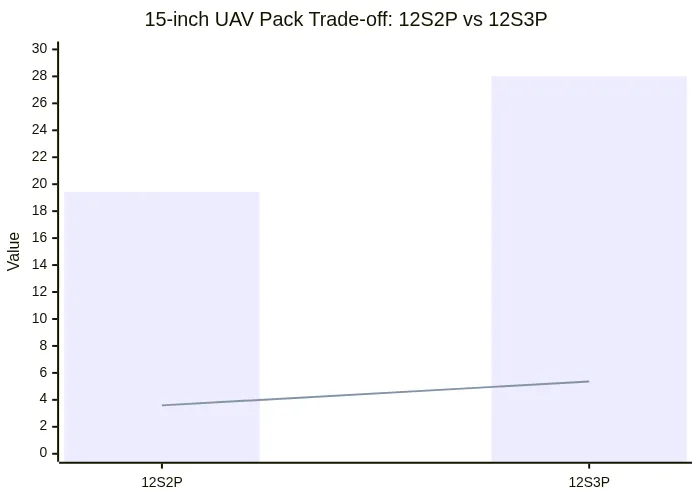
For a 15-inch drone using SPINR26105 10.9Ah cells, Sopowers provides measured data under a heavy configuration (7.5 kg payload, 14 kg total takeoff weight):
- 12S2P: 3.59 kg pack weight, 19.45 minutes flight time
- 12S3P: 5.36 kg pack weight, 28 minutes flight time
This illustrates a critical procurement point: parallelization is not only about endurance. A higher-P pack often reduces per-cell stress for the same power, improving thermal margin and consistency, which is a safety benefit in its own right.
How to use this in a defense and security buying process (a practical 9-point checklist):
- Define mission profile: hover time, cruise segments, peak thrust events, reserves.
- Set temperature envelope (hot city operation vs sub-zero launches).
- Decide whether safety-first chemistry is required for the operating context.
- Specify minimum protection features (cell monitoring, OC/SC, temperature limits, logging).
- Require UN 38.3 and IEC 62133-2 documentation early, before you freeze the pack design.
- Ask for cell screening and consistency controls (capacity match, internal resistance checks).
- Confirm connector and cabling ratings for peak current, not just nominal current.
- Validate with a conservative flight test plan: worst-case payload, worst-case temperature, worst-case wind.
- Plan post-delivery support: how logs are reviewed, how root cause analysis is handled, and how design changes are controlled.
Sopowers positions its service around this full lifecycle: pre-sales solution matching (voltage, capacity, power rating, feasibility), in-production testing and consistency screening, and post-delivery troubleshooting support. For additional selection guidance, Sopowers also provides a practical buyer-oriented checklist in What you should pay attention to when buying drone batteries and handling practices in its LiPo battery safety guide.
Summary and next step
A safer defense drone battery is the outcome of disciplined choices: standards-first documentation (UN 38.3 and IEC 62133-2), layered protection architecture, chemistry matched to mission risk, and validation based on measured performance rather than marketing claims.
If you want technical matching support for drone battery, lipo battery, high discharge battery, low temperature battery, or high energy density battery requirements, Sopowers can align a pack configuration to your airframe, payload, and operating environment, with factory screening and post-delivery engineering support.


