
CATL’s latest sodium-based cell platform, branded “Naxtra”, is the strongest signal so far that sodium chemistry is moving from demos into real commercialization. For battery distributors and technical buyers, the key is to treat it as a new option with clear strengths (cold performance, safety, durability, resource diversification) and equally clear constraints (energy density, early-stage ecosystem, yield consistency at scale).
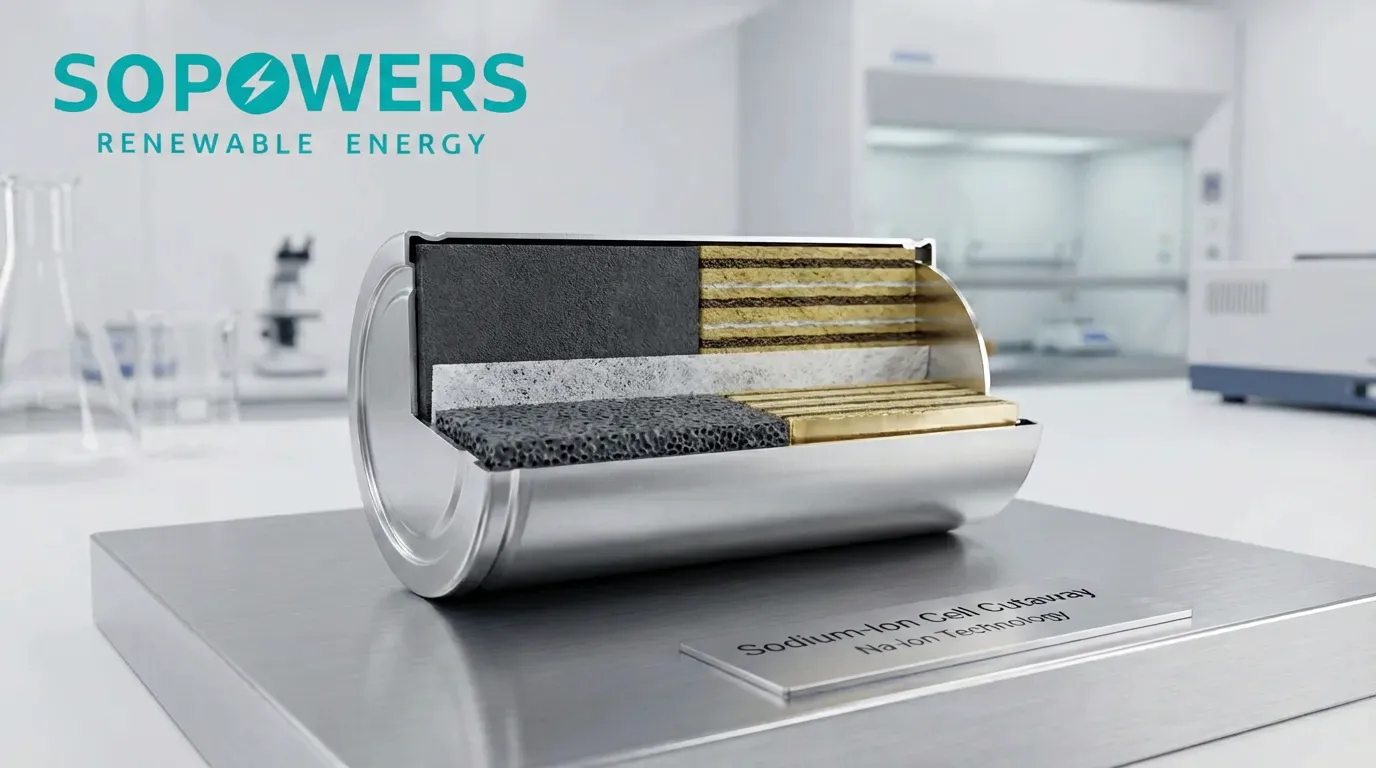
Why Naxtra is showing up now (and why it matters)
Sodium chemistry is gaining attention for three structural reasons:
- Resource diversification: Sodium is abundant and broadly available, reducing reliance on geographically concentrated lithium supply chains. A good overview of lithium price swings and supply concentration is summarized in an Oxford Institute for Energy Studies paper on lithium price volatility.
- Cold-climate usability: Sub-zero discharge and charging performance is a recurring pain point for many lithium systems, especially without preheating.
- Safety pressure: EV safety standards are tightening. CATL highlights that its sodium-based system is aligned with stricter traction battery safety testing, referencing its coverage of the GB 38031-2025 safety standard.
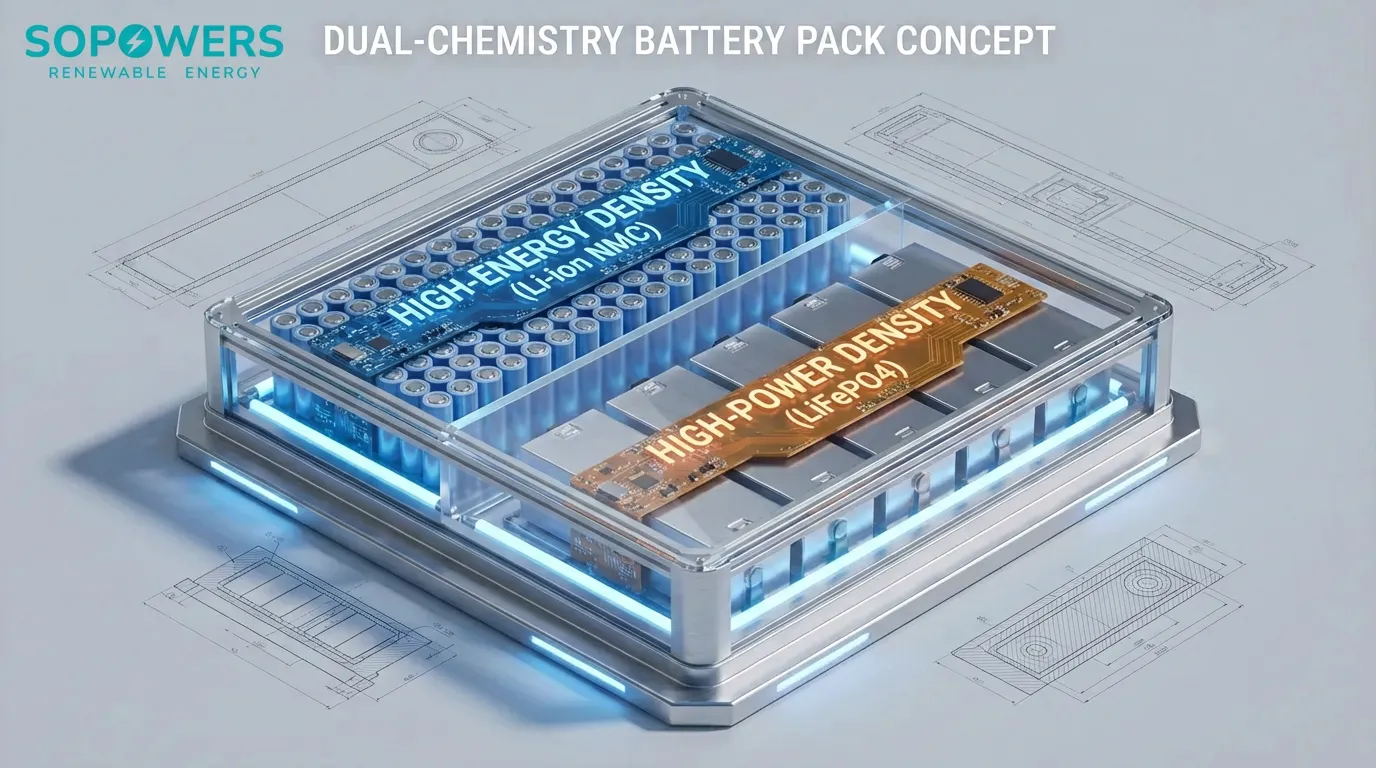
At the same time, this is not a “lithium replacement” story. CATL is also pushing a dual-chemistry pack concept (Freevoy), which implicitly frames sodium chemistry as complementary rather than universal. See the launch coverage in the CATL event release.
Naxtra in numbers: what CATL is claiming (and what to compare)
Naxtra’s headline metrics put it near mainstream LFP on energy density while differentiating on low-temperature output, safety testing claims, and cycle life. CATL’s published update on the platform is in its Naxtra news page, with additional reporting that it has already been installed in passenger vehicles via CNEVPost coverage.
Quick comparison table (cell-level, typical ranges)
| Metric (cell level) | Naxtra sodium-based (CATL) | LFP (typical EV cells) | High-Ni NMC (typical EV cells) | Why it matters to buyers |
|---|---|---|---|---|
| Energy density (Wh/kg) | Up to 175 | About 160 to 210 | About 240 to 280 | Range vs weight trade-off |
| Cycle life (full cycles) | Reported >10,000 | Often 3,000 to 5,000 | Often 1,500 to 2,500 | Fleet TCO, swapping suitability |
| Low-temperature power | Strong at -30 C, reported much higher than comparable LFP | Often needs preheating at sub-zero temps | Also limited at sub-zero temps | Winter uptime and power delivery |
| Safety positioning | Claimed to pass GB 38031-2025 | Strong safety reputation | Higher thermal management burden | Compliance and operational risk |
Sources for the table ranges: CATL platform announcements and safety note (CATL Naxtra update, GB 38031-2025 note, launch release) and benchmark context on LFP vs NMC from Electronics360.
Chart: energy density context (approximate cell-level)
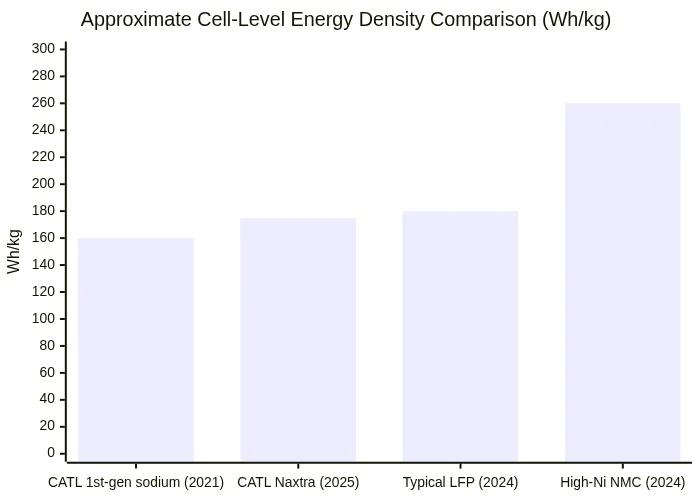
Data basis: CATL first-gen announcement (CATL 2021 sodium update), Naxtra energy density (CATL Naxtra update), and chemistry benchmarks (Electronics360 LFP vs NMC).
6 opportunities opened by Naxtra-style sodium chemistry
Below are the most realistic near-term “win zones” indicated by CATL’s positioning and early commercialization reports.
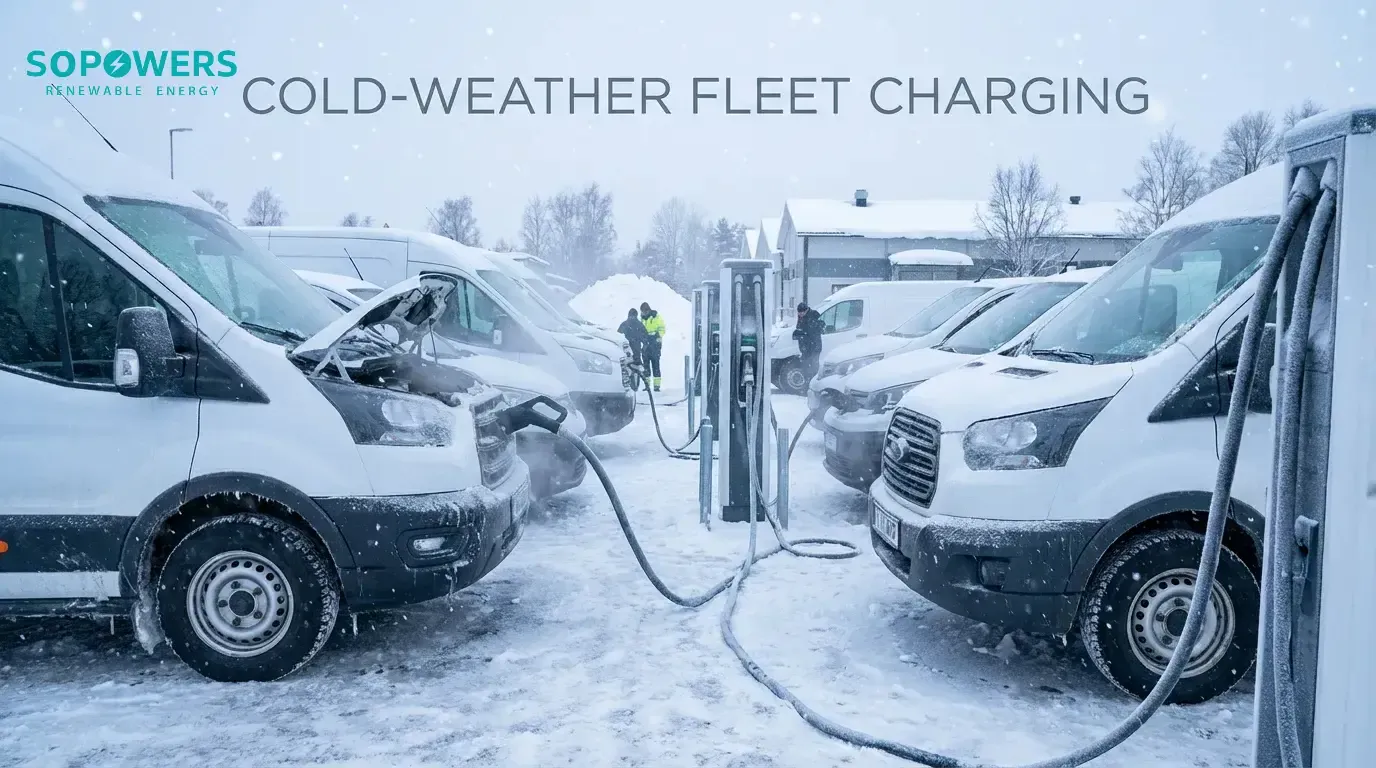
- Better low-temperature performance without heavy preheating
- CATL highlights strong discharge power at -30 C and usable operation well below that in demonstrations, which can simplify winter thermal strategies in some applications.
- For buyers, the actionable question is not “does it work in cold”, but “what is the verified power and capacity at your discharge rate and at your coldest ambient”.
- Safety narrative that matches tightening standards
- CATL emphasizes passing GB 38031-2025 and abuse-test behavior at pack level. That matters for fleets, swapping stations, and high-density urban operations where risk tolerance is low.
- Long cycle life for high-utilization assets
- If >10,000 cycles holds up in field conditions, it is a strong fit for high-turn assets (frequent cycling) where durability dominates value.
- Cost potential at scale (but only after yield stabilizes)
- CATL has signaled aggressive cost targets at scale, and third-party market discussion expects broader cost reductions as supply chains mature. Reference market discussion: CATL launch release and an industry overview from Global IMI.
- Important nuance: lower raw material cost does not automatically mean lower delivered pack cost until yields, QA, and supplier competition mature.
- Battery-swapping and standardized packs
- Swapping reduces sensitivity to absolute energy density because operations can compensate with swap frequency, and long cycle life is a direct advantage.
- Entry-level passenger EVs and light commercial vehicles
- Commercial production is being reported for light commercial packs and initial passenger installs, with coverage by CleanTechnica and Electrive.
6 challenges buyers should pressure-test before committing volume
For distributors, the risks are less about a single spec and more about consistency, qualification, and support burden.
- Energy density vs range trade-off is still real
- Even at 175 Wh/kg, you are not in high-Ni territory. Any use case that is weight-limited (or needs maximum runtime) must quantify the payload and endurance penalty.
- Mass-production yield and pack-to-pack consistency
- Early-stage chemistries can show wider variance until process windows mature. This is especially critical for multi-pack fleets where variance becomes an operational issue.
- Materials-system maturity and multi-supplier stability
- Buyers should ask: Are there multiple qualified sources for key materials (cathode precursors, hard carbon, electrolyte additives), and how is lot-to-lot variation controlled?
- Certification and re-certification workload
- Even if one national EV standard is met, international shipping and deployment often require additional testing and documentation. This affects timelines and landed cost, especially for exporters.
- Limited public evidence on very high C-rate performance
- Many UAV and high-power tool scenarios are defined by burst discharge and voltage sag. Sodium chemistry may get there, but published, repeatable high C-rate data is still limited in mainstream commercial messaging.
- Market education and overhype risk
- The industry already suffers from exaggerated claims. New chemistries can amplify confusion if buyers do not demand test conditions, curves, and acceptance criteria.
Buyer checklist (use this to qualify any new chemistry)
- Ask for curves, not only nameplate specs:
- Capacity vs temperature at your C-rate.
- Voltage sag vs current (burst and continuous).
- Cycle life under your depth-of-discharge and thermal profile.
- Confirm QA methodology:
- Cell matching, internal resistance screening, and consistency grading.
- Confirm compliance path:
- Shipping and in-market certifications needed for your target countries.
- Plan a pilot:
- Small batch validation in your actual device, not only lab fixtures.
What this means for UAVs, FPV, and power tools (and how Sopowers supports buyers)
For flight-critical propulsion, today’s practical reality is:
- Most industrial UAVs and FPV platforms still prioritize high discharge capability and high energy density (often requiring LiPo or other advanced lithium systems).
- Sodium chemistry’s cold performance is attractive, but energy density and high C-rate maturity are the gating factors for main flight packs.
Where sodium chemistry may fit sooner in UAV ecosystems is often not the aircraft pack itself, but supporting power roles in cold environments (ground equipment, portable field power, base stations), where weight is less critical and safety plus cycle life matter.
This is also where Sopowers can help buyers make correct chemistry choices without speculation:
- Pre-delivery: solution matching and technical confirmation based on application scenario, including capacity, voltage, power rating, and feasibility checks.
- During delivery: factory testing and consistency screening to reduce the risk of pack-to-pack variance.
- After delivery: technical support and troubleshooting, including root-cause analysis and optimization recommendations for next batches.
If your immediate need is proven performance for drones or tools in cold environments, Sopowers’ existing low-temperature lithium solutions and validation approach are typically the most direct route today. Relevant technical references on Sopowers include its explainer on low-temperature battery behavior and a representative low-temperature cell listing such as the 20C cylindrical battery cell. For discharge-driven platforms, see Sopowers’ engineering discussion of high-discharge batteries for UAVs.
Summary: the practical takeaway
- Naxtra signals real momentum: strong cold performance, safety positioning, long cycle life, and commercialization progress into 2026.
- The biggest risks to manage are energy density trade-offs, early mass-production consistency, and certification complexity.
- For UAV and high-power tools, sodium chemistry is better viewed as complementary in the near term, while proven lithium solutions remain the primary choice for weight- and power-critical packs.
If you want a chemistry selection recommendation based on your device profile (temperature window, current draw, runtime target, and certification needs), use Contact Us or Send Inquiry.


