
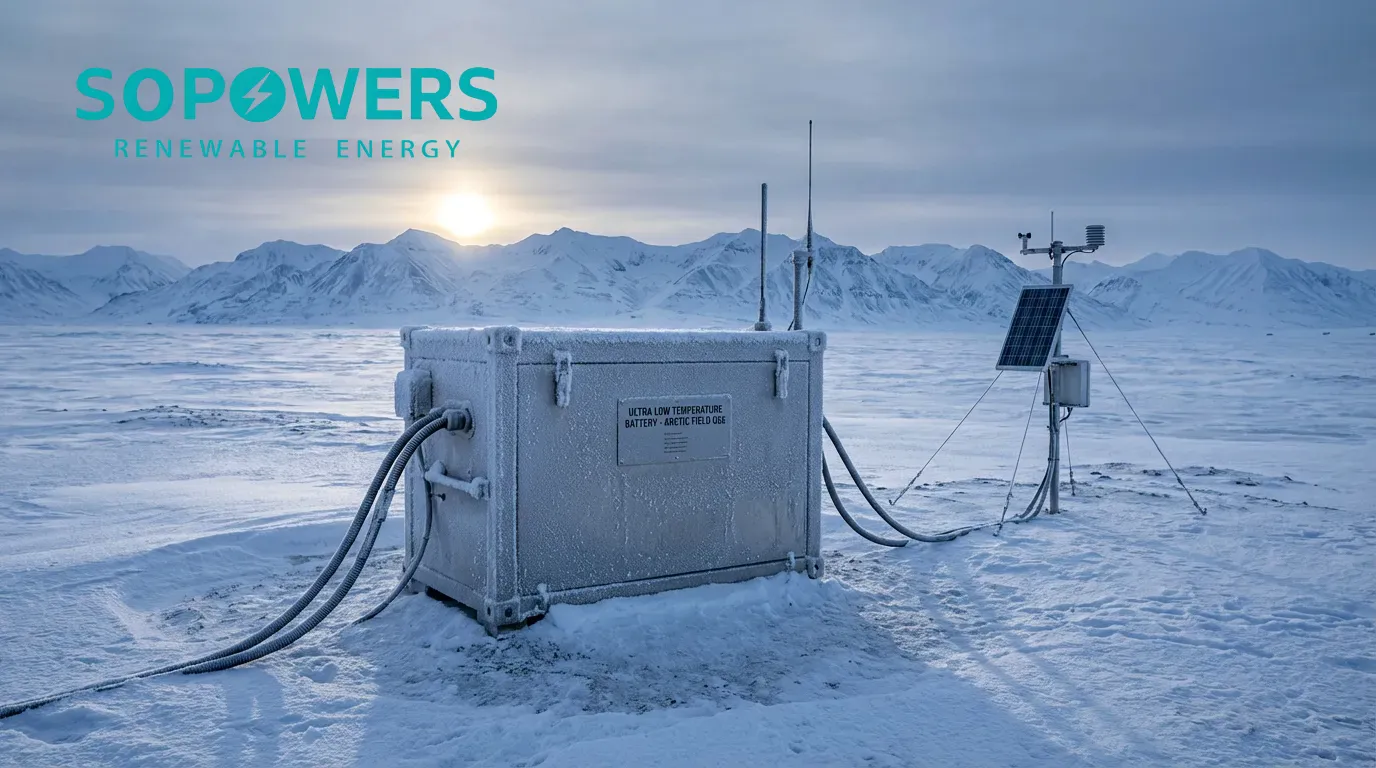
Cold environments expose the gap between a standard battery spec sheet and real-world performance. For technical buyers evaluating an ultra low temperature lithium battery for drones, robots, telecom, or industrial systems, the main question is not whether a pack can turn on in the cold. It is whether it can still deliver usable capacity, stable voltage, and safe operation when ambient temperature drops to -40°C.
A true low temperature lithium battery pack is engineered for that challenge. It uses optimized chemistry, low-temperature electrolyte design, pack-level thermal management, and a control strategy that respects charging limits in deep cold. According to the research report, standard lithium packs can lose more than 50% of usable capacity at low temperatures, while purpose-built low-temperature solutions from manufacturers such as Sopowers can retain around 70% or more at -40°C in selected lines.
For distributors, OEMs, and industrial integrators, that difference directly affects uptime, winter flight duration, maintenance risk, and warranty exposure.
1. Why -40°C battery performance matters in real applications
The demand for a lithium battery for -40°C environment is driven by applications where power failure is not acceptable. In cold regions, batteries may sit at ambient temperature before use, which means a system must cold-start and work immediately.
Typical use cases include:
- Industrial drones for inspection, mapping, surveying, and logistics.
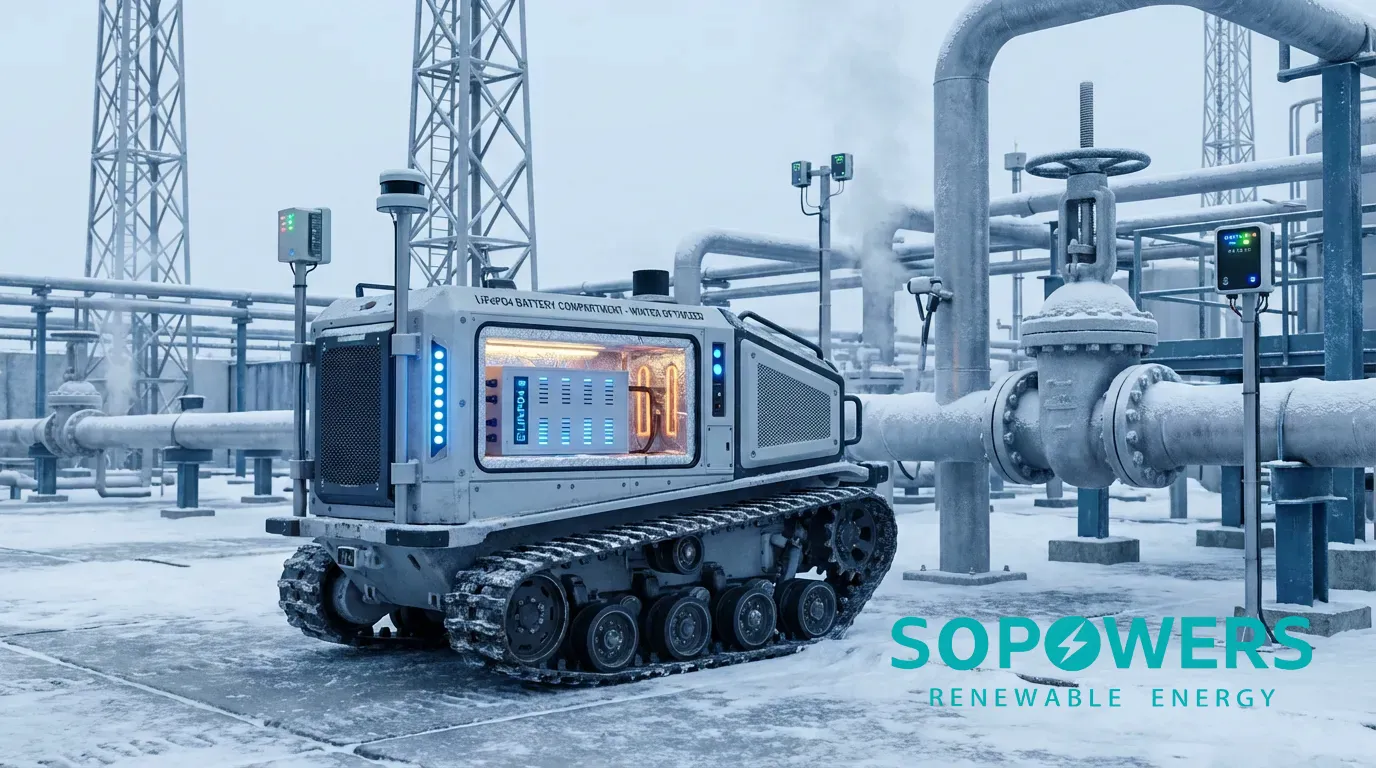
- AI robots operating in outdoor yards, industrial sites, and semi-heated facilities.
- Remote telecom, monitoring, and backup systems in extreme cold.
- Cold-chain logistics, mining, utilities, and outdoor IoT deployments.
The operational impact of low temperature is severe:
- Capacity falls as ion transport slows.
- Voltage sag increases under load.
- Peak power becomes less reliable.
- Charging risk rises because low-temperature charging can cause lithium plating.
For drones, this can mean early return-to-home and reduced mission time. For robots, it can mean unstable motion and shorter duty cycles. For fixed infrastructure, it can mean failed startup after long idle periods.
Sopowers addresses these issues with application-specific design and technical validation. Before delivery, the team provides solution matching based on the application scenario, including capacity, voltage, power rating, and feasibility review. During delivery, all batteries go through factory testing and consistency screening. After delivery, technical support continues with troubleshooting and root-cause analysis if field issues appear.
If you want to review relevant product options, explore Sopowers’ product portfolio.

Example: 15-inch drone battery solutions
Sopowers has already developed high-performance solutions for 15-inch drones using SPINR26105 10.9Ah cells. The reported configurations are:
| Configuration | Pack weight | Flight time | Compatible Platform | Total Weight | Payload |
|---|---|---|---|---|---|
| 12S2P | 3.59 kg | 19.47 min | 15-inch drone | 15 kg (frame + battery + payload) | 7.5 kg |
| 12S3P | 5.36 kg | 28 min | 15-inch drone | 15 kg (frame + battery + payload) | 7.5 kg |
For cold missions, the same design logic can be adapted using low-temperature-capable cells, insulation, and temperature-aware BMS logic. That is the difference between a generic pack and an industrial low temperature battery pack.
Example: AI robot battery safety and robustness
For AI robots, Sopowers highlights a 15Ah 15S1P 48V LiFePO4 battery pack with 5C rate capability. The pack is designed for very high safety and, as provided in the research report, will not explode or catch fire even under a 120 km/h impact. That matters for robots working near people, equipment, and public infrastructure.
2. How lithium batteries behave from -20°C to -40°C
At low temperature, the problem is not just “less capacity”. The internal electrochemistry becomes slower and more resistive.
Main low-temperature effects include:
- Electrolyte viscosity rises, reducing ion mobility.
- Charge transfer slows at the electrodes.
- Internal resistance increases sharply.
- Voltage drops more under the same current.
- Charging becomes risky because lithium plating is more likely.
This is why a standard pack that works acceptably at room temperature can become unreliable in winter.
Capacity retention: standard vs low-temperature pack
The research report shows a clear difference between conventional cells and optimized low-temperature designs.
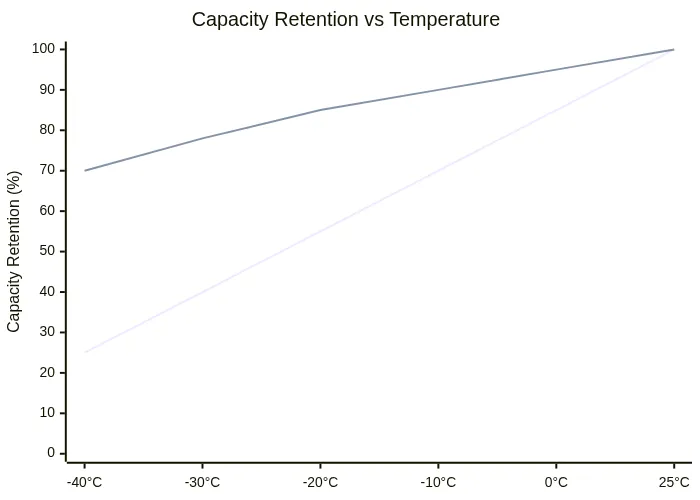
In practical terms:
- A standard pack may become marginal at -40°C.
- A properly designed cold resistant lithium battery can still provide useful runtime and more stable voltage.
- The difference is especially important in systems with high load pulses such as UAV propulsion and robotic actuators.
Why charging strategy matters
A common misunderstanding is that discharge and charge limits are the same. They are not.
For most lithium systems:
- Deep cold discharge may be possible.
- Deep cold charging is usually restricted or prohibited unless heating and control logic are used.
That is why buyers should ask not only for discharge temperature but also for:
- charging temperature limits,
- BMS temperature protection,
- pre-heating options,
- low-temperature charge current rules.
For a deeper technical explanation, Sopowers has related reading on what low-temperature batteries are and how they work and low-temperature battery challenges and solutions.
3. How to choose the right low temperature lithium battery pack
Not every cold weather lithium battery pack is built the same. The best choice depends on the balance between energy density, safety, charge acceptance, and cycle life.
Chemistry comparison for extreme cold
| Chemistry | Low-Temperature Strength | Main Advantage | Main Trade-Off | Best Fit |
|---|---|---|---|---|
| Optimized NMC/NCA | Moderate to strong, depending on design | High energy density | More careful low-temp charging control needed | Weight-sensitive drones |
| Optimized LiFePO4 | Strong | Safety, cycle life, stability | Lower energy density than NMC | AI robots, industrial systems |
| LTO | Very strong | Excellent low-temp charge acceptance and long cycle life | Lower energy density, higher cost per Wh | Mission-critical industrial use |
Approximate low-temperature performance by chemistry
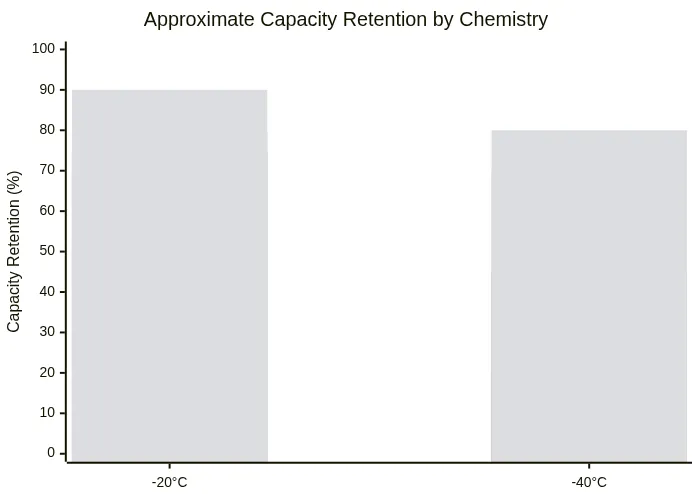
Reading order:
- Standard NMC/NCA Li-ion
- Optimized low-temp NMC/NCA
- Low-temp LiFePO4
- LTO-based pack
What technical buyers should verify
When selecting a lithium battery pack for extreme cold, ask for:
- Capacity vs temperature curves at the target C-rate.
- Voltage sag behavior under real load.
- Charge temperature limits and charging logic.
- Certifications such as UN38.3, IEC 62133, UL, and CE where relevant.
- Pack architecture details, including BMS, insulation, and optional self-heating.
- Factory screening and consistency control.
This is where Sopowers’ process is useful. The company emphasizes technical confirmation before delivery, consistency screening during production, and after-sales troubleshooting support. For buyers who have seen overpromised claims in the market, that process reduces risk.
If your project requires cell-level selection, Sopowers also offers a dedicated -40°C cylindrical battery cell for extreme cold.
4. Sopowers solutions for drones, AI robots, and industrial low-temperature systems
Sopowers positions its low-temperature offering around real application matching rather than generic marketing claims. Based on the research report, the company offers:
- -40°C cylindrical cells in SP18650 and SP26650 series.
- Low-temperature packs and selected lines with discharge capability down to -50°C.
- Optional self-heating approaches in certain low-temperature designs.
- Support for drone, robot, and industrial system integration.
Where Sopowers fits well
| Application | Key Need | Suitable Sopowers Direction |
|---|---|---|
| Industrial drones | Energy density, discharge power, reduced winter voltage sag | Low-temperature Li-ion pack design, custom high-discharge configuration |
| AI robots | Safety, impact robustness, stable power | LiFePO4 pack architecture with 5C capability and strong safety margin |
| Polar or remote systems | Reliable cold start, low maintenance, certification readiness | Low-temperature cylindrical or prismatic pack platform |
| Outdoor industrial equipment | Stable operation, long service cycle, practical integration | Application-matched pack with thermal and BMS strategy |
Relative requirement levels by application
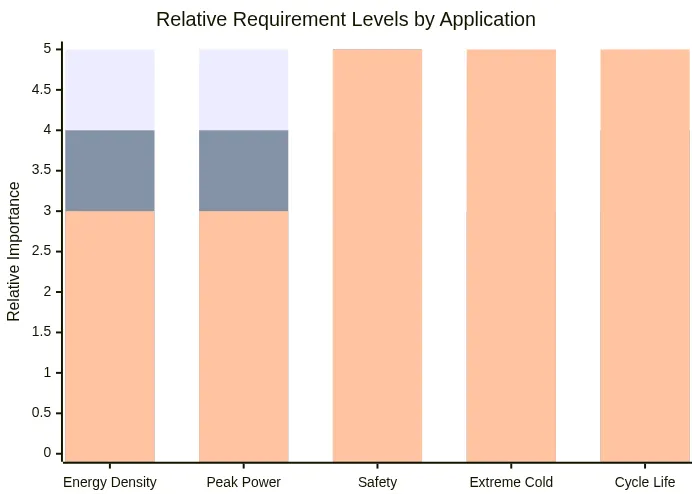
Reading order:
- Industrial drones and UAVs
- AI robots
- Polar, telecom, and industrial backup
For drone-focused readers, additional related information is available in Sopowers’ drone battery troubleshooting guide and broader news and technical articles on drone batteries.
For broader low-temperature project evaluation, see low-temperature environment battery solutions and Sopowers’ low-temperature lithium battery solutions.
5. Certifications, testing, and what serious buyers should expect
A reliable low temperature Li-ion battery pack is not only about chemistry. It also needs transport compliance, safety documentation, and repeatable testing.
Important standards mentioned in the research report include:
- UN38.3 for lithium battery transport.
- IEC 62133 for rechargeable lithium battery safety.
- UL 2054 and UL 62133 for many North American requirements.
- CE-related compliance pathways for Europe.
For technical procurement teams, these points matter because re-certification takes time and money. It is better to work with a supplier that understands how certified cells, tested pack designs, and documentation affect project timelines.
Practical buying checklist
Before approving a supplier, confirm:
- Is the -40°C rating for discharge only, or also for charging?
- At what C-rate is the low-temperature capacity measured?
- Is there real test data for -20°C, -30°C, and -40°C?
- Does the pack include temperature-aware BMS protection?
- Are consistency screening and factory tests part of delivery?
- Is after-sales root-cause analysis available if field performance differs from expectation?
These questions help separate a marketing claim from a usable lithium battery for polar and arctic applications.
For product and category review, you can also browse Sopowers’ high energy density LiPo battery packs for UAV and RC and LiPo battery pack portfolio for industrial and drone use.
Key takeaways
A true ultra low temperature lithium battery is defined by validated cold-weather performance, not by a broad label on a datasheet.
At -40°C, the right pack should offer:
- usable retained capacity,
- controlled voltage sag,
- safe charging strategy,
- application-specific BMS and thermal design,
- documented certification readiness,
- and consistent factory screening.
For drones, robots, and industrial systems, Sopowers combines low-temperature battery technology with a structured service process:
- pre-sales solution matching and technical confirmation,
- factory testing and consistency screening during delivery,
- and after-sales technical support with troubleshooting and optimization.
That approach is especially relevant for buyers who need dependable winter performance and prefer measurable results over exaggerated claims.
If you are planning a low temperature lithium battery pack for drones, robotics, or industrial equipment, Contact Us or Send Inquiry to discuss your application requirements.


