
For IoT battery solutions with health monitoring, the real value depends on three things: reliable battery data, stable performance under real operating conditions, and clear fault diagnosis after deployment.
For drone and robotics buyers, the bigger risk is not choosing a battery that looks weak on paper. It is approving one that looks advanced in a presentation but adds cost and integration complexity without improving field reliability.
This guide looks at when battery health monitoring adds real value, what to check before approving a pack, and how Sopowers supports battery projects through solution matching, testing, and troubleshooting.
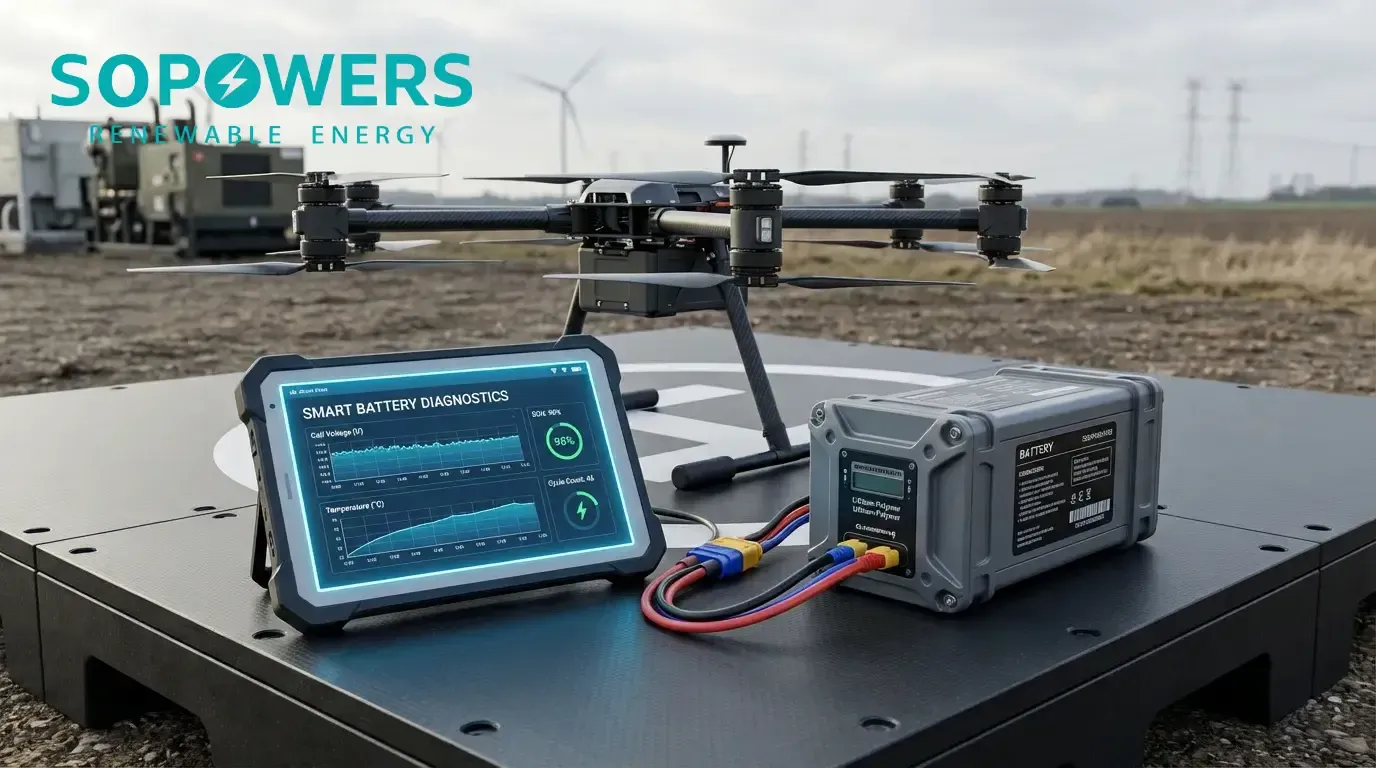
1. AI battery management system basics for real fleet decisions
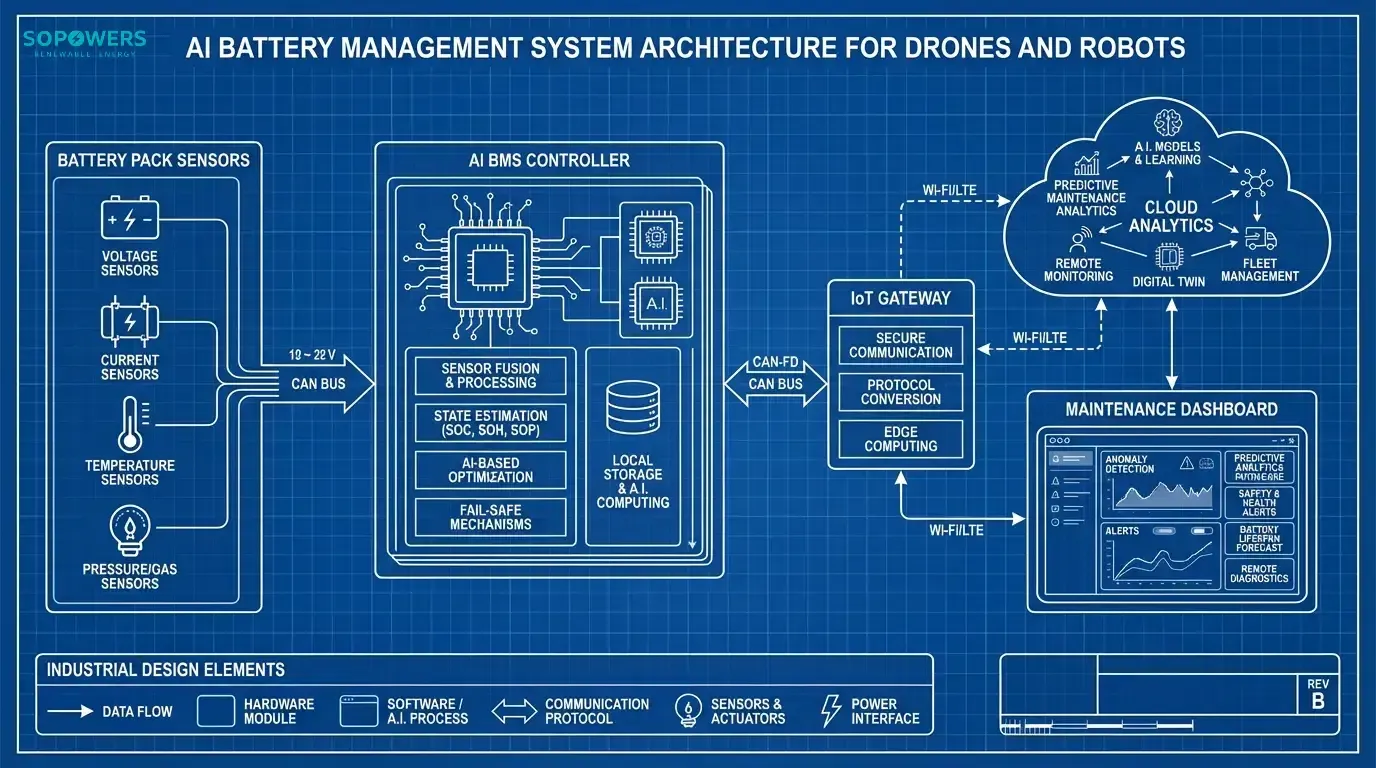
An AI battery management system sits on top of the same safety foundation as any standard BMS. You still need over-voltage, under-voltage, over-current, short-circuit, over-temperature protection, and cell balancing. The difference is that an AI battery management system adds richer sensing, historical data use, and predictive logic.
In most sourcing discussions, these three levels are blurred together. That is where buyers lose clarity. A telemetry-enabled BMS, a health-monitoring stack, and a predictive system are not the same product tier, and they should not be evaluated the same way. In practice, buyers usually compare three levels:
| Level | What it does | Best fit |
|---|---|---|
| Standard BMS | Basic protection, simple state-of-charge logic, limited or no communication | Low-risk systems, low-cost packs |
| Smart BMS technology | Adds telemetry such as per-cell voltage, current, temperature, cycle count, and communication interfaces | Industrial drones, robots, and monitored deployments |
| AI battery management system | Adds predictive battery analytics, remaining useful life models, anomaly detection, and cloud or edge decision logic | High-value fleets, uptime-sensitive operations, traceable maintenance programs |
What buyers usually miss is that AI battery management system value depends on data quality first. If current sensing is noisy, temperature coverage is incomplete, or pack consistency is poor, the model quality will always disappoint.
For drone battery and lipo battery applications, smart BMS technology is often the minimum practical level when fleets are involved. For AI robots and mission-critical drones, a full AI battery management system may justify itself if downtime, replacement cost, or warranty risk is high enough.
2. When an AI battery management system outperforms basic smart BMS technology
A lot of suppliers use “smart” and “AI” loosely. In sourcing discussions, that creates confusion. The practical difference is whether the system only reports data or also learns from it.
A standard smart BMS technology stack is often enough when:
- Missions are short and repeatable.
- Pack replacement cost is manageable.
- Safety margins are conservative.
- Downtime does not create major commercial loss.
- The operation only needs alarms and basic event logs.
An AI battery management system starts to make sense when:
- Your drone battery fleet runs under variable payload and weather conditions.
- You need predictive battery analytics for replacement planning.
- Battery health monitoring software is tied to service contracts or uptime targets.
- Your team wants evidence-based retirement rules instead of fixed cycle-count rules.
- Your packs operate under high discharge battery stress or low temperature battery conditions.
Here is the more useful way to think about it:
| Decision factor | Smart BMS technology is enough | AI battery management system is justified |
|---|---|---|
| Fleet size | Small to mid-sized | Mid to large fleets |
| Mission value | Moderate | High |
| Thermal and load variability | Limited | Significant |
| Maintenance model | Reactive or scheduled | Predictive |
| Data use | Monitoring and alerts | Optimization, forecasting, anomaly detection |
| Integration effort tolerance | Lower | Higher |
For example, a 15-inch drone platform doing repeatable short inspection flights may only need strong telemetry and clean battery health monitoring software. But if that same aircraft operates in cold conditions, carries changing payloads, and must hit uptime commitments, an AI battery management system becomes much easier to justify.
3. AI battery management system variables that actually predict field performance
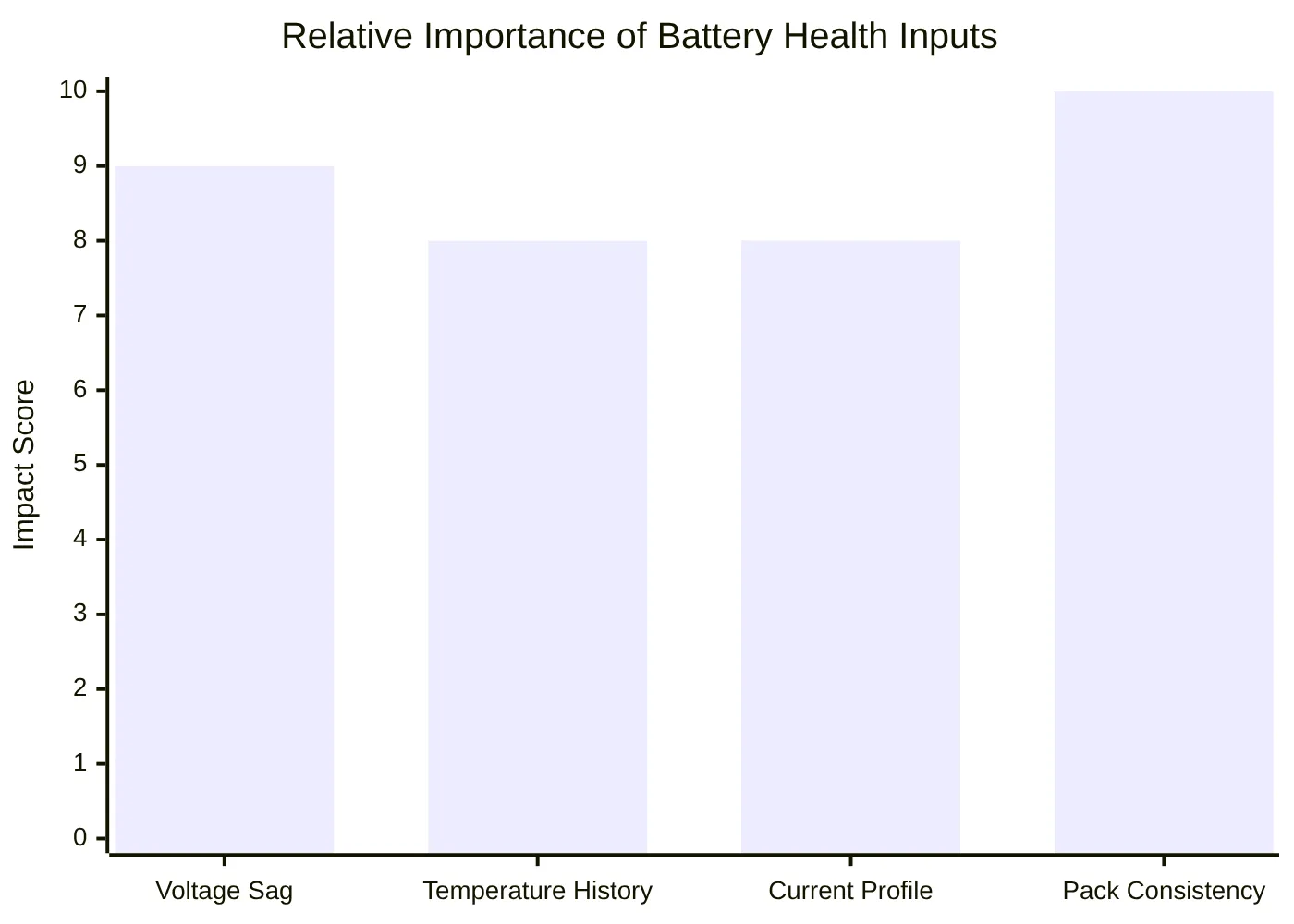
If you are evaluating predictive battery analytics, these are the variables that matter most.
AI battery management system and voltage sag
Voltage sag is where many field problems first appear. A pack can still look acceptable by capacity, but if internal resistance has risen, the voltage may collapse under load long before nominal capacity is fully used. For a high discharge battery, this matters more than simple cycle count.
What to evaluate:
- Peak current under actual mission load.
- Voltage drop near end-of-discharge.
- Change in internal resistance over time.
- Temperature-linked sag behavior.
AI battery management system and low temperature battery behavior
Cold operation changes everything. At low temperatures, lithium-based packs lose effective capacity and show higher resistance. This is especially relevant for low temperature battery projects and winter drone deployment. If predictive battery analytics ignore temperature history, state-of-health estimates can be misleading.
Sopowers publishes related technical content on low temperature batteries and how they work, which is directly relevant when your mission profile includes sub-zero operation.
AI battery management system and telemetry granularity
Battery health monitoring software is only as useful as the telemetry it receives. At minimum, buyers should confirm that the system logs:
- Pack voltage.
- Pack current.
- Per-cell voltage where possible.
- Multiple temperature points.
- Cycle count.
- Fault history.
- Time stamps.
- Mission context such as payload or operating mode.
AI battery management system and pack consistency
This is where teams get misled most often. Predictive models assume the pack population is reasonably consistent. If cell matching, internal resistance screening, and final pack testing are weak, the analytics layer will look less accurate than advertised.
That is why Sopowers’ process matters. Before delivery, Sopowers provides solution matching and technical confirmation based on the application scenario, including capacity, voltage, power rating, and feasibility. During delivery, all batteries undergo factory testing and consistency screening to ensure stable performance. After delivery, Sopowers supports troubleshooting and root-cause analysis.
4. AI battery management system examples for 15-inch drones and AI robots
The research report gives two especially useful cases because they show how predictive battery analytics can support real selection decisions.
AI battery management system and 15-inch drone battery selection
Buyers often default to the longer-flight configuration because it looks safer in a comparison sheet. But for fleet operations, the better choice depends on how the aircraft is actually used. If the platform flies short, aggressive missions with high current draw and frequent turnarounds, the question is not just runtime. You need to know how quickly voltage sag appears, how much thermal stress accumulates, and how the pack ages across repeated missions.
That is where health monitoring becomes useful. It helps teams see whether a configuration that looks acceptable in early testing is actually creating faster degradation or higher replacement cost over time.
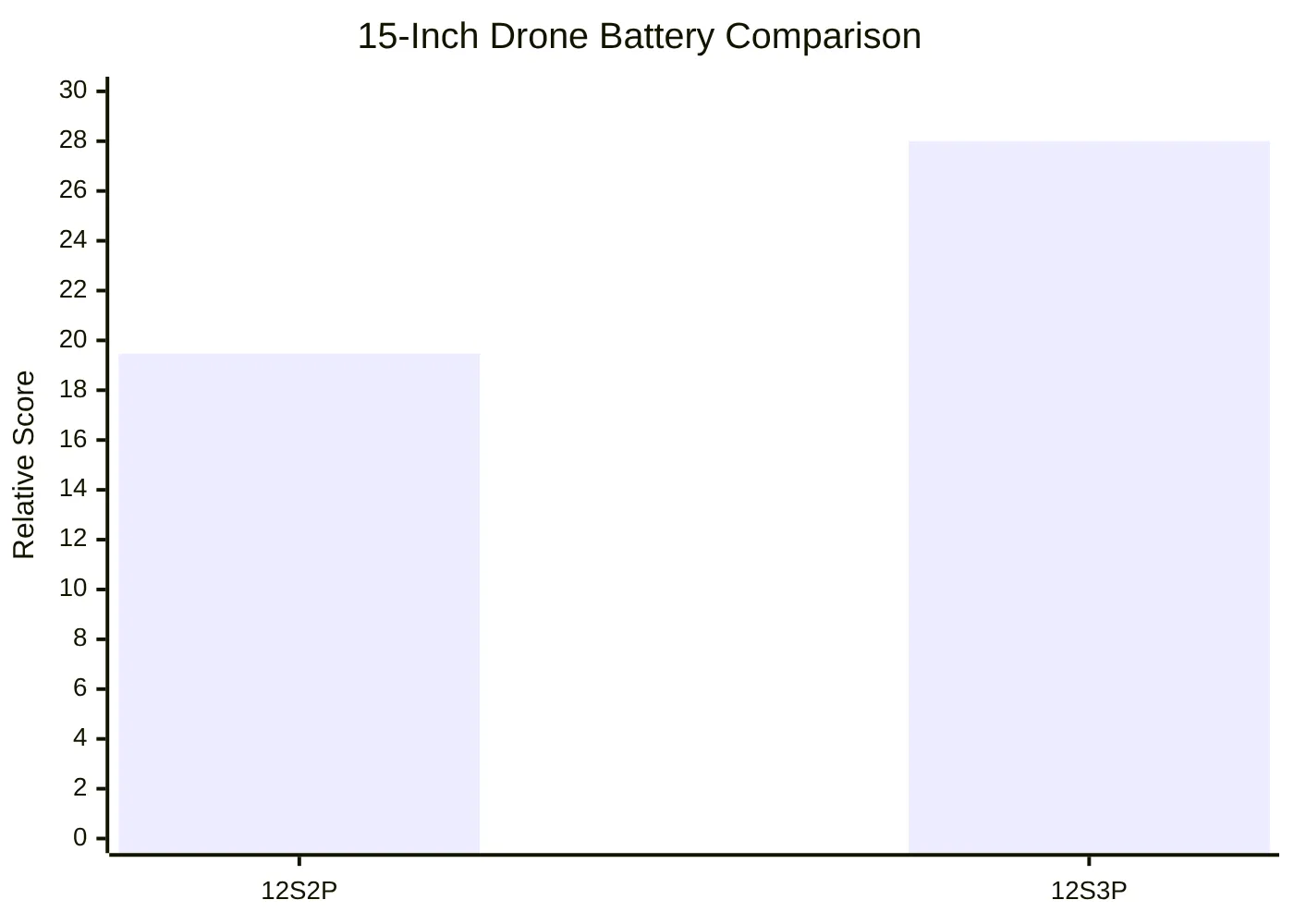
For a 15-inch drone platform, Sopowers provides two Li-ion options:
- 12S2P Li-ion battery solutions for 15-inch drones
- Flight time: 19.47 minutes
- Total weight: 15 kg
- Payload: 7.5 kg
- 12S3P Li-ion battery solutions for 15-inch drones
- Flight time: 28 minutes
- Total weight: 15 kg
- Payload: 7.5 kg
On paper, many buyers will default to the longer-flight option. In operation, the trade-off is more nuanced.
| Configuration | Flight time | Relative per-cell stress | Typical implication |
|---|---|---|---|
| 12S2P | 19.47 min | Higher | More sag, more thermal stress, faster degradation risk |
| 12S3P | 28 min | Lower | Better current sharing, lower stress, more favorable long-term economics |
For an AI battery management system, this comparison matters because the model can track how each pack architecture ages under actual missions. If your operation is dominated by short but aggressive flights, the 12S2P setup may still be viable. If your missions are longer and more repetitive, the 12S3P setup may reduce total cost per flight hour despite a different upfront profile.
If you need broader product access, Sopowers’ product page is the correct source to review available pack categories.
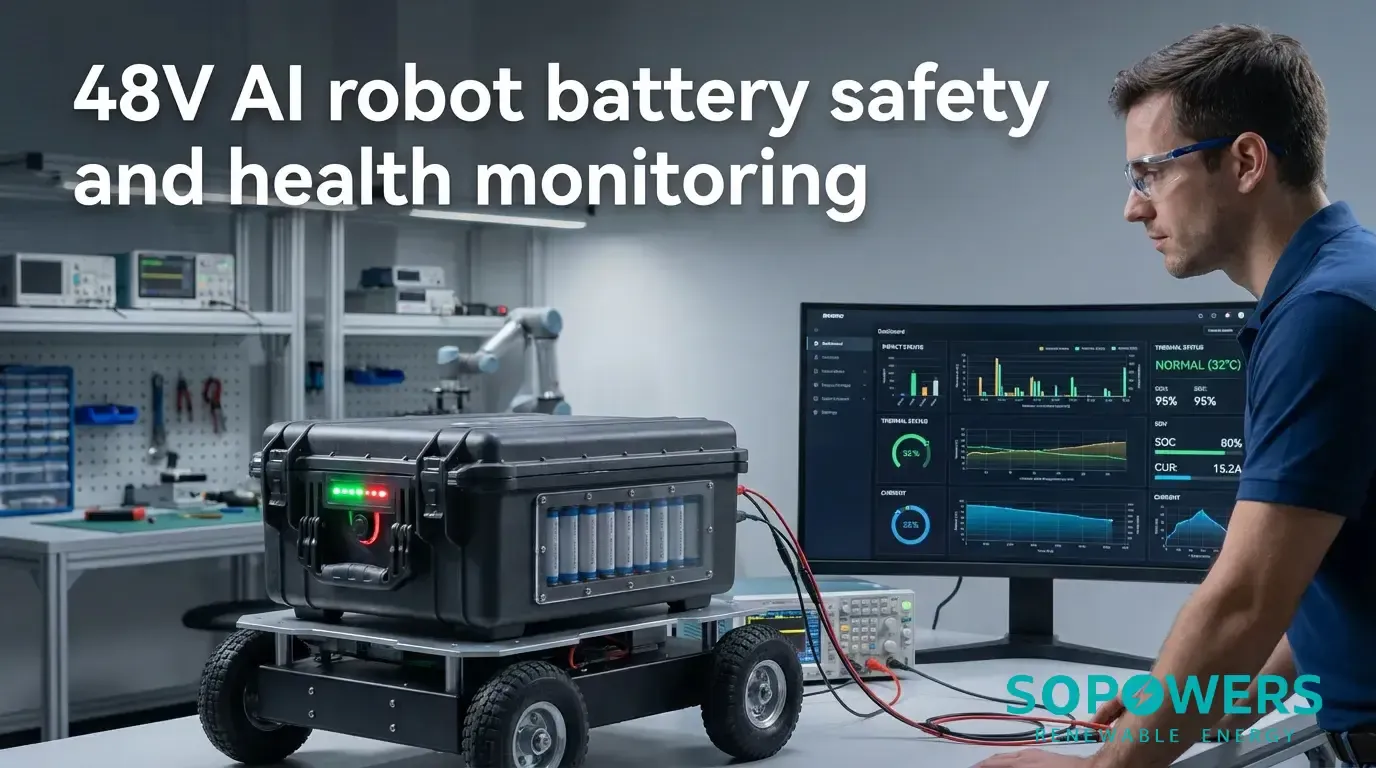
AI battery management system and AI robot battery safety
The robot-side example is also useful:
- 15Ah-15S1P-48V
- LFP chemistry
- 5C rate
- Strong abuse safety profile, including resistance to fire or explosion even under severe impact conditions
This is a very different design logic from a high energy density battery used in a drone battery application. The LFP choice trades some energy density for higher safety and more predictable behavior. For robotics, that can be the right trade, especially when uptime and incident traceability matter.
An AI battery management system adds value here by logging:
- Impact-related events.
- Thermal patterns before and after incidents.
- Overcurrent episodes.
- Long-term resistance growth.
- Runtime consistency by duty cycle.
That kind of evidence is useful for warranty analysis, field service, and root-cause reviews.
If your application spans industrial or IoT equipment, Sopowers also organizes relevant solution areas through its IoT applications page and industrial applications page.
5. AI battery management system checklist, common mistakes, and what to ask suppliers
A buyer-useful article needs tools, not just explanations. Use the sections below in supplier meetings.
AI battery management system checklist
| Category | What to confirm |
|---|---|
| Battery design | Chemistry, nominal voltage, capacity, continuous and burst discharge rating |
| Validation | Factory testing, consistency screening, internal resistance matching |
| Telemetry | Per-cell voltage, current, temperatures, cycle count, fault logs |
| Interfaces | CAN, SMBus, UART, RS485, or other required protocol |
| Analytics | State-of-health logic, remaining useful life method, validation range |
| Software | Battery health monitoring software access, raw data availability, export options |
| Service | Pre-delivery matching, post-delivery troubleshooting, root-cause support |
| Compliance | Export and application certification readiness |
Common mistakes when buying an AI battery management system
- Confusing dashboards with predictive battery analytics.
Remote charts are not the same as a real AI battery management system. - Ignoring test conditions behind performance claims.
A high discharge battery that looks strong in a room-temperature test may behave very differently in cold air or repeated heavy-load missions. - Asking for maximum runtime without checking lifetime cost.
What sounds good on paper often fails in operation if higher runtime comes with much faster degradation. - Treating cycle count as the same thing as battery health.
Two packs with the same cycle count can have very different remaining useful life. - Overlooking supplier process discipline.
Battery health monitoring software cannot compensate for inconsistent manufacturing.
What to ask the supplier before approval
Ask these directly:
- Which variables feed the AI battery management system model?
- Is the battery health monitoring software using threshold alarms, trend analysis, or actual predictive battery analytics?
- What is the expected state-of-health error range under our temperature and load profile?
- Can the pack communicate using the protocol our controller already supports?
- How does the supplier validate low temperature battery performance?
- What testing is done for high discharge battery consistency before shipment?
- What happens after delivery if our logs show early voltage sag or abnormal heat rise?
These questions are where weak claims tend to fall apart.
For buyers comparing chemistry options and density trade-offs, Sopowers also has relevant background on solid-state and high energy density battery topics and additional technical reading on its blog section.
6. How Sopowers supports AI battery management system projects from spec to field use
The best reason to involve a battery supplier early is not marketing support. It is engineering risk reduction.
Sopowers’ workflow aligns well with AI battery management system adoption because the company addresses the pack before, during, and after delivery.
Pre-delivery support for AI battery management system success
Before shipment, Sopowers provides solution matching and technical confirmation based on customer needs and application scenarios. That includes:
- Capacity assessment.
- Voltage selection.
- Power rating review.
- Feasibility confirmation for the actual use case.
This matters because predictive battery analytics cannot rescue a badly sized pack.
During-delivery controls that improve battery health monitoring software accuracy
All batteries undergo factory testing and consistency screening. For any smart BMS technology or AI battery management system project, this creates the stable baseline that analytics depends on. If your fleet data starts with inconsistent packs, everything downstream gets noisier.
Post-delivery support that makes AI battery management system data actionable
After delivery, Sopowers provides technical support and troubleshooting assistance. If issues arise in actual use, Sopowers helps analyze root causes and recommends optimization steps. That is especially valuable when a battery health monitoring software platform flags anomalies but the source is unclear.
In other words, the useful role of the supplier is not just to ship a drone battery, lipo battery, low temperature battery, or high energy density battery. It is to help interpret performance in the field and improve the next iteration.
If you are reviewing concrete options now, use the resources below:
In summary, an AI battery management system is worth the investment when your operation truly benefits from predictive battery analytics, better replacement planning, and higher confidence under variable real-world conditions. If your missions are simple and your safety margins are wide, smart BMS technology may be enough. But when runtime, traceability, field reliability, and supplier accountability all matter at once, the right IoT battery solution becomes a practical engineering tool rather than a buzzword.


