
Industrial UAV inspection is shifting from “pilot projects” to daily operations across power grids, oil and gas, renewables, and high-rise urban infrastructure. Market studies project the UAV inspection segment growing at roughly 15 percent CAGR through 2030, driven by aging assets and automation mandates (see sources from Fact.MR market report and Global Market Insights). In dense, high-value districts like Downtown Dubai, the Museum of the Future area, Business Bay, and the Marina, battery performance becomes a safety and productivity variable, not a spec-sheet detail.
For technical buyers and distributors, the challenge is consistent: exaggerated claims are common, but real mission outcomes depend on validated discharge behavior, temperature resilience, and documentation that supports export logistics. The goal of this guide is to make inspection drone battery selection and portfolio planning more predictable.

Why inspection drone batteries become the limiting factor in industrial operations
Inspection flight profiles are battery-hostile in ways that “typical flight time tests” often hide:
- High hover ratio and stop-and-go positioning: facade scans, tower hardware checks, and blade imaging require sustained hover and repeated micro-climbs, increasing heat and voltage sag risk.
- Power spikes in real wind: gust rejection and lateral repositioning can demand high peak current even when average power seems modest.
- Payload sensitivity: EO/IR, LiDAR, and zoom cameras punish voltage instability; sag can cause payload brownouts or degraded sensor performance.
- Temperature extremes: cold starts reduce usable capacity sharply without dedicated low-temperature design; hot urban sun-load increases thermal stress and accelerates aging.
- Compliance burden: for distributors shipping into Europe and North America, transport and safety documentation (UN38.3, plus regional requirements) is often as important as Wh.
Sopowers positions its inspection-focused solutions around realistic performance and end-to-end support: pre-delivery solution matching and technical confirmation, 100 percent factory testing and consistency screening during delivery, and post-delivery troubleshooting support based on real flight data. (See Sopowers guidance on what to pay attention to when buying drone batteries and battery safety practices in thermal runaway prevention strategy.)
A 10-point selection checklist for an inspection drone battery (what to verify, not just what to read)
Use this list to qualify any inspection drone battery, industrial UAV battery, or custom UAV battery pack proposal. It is intentionally “test- and evidence-first” to reduce surprises after you receive stock.
- Mission energy in Wh (not only mAh): define required mission time-on-target plus reserve.
- Continuous current capability: validate sustained draw for hover and climbs, not only burst ratings.
- Voltage sag under load: require discharge curves under realistic load steps (hover → climb → hover).
- Thermal rise at your duty cycle: confirm maximum internal temperature at ambient conditions you expect.
- Energy density vs. integration: evaluate Wh/kg alongside pack dimensions and CG constraints.
- Cycle-life assumptions: confirm depth-of-discharge and temperature conditions used to claim cycle life.
- Protection architecture: verify over-current, over/under-voltage, short-circuit, and over-temp behavior.
- Smart telemetry needs: if fleet-managed, specify what you need from a smart BMS drone battery (SoC, SoH, logs, comms).
- Consistency screening for fleets: ensure pack-to-pack variation control (capacity and internal resistance matching).
- Export-ready documentation: plan for UN38.3 and shipping rules early to avoid rework.
A practical way to run procurement is to convert the checklist into a “request for evidence” table:
| Checklist item | What to request from supplier | Why it matters in inspection |
|---|---|---|
| Voltage sag | Discharge curves at mission-like current | Prevents control/payload instability |
| Thermal behavior | Temperature vs. time at continuous load | Avoids accelerated aging and safety events |
| Consistency | Screening method + acceptance thresholds | Reduces unexpected early low-voltage cutoffs in fleets |
| Smart BMS | Telemetry list, balancing method, supported protocols | Enables predictive maintenance and traceability |
| Compliance | UN38.3 summary + MSDS + labeling approach | Reduces customs delays and shipment rejection risk |
For high-current requirements (climb, wind, aggressive positioning), Sopowers also publishes engineering considerations on high discharge batteries for UAVs.

Chemistry and pack architecture options (and when each wins)
Most inspection programs converge on three practical choices: LiPo, cylindrical NMC/NCA lithium-ion, and LiFePO4. The “best” choice depends on whether your mission is power-limited, energy-limited, or safety/compliance-limited.
Quick comparison for inspection missions
| Battery type | Strengths for inspection | Typical trade-offs |
|---|---|---|
| LiPo (pouch) | High power, strong burst response, flexible shapes for integration | Typically lower cycle life under hard use; more sensitive to abuse without robust pack design |
| NMC/NCA Li-ion (cylindrical, e.g., 21700/26105) | High energy density for long flight time drone battery goals; good consistency from automated cell production | Often lower peak C-rate than FPV-style LiPo; pack design can be more complex |
| LiFePO4 | Excellent thermal stability and long cycle life; strong fit for safety-first systems and ground support | Lower Wh/kg means heavier for the same endurance; lower cell voltage increases series count |
Sopowers supports multiple pathways depending on the target SKU and the distributor’s application map:
- For energy-focused endurance improvements, Sopowers discusses cell-level benefits and consistency of 21700 platforms in 21700 cells for industrial drone endurance and reliability and the broader context in high energy density battery guide.
- For cold-region deployments, Sopowers offers dedicated low-temperature solutions, including a minus 40 C cylindrical battery cell and explains design principles in how low-temperature batteries work.
A safety-first note on LiFePO4 (relevant beyond drones)
Even when LiFePO4 is not the best airborne choice for endurance, it can be the right decision for high-safety supporting systems around inspection operations. Sopowers’ AI robot pack case (15Ah, 15S1P, 48V) highlights a 5C rate and a safety design target of not exploding or catching fire even under a 120 km/h impact. That kind of safety margin can be valuable for ground robots, charging carts, and other equipment that operates near people and assets.
Smart BMS for fleet inspection: what “smart” should actually include
A smart BMS drone battery is most valuable when you treat it as a fleet reliability tool, not a marketing label. In industrial inspection, smart BMS capabilities typically justify themselves in three ways:
- Safety enforcement: protection thresholds and temperature controls reduce incident probability over critical infrastructure.
- Predictive maintenance: tracking internal resistance growth, temperature excursions, and cycle counters helps retire packs before failure.
- Traceability: flight-by-flight logs support root-cause analysis when something goes wrong.
At a minimum, define these requirements up front:
- Cell-level monitoring and balancing: to reduce divergence over time in multi-cell packs.
- SoC and SoH estimation: to avoid overly conservative reserves while keeping risk controlled.
- Data logging: to support warranty control and engineering improvements.
- Communication interface: align with your system needs (for example, CAN/UART integration).
Sopowers summarizes its BMS and protection approach on its BMS and PCM technology page, which is useful when you need to specify telemetry and protection functions in a distributor-ready datasheet.

A proven 15-inch inspection configuration example (how to think in trade-offs)
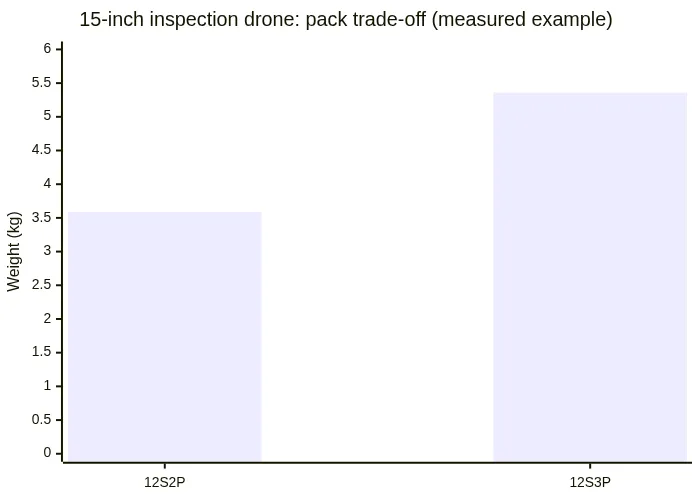
Sopowers characterized an industrial 15-inch multirotor using SPINR26105 10.9Ah cylindrical lithium-ion cells, with:
- Payload: 7.5 kg
- Total takeoff weight: 14 kg (airframe + payload)
- Two pack options: 12S2P and 12S3P
| Configuration | Pack weight | Flight time | What it implies for inspection |
|---|---|---|---|
| 12S2P | 3.59 kg | 19.45 min | Lighter pack for better agility or payload margin |
| 12S3P | 5.36 kg | 28.00 min | Longer time-on-target, fewer landings and battery swaps |
The key insight: adding 1.77 kg of battery increased endurance by about 8.55 minutes (around 44 percent). For inspections where setup time, takeoff/landing risk, or access constraints dominate, that trade can reduce total mission cost even if the drone becomes slightly less agile.
To evaluate your own platform, reuse the same logic:
- Start with flight logs (Wh consumed per mission segment).
- Model weight impact (battery mass affects hover power).
- Select the smallest pack that meets mission energy plus reserve without pushing thermal limits.
Export-ready execution: how Sopowers supports distributors from matching to after-sales
For distributors building an inspection drone battery line, the biggest operational risks are usually (1) inconsistent field performance and (2) certification and logistics delays. Sopowers’ process is designed to reduce both:
1) Before delivery: solution matching and technical confirmation
Sopowers confirms feasibility based on:
- Capacity and total energy (Ah/Wh) for the mission profile
- Voltage and power rating (continuous and peak current)
- Environmental window (hot/cold operation)
- Integration constraints (dimensions, connectors, CG)
This is where lightweight inspection drone battery priorities, smart BMS requirements, and high energy density UAV pack targets get turned into a buildable specification.
2) During delivery: factory testing and consistency screening
All shipped batteries undergo factory testing and consistency screening to stabilize fleet behavior and reduce pack-to-pack variance.
3) After delivery: technical support and troubleshooting
When real missions reveal edge cases (unexpected voltage drop, thermal rise, shortened endurance), Sopowers supports root-cause analysis and optimization recommendations.
Compliance and shipping documentation (what to align early)
For lithium battery export/import, it is standard to plan around UN38.3 plus region-specific requirements and shipping rules. For reference, see summaries from JJRLab on export certifications and Americase on lithium battery shipping regulations. For a buyer-friendly overview of battery types, safety, and flight time, the Unmanned Systems Technology drone battery guide is also useful when aligning internal training and customer documentation.
Explore Sopowers products and start a project discussion
- Browse Sopowers battery solutions: Jump to Product Page
- Technical consultation and quoting: Contact Us
- For distributor/OEM requests: Send Inquiry
If you share your UAV platform basics (voltage, current, payload, target endurance, and operating temperature), Sopowers can propose an inspection drone battery configuration with technical validation steps and documentation planning, aiming for reliable performance without relying on optimistic labels.


