
LiPo packs have become the default power source for drones, FPV, RC models, and many portable industrial tools. But from a distributor’s point of view, choosing between a 1S micro pack and a lipo battery 12s heavy‑lift module is not just about voltage—it’s about real C‑rate, cycle life, certification, and supply reliability.
This guide reviews key LiPo configurations from 1S to 12S, explains where 12S battery lipo systems make sense, and evaluates what you should expect from a professional supplier like Sopowers if you distribute batteries into Europe, North America, and nearby regions.
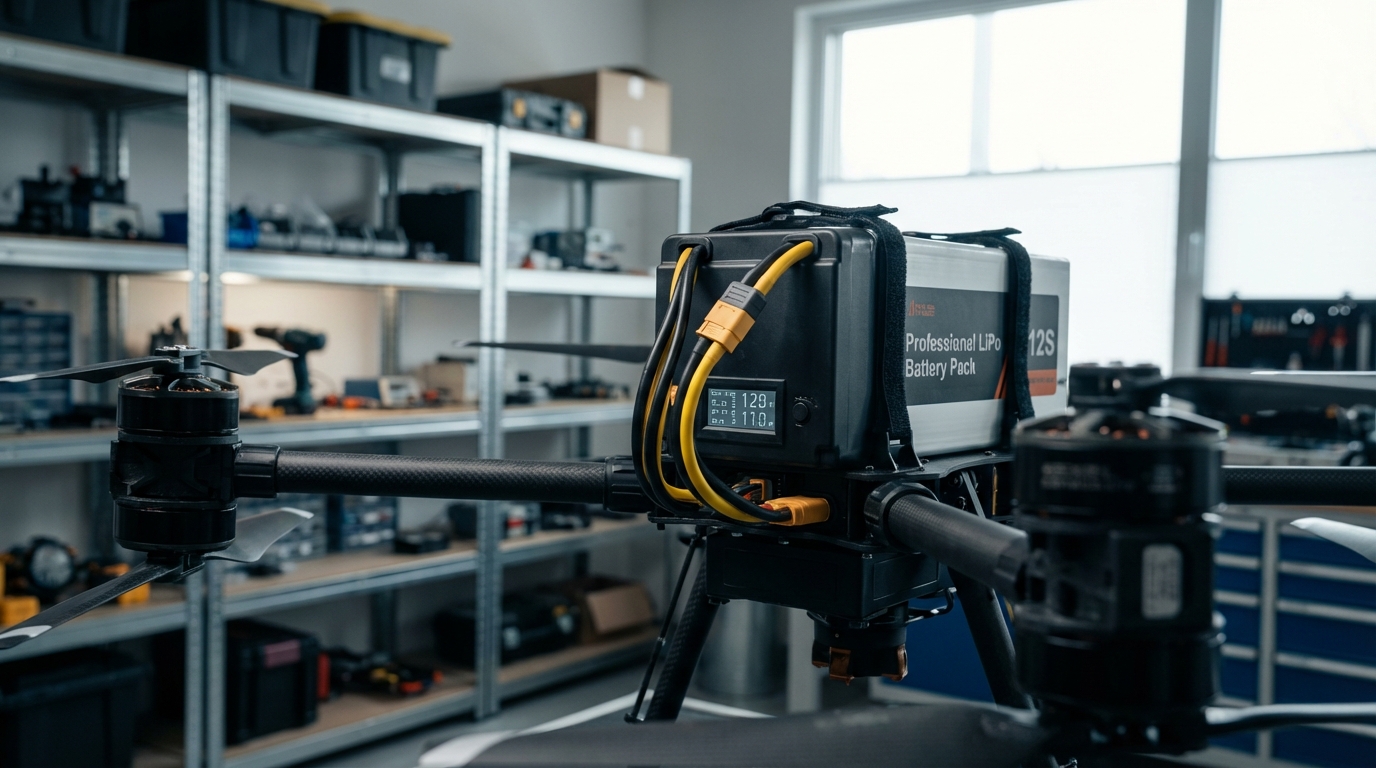
1. LiPo fundamentals: what “S” really means
A lipo battery (lithium‑polymer) is a lithium‑ion cell in a flexible pouch, using a graphite anode and lithium‑metal‑oxide cathode (often NMC).Packs are built by putting cells in series (S) to raise voltage andin parallel (P) to raise capacity.
Common per‑cell values for standard LiPo:
- Nominal: 3.7 V
- Full: 4.2 V
- Recommended minimum under load: ≈3.3 V
Key small‑format examples:
- 1s battery lipo / lipo battery 3 7v → 3.7 V nominal single cell.
- 2 cell li polymer battery (2S) → 7.4 V nominal.
- 12 v lipo (3S) → 11.1 V nominal, 12.6 V full.
Typical voltages by S‑count
| S count | Example keyword | Nominal voltage | Full voltage | Typical applications |
|---|---|---|---|---|
| 1S | 1s battery lipo, lipo battery 3 7v | 3.7 V | 4.2 V | Tiny FPV whoops, IoT, wearables |
| 2S | 2 cell li polymer battery | 7.4 V | 8.4 V | Micro drones, gimbals, small RC, 2s 350mah lipo battery‑class |
| 3S | 12 v lipo, best 3s lipo battery | 11.1 V | 12.6 V | Entry drones, FPV trainers, instruments |
| 4S | – | 14.8 V | 16.8 V | Mainstream FPV, mid‑size RC |
| 6S | fpv 6s battery | 22.2 V | 25.2 V | Performance FPV, mid‑large UAVs |
| 8S | lipo battery 8s, 8s lipo batteries | 29.6 V | 33.6 V | Prosumer/industrial drones, robotics |
| 12S | lipo battery 12s, 12s battery lipo | 44.4 V | 50.4 V | Heavy‑lift UAVs, AGVs/AMRs, 48 V‑class tools |
To visualize how quickly voltage scales as you move toward 8S and 12S:
For distributors, that voltage drives not only performance, but also Wh limits for air transport, connector choices, and safety design.
2. Why 12S LiPo is the workhorse of professional UAV power
A lipo battery 12s (44.4 V nominal, 50.4 V full) aligns with the broader “48 V‑class” ecosystem used in industrial electronics, motors, and inverters. That gives several advantages:
Lower current for the same power
Doubling voltage roughly halves current. A 2 kW drone powertrain at 12S draws ~45 A instead of ~90 A at 6S, which:- Reduces cable cross‑section and weight.
- Lowers I²R losses and heating in ESCs and wiring.
Better compatibility with industrial components
Many AGV/AMR controllers, BLDC drives, and power modules are already optimized for 48 V‑class input.Scalable energy
Common 12S capacities: 4000–30000 mAh, often used in parallel pairs for redundancy and extended flight time.
Where 12S LiPo makes sense
- Heavy‑lift multirotor drones for mapping, logistics, and inspection.
- Long‑range UAVs and VTOLs that demand high Wh/kg.
- Compact, high‑power industrial tools or portable power systems that need 48 V input.
Sopowers focuses heavily on this segment, using stacking technology to reach ≈275 Wh/kg in high‑energy LiPo cells and up to 377 Wh/kg in advanced solid‑state/high‑density variants—while still supporting meaningful discharge rates for UAVs and robotics.
3. Popular LiPo setups by segment (1S–8S)
While 12S dominates heavy platforms, distributors also need strong coverage in lower S‑counts.
1S and 2S: micro drones and compact devices
1S / lipo battery 3 7v / 1s battery lipo
Used in tiny FPV whoops, toys, wearables, and IoT. Form factor, weight, and cost matter more than extreme C‑rate.2S / 2 cell li polymer battery
Capacities like a 2s 350mah lipo battery are common in micro FPV and small RC planes. For OEMs, these often become private‑label packs.
Shorty 2S for RC racing
Keywords such as 2s lipo battery shorty, shorty lipo 2s, 2s lipo shorty, and 2s shorty lipo battery refer to compact, hard‑case 2S packs:
- Designed for 1/10 scale RC cars.
- Shorter length allows chassis weight balance tuning.
- Requirements:
- Very low internal resistance (IR).
- Extremely high burst current (often >100 A).
- Robust hard case for crash protection.
Sopowers’ high‑discharge LiPo technology (up to ~45 C continuous, 90 C bursts on some designs) targets exactly these needs, but with a focus on measured performance rather than aggressive label marketing.
3S and 4S: 12 V‑class and mainstream FPV
A best 3s lipo battery for drones or RC usually balances capacity, IR, and cycle life:
- A 2800 mah 11.4 v 30 c li-po battery class pack (often HV LiPo) suits small camera drones, offering higher energy than traditional 3S at similar size.
- 4S (14.8 V) remains a staple for 5″ FPV freestyle quads.
6S: performance FPV and mid‑size drones
The fpv 6s battery segment is the standard for modern 5″ racers and many cinematic rigs:
- Typical sizes: 1000–1500 mAh (racing), 1300–1800 mAh (long‑range).
- Labelled C‑rates: 45–130 C, though real continuous capability is usually lower.
8S: between hobby and industrial
8s lipo batteries (lipo battery 8s) at 29.6 V nominal are less common in retail but relevant for:
- Larger prosumer drones.
- Robotics platforms that want a step toward 48 V, but at smaller capacity or size than a full 12S.
Most 8S and 12S supplies to this market are B2B/OEM only, making supplier choice critical.
4. Reading a LiPo battery discharge curve
A lipo battery discharge curve plots voltage vs capacity (or time) at a given C‑rate. Understanding it is essential if you want honest specifications:
- Voltage quickly drops from 4.2 V to around 3.7–3.8 V, then stays relatively flat.
- Near empty, voltage falls sharply below ~3.5 V/cell—this is where sudden cut‑offs can happen.
- At higher C‑rates, you see:
- Stronger voltage sag under load.
- Lower usable capacity due to heat and earlier voltage‑based cut‑off.
Illustrative comparison:

For B2B buyers, this curve—measured at realistic temperatures—is far more meaningful than a headline C‑rating alone. Serious suppliers like Sopowers provide capacity, IR, and discharge data at multiple currents and temperatures as part of technical validation.
5. Charging & chemistry: LiPo vs LiFePO₄ vs NiMH
LiPo battery vs NiMH
Compared with NiMH, LiPo offers:
- Much higher energy density (≈160–220 Wh/kg vs 60–100 Wh/kg).
- Higher voltage per cell (3.7 V vs 1.2 V).
- Far higher usable C‑rate (10–60 C vs ~1–5 C).
NiMH still has advantages in inherent fire resistance and abuse tolerance, but in drones, FPV, and high‑power RC, lipo battery vs nimh decisions nearly always favor LiPo on weight and power grounds.
NMC vs LiFePO₄ (nmc vs lifepo4)
Most high‑rate LiPo cells use NMC cathodes; LiFePO₄ (LFP) is a different chemistry:
| Parameter | NMC (LiPo / Li‑ion) | LiFePO₄ (LFP) |
|---|---|---|
| Nominal voltage | 3.6–3.7 V/cell | 3.2–3.3 V/cell |
| Energy density | ~180–280 Wh/kg | ~100–160 Wh/kg |
| Typical cycle life | 500–1500 cycles | 2000–5000 cycles |
| Safety | Good with protection | Very high, stable |
- Use NMC/LiPo when you need maximum power and energy per kg (FPV, UAV, compact robots).
- Use LiFePO₄ when ultra‑long life and safety are critical and extra weight is acceptable (many AGVs/AMRs, backup systems).
How to charge a LiFePO₄ battery (and why chargers differ)
Queries like how to charge a lifepo4 battery and lifepo4 24v battery charger show a common mistake: using a LiPo charger on LiFePO₄.
- LiPo CC/CV charge limit: 4.2 V/cell
- LiFePO₄ CC/CV charge limit: 3.6–3.65 V/cell
For an 8S “24 V” LiFePO₄ pack:
- Nominal: 8 × 3.2 V = 25.6 V
- Charger CV phase: ≈ 28.8–29.2 V
That’s why you must use a dedicated lifepo4 24v battery charger, not a standard battery charger lipo balancer. A LiPo charger will overcharge LiFePO₄, risking damage or failure.
For LiPo multi‑S packs (1S–12S), use a battery charger lipo balancer that:
- Tracks each cell’s voltage via a balance connector or BMS.
- Balances cells near the top of charge to avoid over‑voltage on any one cell.
6. Connectors, adapters, and system integration
High‑S systems pull significant current, so connector selection matters:
- XT60 – common up to ~60 A in hobby FPV/RC use.
- XT90 – more appropriate for higher continuous currents in 6S–12S industrial drones and robots.
An xt60 xt90 adapter is useful when fleets mix connector types, but for OEM designs and serious UAV platforms, it’s better to standardize on the correct connector to avoid added resistance and extra failure points.
When Sopowers matches solutions for a new 8S or 12S design, connector choice (XT60 vs XT90, or industrial alternatives) is part of the technical confirmation—alongside voltage, capacity, C‑rate, and thermal envelope.
7. What to look for in a LiPo supplier (1S–12S)
For distributors and OEM buyers, especially in drone and robotics markets, the key risks are over‑stated performance, inconsistent quality, and slow or costly certification.
A robust supplier should provide:
Performance honesty
- Realistic continuous and burst C‑ratings backed by test curves.
- IR and capacity distributions for each batch.
Strong QC and consistency
- 100 % cell testing (capacity, IR) and consistency screening to remove outliers.
- Pack‑level end‑of‑line tests, especially for 6S–12S UAV packs.
Certification and documentation
- Up‑to‑date UN 38.3 reports for each cell and pack family.
- IEC/UL reports where required (e.g., IEC 62133‑2, IEC 62619, UL 2054/62133).
Logistics awareness
- Understanding of Wh thresholds and packing instructions for air transport.
- Ability to leverage logistics hubs—such as Downtown Dubai, Business Bay, Marina and other major EU/US gateways—for efficient routing and consolidation.
Pre‑ and post‑sales technical support
- Engineering support for BMS/ESC sizing in 8S–12S systems.
- Failure analysis support if field issues (swelling, imbalance, early fade) appear.
How Sopowers’ process addresses these points
Sopowers uses a solution‑matching framework that closely aligns with best practice for B2B LiPo supply:
Before delivery
- Joint analysis of the application scenario:
- Required capacity, voltage (1S–12S), and power rating.
- Environment (including low‑temperature requirements).
- Technical confirmation of:
- Cell chemistry (high‑rate vs high‑energy).
- S/P configuration and connector.
- Feasibility and safety margins.
During delivery / production
- Full factory testing and consistency screening:
- 100 % cell capacity and IR checks.
- Pack‑level tests on representative samples.
- Clear QC records and batch traceability.
After delivery
- Ongoing technical support and troubleshooting:
- Root‑cause analysis of problems encountered in real use.
- Optimization advice (e.g., ESC settings, BMS cut‑offs for 12S UAVs, or connector upgrades).
For distributors, that means less time re‑testing, less risk of failed deployments, and a clearer path to scaling product lines from 1S micro packs up to 12S battery lipo modules.
8. Staying ahead of LiPo battery news & trends
Industry lipo battery news points to several medium‑term trends:
- Gradual energy‑density increases from improved NMC cathodes and anodes.
- Growing interest in solid‑state and semi‑solid high‑energy LiPo, especially for long‑range drones and e‑VTOL.
- Tighter regulatory scrutiny on transport and safety testing (UN 38.3, IEC/UL) for high‑Wh UAV packs.
Suppliers like Sopowers, Grepow and others already showcase high‑energy LiPo and solid‑state cells above 300 Wh/kg, with cycle lives exceeding 1200 cycles in some designs—signals of where the premium UAV and robotics market is going.
For distributors, keeping stock and custom projects aligned with these trends—while maintaining reliable certification and documentation—is a practical way to stay competitive.
9. Practical next steps for distributors
If you’re planning or expanding a LiPo portfolio from 1S to 12S:
Map your applications by S‑count
- 1S–2S: micro/IoT.
- 3S–4S: small drones, RC.
- 6S: FPV and mid‑size UAV.
- 8S–12S: industrial drones, AGVs/AMRs, 48 V‑class tools.
Standardize around tested pack families
- Avoid constant redesign and re‑certification.
- Re‑use proven cell chemistries and stacking structures.
Insist on real data
- Request LiPo battery discharge curves and IR distributions.
- Verify C‑rates with at least sample‑level independent testing.
Leverage solution‑oriented suppliers
- Use Sopowers’ application‑driven solution matching to de‑risk new 8S and 12S projects.
- Utilize their pre‑/during‑/post‑delivery support to shorten development cycles.
10. Contact & CTA
If you need reliable 1S–12S LiPo packs—including lipo battery 12s solutions for UAVs, robotics, or high‑power tools—engineered and validated for real‑world use:
- Jump to Sopowers Product Page →
- Send Inquiry for Custom 6S–12S UAV Packs →
- Contact Us for Technical Solution Matching →
Battery University, “Types of Lithium-ion Batteries (BU‑205)” and related articles on LiPo and NiMH chemistries.
Sopowers, “Consumer Drone Battery,” “Pack Battery,” and “Solid-State High-Density” product pages describing stacking technology, high-rate LiPo, and high-energy-density cells.
Grepow, “Drone Batteries: A Comprehensive Guide,” discussing typical LiPo configurations, capacities, and application trends for drones.
Oscar Liang, “LiPo Battery Guide for FPV Drones,” explaining C‑ratings, discharge behavior, and FPV 4S/6S practices.
Battery University, “Types of Lithium-ion Batteries (BU‑205),” NMC vs LiFePO₄ characteristics.
Battery University, “Charging Lithium-ion Batteries (BU‑409)” and “Charging Lithium Iron Phosphate (BU‑410),” detailing correct CC/CV profiles.
UN Manual of Tests and Criteria, Part III, Section 38.3, defining lithium battery transport tests.
IEC 62133‑2 / IEC 62619 and UL 2054 / UL 62133 standard overviews for lithium battery safety.
IATA Lithium Batteries Guidance Document, covering Wh limits and packing instructions for air transport (UN3480/3481).
Intel Market Research, “Large Capacity High Rate Lithium Polymer Battery Market Insights,” and related market analyses on high‑rate LiPo demand.


