
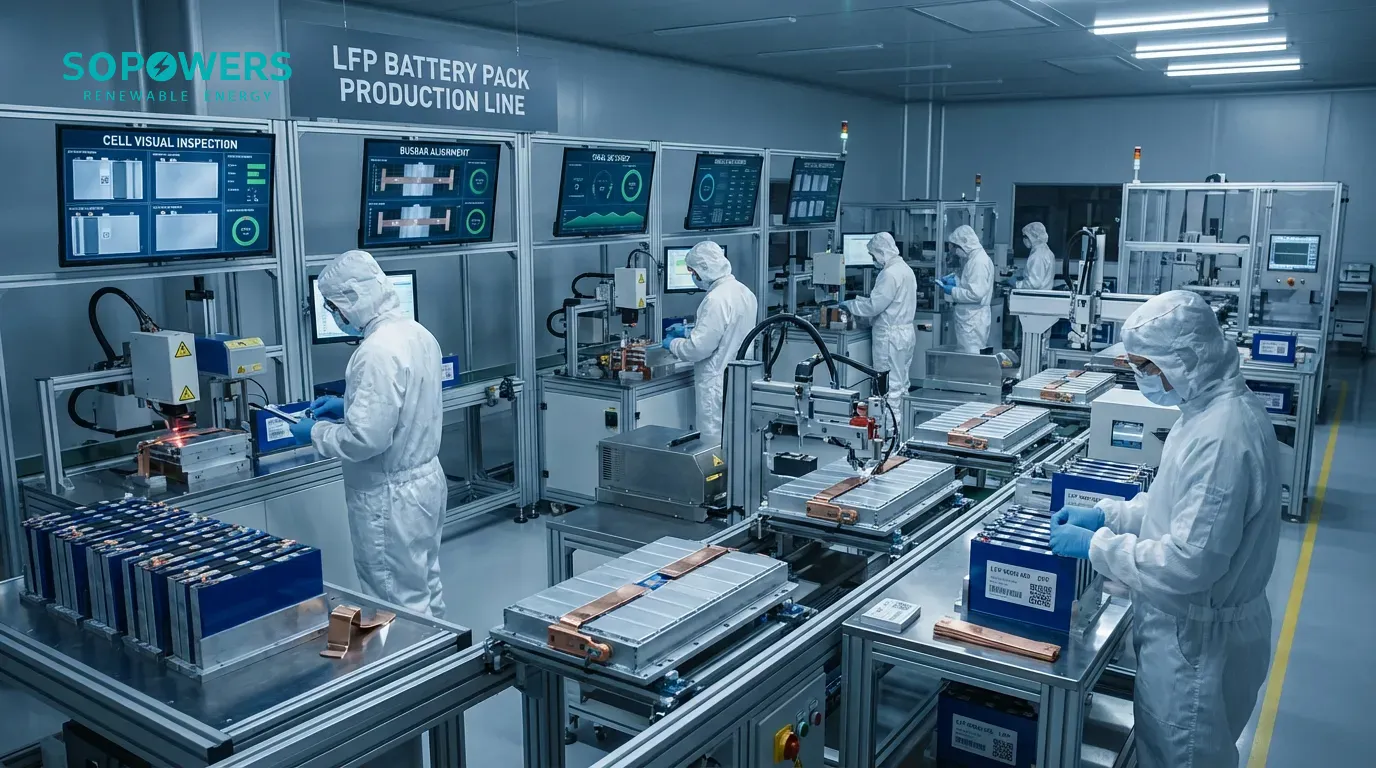
The global lithium iron phosphate (LFP) battery market has moved from a niche chemistry into a default choice for mass-market electrification. What is changing in 2024 to 2030 is not just volume, but the decision logic: buyers are increasingly optimizing for safety, predictable lifetime cost, and supply stability, then engineering around energy-density limits with better pack architecture and application-specific validation.
1) Market snapshot: size, growth, and where demand concentrates
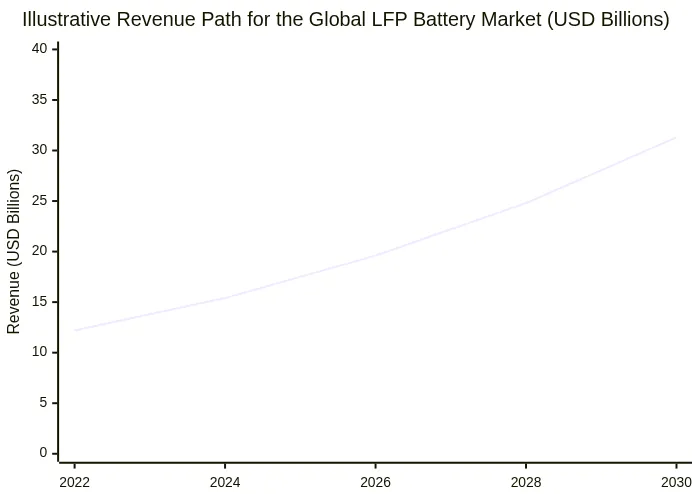
A consistent read across major market trackers is that the market is expanding at a double-digit CAGR through 2030, even though exact totals vary by scope (cells vs packs, inclusion of materials, and applications).
Commonly cited reference points (mid-2020s):
- About $12.2 billion in 2022, with forecasts reaching about $31.3 billion by 2030 at a 12.5 percent CAGR (per an industry synopsis published via EIN Presswire).
- About $18.7 billion in 2024 (Global Market Insights).
- About $23.97 billion in 2025 (Fortune Business Insights).
- A lower-bound 2030 view around $17.5 billion at 10.5 percent CAGR (Grand View Research).
Sources: EIN Presswire market synopsis, Global Market Insights overview, Fortune Business Insights forecast, Grand View Research market analysis.
Where the demand is concentrated
- EVs remain the largest driver of total lithium-ion demand, with stationary storage as the second-largest category (US DOE supply chain review).
- LFP is now broadly recognized as the leading chemistry for new grid-connected storage additions, because safety and cycle life dominate the economics.
Reference: US DOE battery supply chain review PDF.
From a digital demand perspective, procurement-focused search patterns are evolving across global hardware categories.
Evaluation-driven queries, compliance-related keywords, and lifecycle cost comparisons increasingly dominate pre-purchase research.
Independent research into B2B hardware search patterns suggests that specification-driven and certification-oriented keywords are gaining share across industrial supply chains.
2) Five forces accelerating LFP adoption (and what they mean for buyers)
Below are the most decision-relevant drivers buyers are using today, framed as practical procurement implications.
- Lower and more stable materials cost
- LFP avoids nickel and cobalt, reducing exposure to volatility.
- At pack level, LFP is commonly described as about 10 to 30 percent cheaper per kWh than NMC depending on region and scale.
- Higher abuse tolerance and thermal stability
- Thermal runaway onset is often cited around 500 C for LFP versus about 210 C for NMC in common summaries.
Reference: Nickel Institute overview.
- Longer cycle life that changes total cost of ownership
- Typical ranges cited: 3,000 to 6,000 cycles to 80 percent capacity for LFP versus 1,500 to 3,000 for many NMC systems in comparable duty.
Reference: Origotek cycle-life discussion.
- EV chemistry share is shifting quickly
- Public summaries citing BloombergNEF via Electronics360 show LFP rising from about 10 percent (2020) to about 40 percent globally (2024), with much higher penetration in China.
Reference: Electronics360 chemistry shift summary.
- Policy and infrastructure are rewarding safe, long-life batteries
- Fast growth in EVs, charging networks, and grid storage is reinforcing demand for chemistries that are easier to manage at scale.
Reference: IEA Global EV Outlook 2024.
3) LFP vs NMC: a decision table for technical buyers
For many distributors and OEMs, the chemistry choice is not ideological. It is a system optimization across mass, runtime, peak power, safety margin, and certification burden.
Here is a compact comparison based on commonly cited commercial ranges (not lab prototypes):
| Attribute | LFP (LiFePO4) | NMC (NiMnCo) | Practical takeaway |
|---|---|---|---|
| Cell energy density | ~150 to 180 Wh/kg (some designs higher) | ~220 to 280 Wh/kg (high-Ni can be higher) | If mass is the dominant constraint, NMC often wins. |
| Pack energy density | ~120 to 160 Wh/kg | ~180 to 220+ Wh/kg | Pack architecture matters, but chemistry still sets the ceiling. |
| Cycle life (to 80%) | ~3,000 to 6,000 cycles | ~1,500 to 3,000 cycles | High-utilization fleets often favor LFP economics. |
| Thermal runaway onset (often cited) | ~500 C | ~210 C | Safety engineering is still required, but the baseline margin differs. |
| Relative cost per kWh | Typically lower | Typically higher | LFP is often chosen for price-stable scaling. |
| Low-temperature behavior | Often weaker unless optimized | Often better than standard LFP | Cold-climate performance should be validated with real curves. |
Sources: Nickel Institute, Origotek.
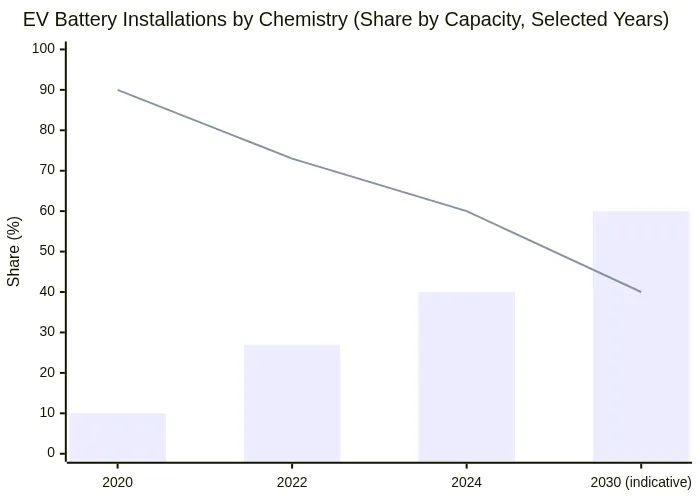
Note: The LFP shares for 2020 and 2024 are commonly cited via BloombergNEF summaries published by Electronics360, and 2022 is cited via an analyst-source compilation. The 2030 split is an indicative synthesis of forward-looking commentary and OEM roadmaps rather than a single point estimate.
4) Industrial spillover: what the market shift means for drones, robots, and power tools
EV and stationary storage dominate total volume, but LFP’s scaling is spilling into industrial categories where procurement teams care about fewer surprises in the field.
A) Drones: balancing endurance, peak power, and safety margin
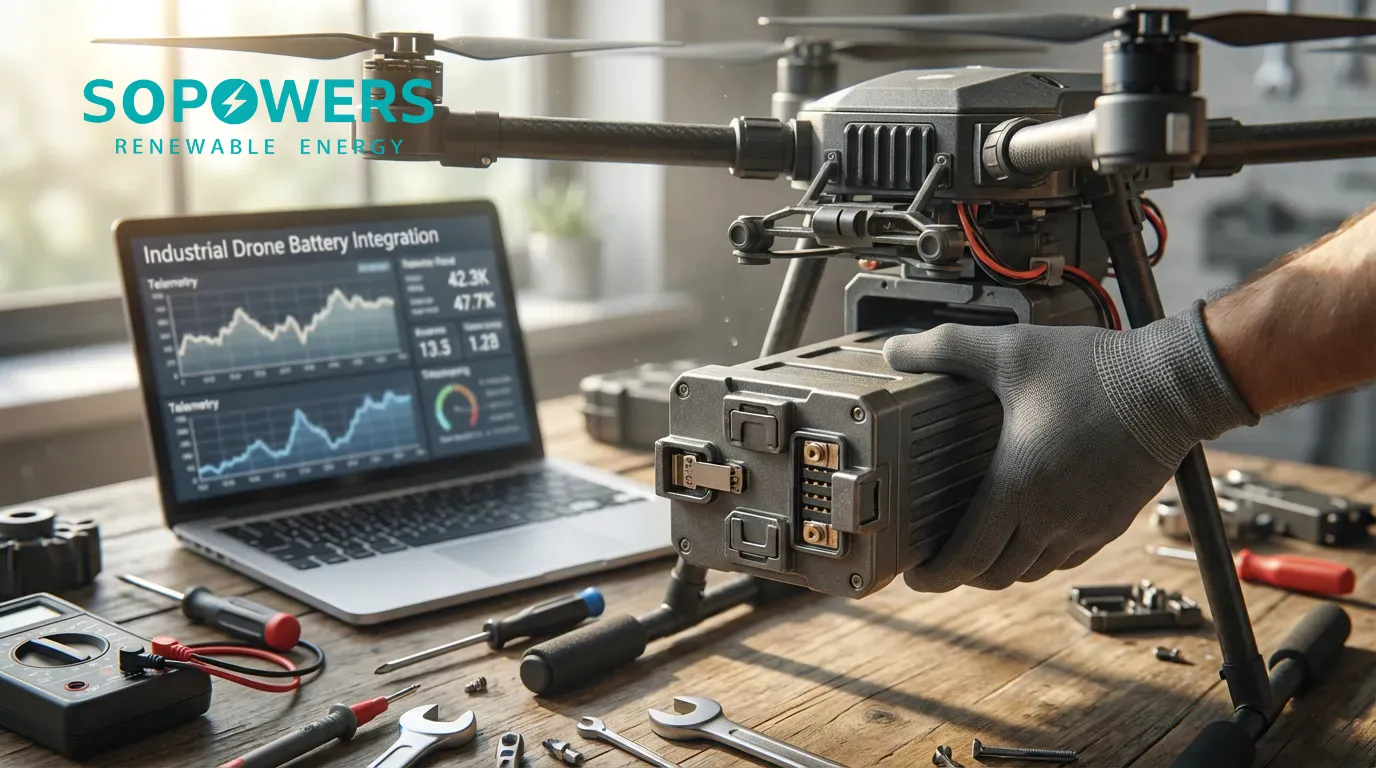
In industrial UAVs, energy density and discharge capability remain decisive. Many platforms still rely on high-rate LiPo or other lithium-ion variants for power density, but LFP is increasingly evaluated where cycle life and safety matter more than maximum flight time.
If you are building or distributing UAV power systems, it helps to treat chemistry as a mission-profile decision:
- Training fleets and repeatable inspection routes: often benefit from higher cycle life and safety margin.
- Heavy lift and time-on-station: often require higher energy density designs and tight voltage stability under load.
Sopowers publishes application-specific guidance for UAV power requirements, including discharge engineering considerations: high-discharge engineering for UAV flight-critical systems and the broader UAV application overview.
Example: 15-inch industrial drone pack trade-off (Sopowers case data)
- Airframe plus payload takeoff weight: 14 kg
- Payload: 7.5 kg
- Cell: SPINR26105 10.9Ah
- 12S2P pack: 3.59 kg, 19.45 minutes
- 12S3P pack: 5.36 kg, 28 minutes
The procurement lesson is straightforward: adding parallel strings can deliver large endurance gains, but changes the aircraft weight budget and may change certification and shipping constraints.
If your program prioritizes endurance and compactness, Sopowers also groups next-generation platforms under Solid State and High Density for high energy density designs.
B) AI robots and mobile robotics: safety-first LFP packs are becoming standard
Robots operate around people, inside facilities, and often with frequent charge-discharge cycling. This combination is naturally aligned with LFP.
Sopowers example (robot pack)
- Configuration: 15Ah, 15S1P, 48V
- Chemistry: LFP
- Discharge capability: 5C
- Safety note: described as impact-safe in internal testing, including no explosion or fire even with a 120 km/h impact scenario
In practice, this is why LFP is increasingly considered for service robots in dense commercial zones (for example, Downtown Dubai, Business Bay, Dubai Marina, and the Museum of the Future area): a higher safety margin reduces operational risk and simplifies stakeholder acceptance.
C) Power tools and professional equipment: picking between peak current and lifecycle
Power tools are driven by peak current, shock resistance, and runtime. Depending on the duty cycle, buyers may choose:
- High-rate packs for peak power and compactness.
- LFP packs for safety margin and long cycle life where size and weight are less restrictive.
Sopowers provides catalog options for high C-rate packs, including the 45C high discharge battery product page, and an overview of their broader high-discharge portfolio here: high-discharge solutions across chemistries.
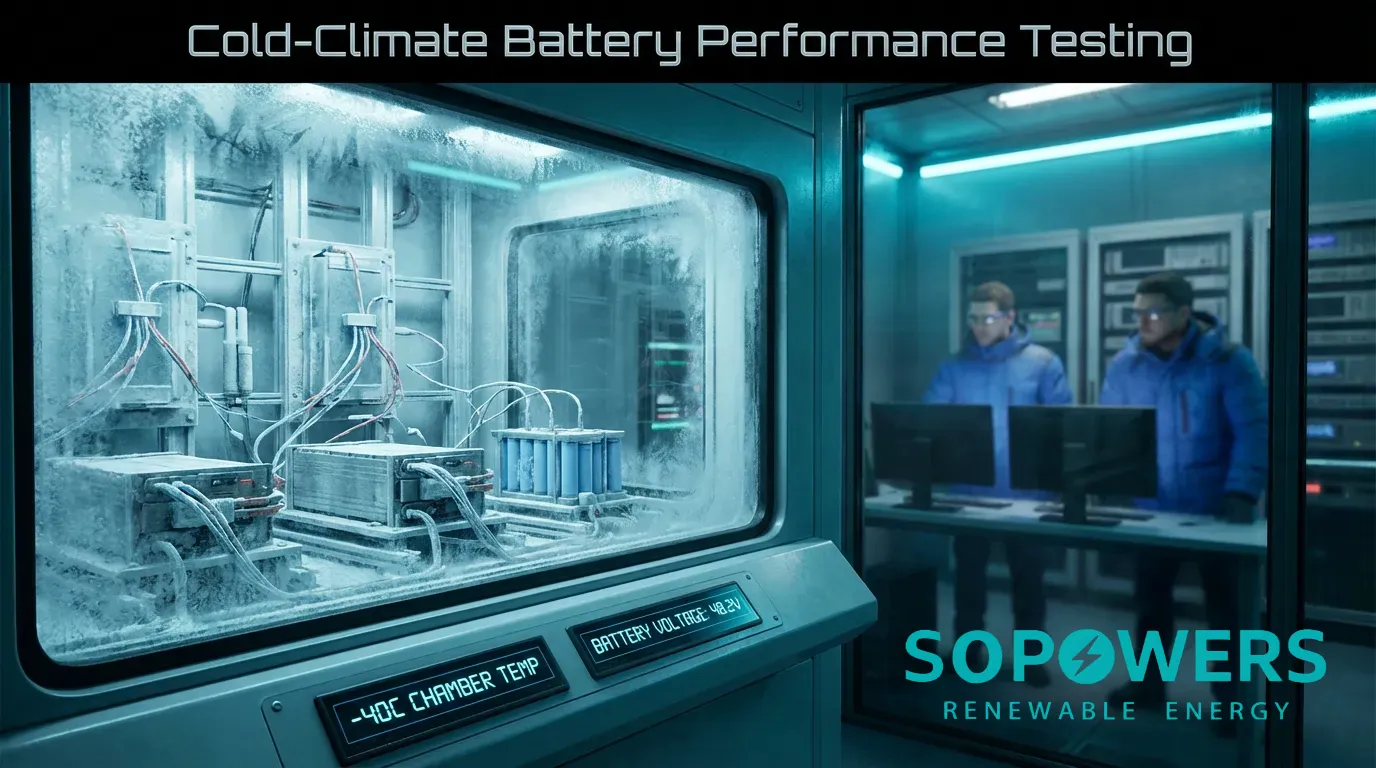
D) Cold and mixed environments: validate, do not assume
One of the most common sourcing failures is buying based on room-temperature datasheets, then discovering large capacity loss or voltage sag in real deployments.
Sopowers highlights ultra-cold designs down to minus 40 C and minus 50 C, including a product family page for ultra-cold cylindrical and prismatic cells. For distributors, the key is to request:
- Capacity retention vs temperature curves.
- Discharge curves at the actual mission C-rate.
- Charging limits and BMS behavior in cold start.
5) A sourcing checklist for distributors (and how Sopowers reduces integration risk)
Technical buyers repeatedly cite three pain points: uncertain real-world performance, certification friction, and delivery predictability. Use the checklist below to make supplier comparisons measurable.
Quick checklist (use in RFQs)
- Performance evidence you can reproduce
- Discharge curves at your duty cycle (not just headline C-rates).
- Cycle-life definition and test conditions.
- Temperature curves relevant to your deployment.
- Process transparency
- Cell matching criteria (OCV, DCIR, capacity).
- Pack-level end-of-line testing scope.
- Traceability from cell lot to pack serial.
- Certification readiness
- Documentation support for common export and safety frameworks (examples mentioned in the report include UN38.3 and IEC/UL families, depending on destination).
- Willingness and ability to support re-testing when a configuration changes.
- Application engineering support
- Can the supplier validate capacity, voltage, power rating, and feasibility for your airframe, robot, or tool before production?
- Can they troubleshoot field issues with root-cause analysis rather than guesswork?
Sopowers service flow (aligned to buyer expectations)
Based on the report, Sopowers emphasizes an engineering-led workflow:
- Pre-delivery: solution matching and technical confirmation based on application scenario (capacity, voltage, power rating, feasibility).
- During delivery: factory testing and consistency screening for stable performance.
- After delivery: technical support and troubleshooting with root-cause analysis and optimization recommendations.
For buyers who want to compare pack types quickly, Sopowers maintains educational guides such as:
- What impacts flight time and how to improve it
- How to choose a drone battery (engineering-oriented)
- LiPo handling and storage practices
Summary and next step
The next phase of the global battery industry will reward buyers who can translate market trends into application-level specifications: required C-rate under load, temperature envelope, cycle-life economics, and certification constraints. LFP’s momentum is strong in EVs and storage, and it is increasingly influencing how industrial platforms are designed and sourced, especially where safety and repeatable lifecycle performance matter.
If you want an engineering review of your battery requirement (chemistry, voltage, capacity, discharge profile, and temperature constraints), use: Contact Us or Send Inquiry.


