
Why the Fast Charging EV Battery Race Matters in 2026
The fast charging EV battery is moving from a convenience feature to a core purchase criterion. In 2026, the market is no longer satisfied with 10 to 80 percent charging in 25 to 30 minutes. The direction is clear: 15 to 20 minutes for mainstream vehicles, and sub-15-minute charging for selected high-rate platforms.
This shift is being driven by three parallel developments:
- Better chemistry, including high-rate LFP, LMFP, silicon-enhanced anodes, and early semi-solid or solid state fast charging battery platforms.
- Better system design, especially 800 V architectures, smarter BMS control, and more capable thermal management.
- Better charging infrastructure, with 150 to 350 kW DC charging expanding across Europe, North America, and high-growth urban corridors such as Downtown Dubai, Business Bay, Dubai Marina, and the Museum of the Future area.
For technical buyers, the key takeaway is simple: the next generation EV battery technology conversation is no longer just about range. It is about balancing charge speed, thermal stability, degradation, safety, and real-world uptime.

1. What Defines Modern EV Fast Charging Battery Technology
When people discuss EV fast charging battery technology, they often focus only on charger power. In practice, charging speed depends on the entire battery system.
Core factors behind fast charging
| Factor | Why it matters |
|---|---|
| Cell chemistry | Determines charge acceptance, safety margin, and degradation behavior |
| Anode design | Strongly affects lithium plating risk during high-rate charging |
| Voltage architecture | 800 V systems reduce current for the same power level |
| Thermal management | Keeps cells in a safe, efficient temperature window |
| BMS strategy | Adjusts current based on SoC, temperature, and cell condition |
A useful benchmark is the 10 to 80 percent charging window:
- Many current 400 V EVs: about 20 to 30 minutes
- Advanced 800 V vehicles: about 18 to 22 minutes
- High-rate LFP systems now being introduced: around 10 to 15 minutes under optimized conditions
- Early pilot solid-state and semi-solid designs: targeting about 10 to 15 minutes in limited deployments
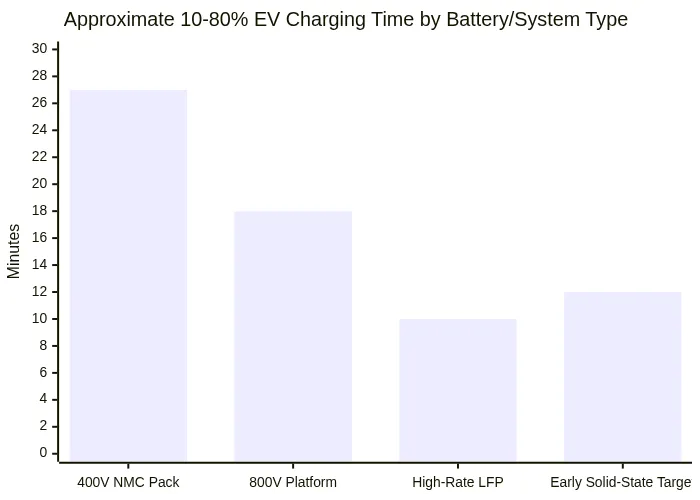
This is why EV battery fast charge technology should be understood as a coordinated result of chemistry, pack design, cooling, and software control.
2. The Main Technologies Shaping EV Battery Technology Trends 2026
The biggest EV battery technology trends 2026 are not speculative. They are already visible in public roadmaps and commercial launches.
High-rate LFP and LMFP
LFP remains highly attractive because of its safety, long cycle life, and cost efficiency. Newer high-rate versions improve charge acceptance significantly. CATL, for example, has publicly claimed 400 km of range added in 10 minutes for its Shenxing platform through optimized LFP design and charging control.
LFP and LMFP are especially relevant for:
- Fleet vehicles
- Urban mobility platforms
- Safety-first passenger EVs
- High-utilization duty cycles
That makes them a strong candidate for the high rate charging EV battery category.
Silicon-enhanced anodes
Silicon increases anode capacity and can improve fast-charge capability, but it introduces major expansion stress. The value is clear:
- Higher energy density
- Better charge acceptance potential
- A path toward shorter charging times without giving up range
The engineering challenge is equally clear: swelling, interface instability, and long-term mechanical degradation must be managed carefully.
Solid-state and semi-solid platforms
The solid state fast charging battery remains one of the most discussed themes in next generation EV battery technology. Public targets often include:
- 10 to 80 percent charging in 10 to 15 minutes
- More than 50 percent higher volumetric energy density
- Better abuse tolerance due to reduced flammable liquid electrolyte content
Mass-market rollout still appears to be later than 2026, but pilot and premium deployments are increasingly realistic.

Technology comparison at a glance
| Technology | Fast-charge potential | Safety profile | Energy density | 2026 outlook |
|---|---|---|---|---|
| Conventional NMC/NCA | Strong | Moderate, needs strict control | High | Still widely used |
| High-rate LFP | Very strong | Very high | Moderate | Fast growth |
| LMFP | Strong | High | Better than LFP | Expanding adoption |
| Silicon-enhanced Li-ion | Very strong | Chemistry-dependent | High to very high | Premium and advanced platforms |
| Semi-solid / solid-state | Very strong on paper | Potentially high | Very high | Early pilot stage |
3. The Real Bottlenecks: Heat, Lithium Plating, and Battery Life
The best fast charging lithium battery for EV applications is not simply the one with the highest advertised power. It is the one that can repeat high-rate charging with acceptable degradation and safe thermal behavior.
The three engineering limits
1. Lithium plating
At low temperatures or high SoC, lithium can deposit on the anode surface instead of intercalating properly. This reduces capacity and can create safety risk.
2. Thermal buildup
Higher charging current means more resistive heating. Without effective cooling, charge speed must be reduced.
3. Degradation under repeated high-rate use
Fast charging stresses electrodes, interfaces, and separators. Real-world life depends on how well the battery system manages those stresses.
That is why many battery developers now focus on narrower but more realistic questions:
- Can the pack hold performance over repeated fast-charge cycles?
- Can it handle hot climates and cold starts?
- Can it maintain cell consistency over time?
This system-level thinking strongly resembles what Sopowers already applies in other high-demand battery applications. In its solution process, Sopowers starts with application-scenario matching, verifies capacity, voltage, power rating, and feasibility before delivery, then performs factory testing and consistency screening during production, followed by technical support and troubleshooting after delivery. That approach matters because battery performance is only meaningful when it is verified in actual use conditions.
For readers evaluating related high-performance battery solutions, Sopowers also showcases this engineering mindset across its Consumer Drone Battery Solutions, Battery Pack Solutions, and product portfolio.
4. What Drones and Robotics Teach Us About Ultra Fast Charging EV Battery Design
One useful way to understand EV charging technology innovations is to look at adjacent industries that already deal with high discharge, high C-rate operation, strict weight limits, and harsh environments.
A real trade-off example: endurance vs weight
Sopowers’ published 12S2P and 12S3P Li-ion battery solutions for 15-inch drones provide a clear case study:
| Configuration | Pack weight | Flight time | Application insight |
|---|---|---|---|
| 12S2P | 3.59 kg | 19.45 min | Lower weight, shorter endurance |
| 12S3P | 5.36 kg | 28 min | More energy, better endurance, added weight |
See the full technical case here: 12S2P and 12S3P Li-ion Battery Solutions for 15-inch Drones.
This mirrors EV design choices closely:
- More parallel cells can improve endurance and reduce per-cell stress.
- Higher energy configurations can improve range but add mass and cost.
- High-power variants may sacrifice some energy density for better rate capability.
A real safety example: high-rate LFP in robotics
Sopowers also highlights an AI robot battery pack configuration of 15Ah, 15S1P, 48V LFP with 5C rate capability. The notable point is not just the rate. It is the safety profile: the pack is described as not exploding or catching fire even under a 120 km/h impact condition.
That example matters because it illustrates why high-rate LFP is getting so much attention in EV battery technology trends 2026:
- High intrinsic safety
- Good high-rate potential
- Strong fit for demanding duty cycles
- More predictable thermal behavior than many higher-energy chemistries
For broader battery applications and product directions, readers can also explore Sopowers’ consumer battery categories and high-performance drone battery offerings.

5. What Buyers Should Look for in a Fast Charging EV Battery in 2026
Whether the application is EV, robotics, or another high-power system, technical buyers should evaluate more than charging headline numbers.
Practical selection criteria
- Verified 10 to 80 percent charging performance under defined conditions
- Temperature window for both charging and operation
- Cell consistency and production screening process
- BMS sophistication for current control, balancing, and protection
- Safety and abuse performance
- Certification readiness for export and target markets
- Supplier support before, during, and after delivery
A concise evaluation framework is below.
| Question | Why it matters |
|---|---|
| What charger power and voltage architecture is required? | Determines whether advertised charge times are realistic |
| How does the pack behave in cold or hot conditions? | Fast charging performance changes sharply with temperature |
| What is the degradation profile under repeated DC fast charging? | Affects warranty, TCO, and fleet uptime |
| How is consistency controlled in production? | Weak cells limit the whole pack |
| What technical support is available after shipment? | Important for troubleshooting real-world issues |
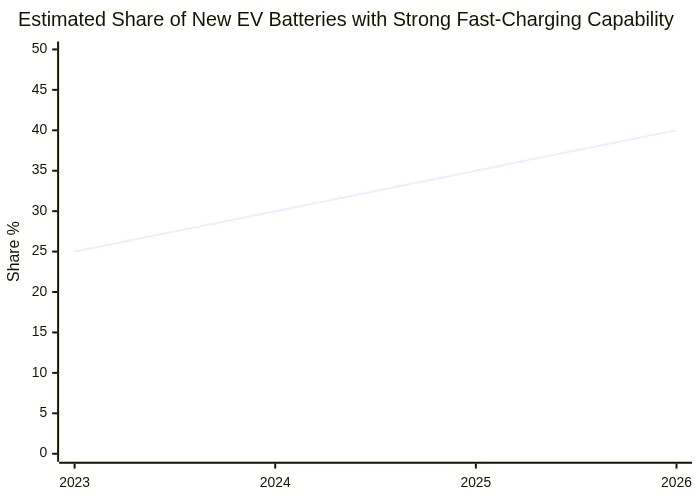
The growth trend above reflects the rising importance of fast-charge-capable platforms, especially in LFP and LMFP segments.
For buyers working across UAV, robotics, or custom battery programs, Sopowers’ solution model is relevant because it emphasizes:
- solution matching before delivery
- factory testing and consistency screening during delivery
- root-cause analysis and optimization support after delivery
That process-oriented approach is often more valuable than aggressive spec claims alone.
Conclusion: Fast Charging Will Be Defined by Real Engineering, Not Just Big Numbers
The fast charging EV battery market in 2026 is being shaped by a clear technical reality: faster charging is possible, but only when chemistry, cooling, voltage architecture, and BMS control are aligned.
The most important trends are:
- High-rate LFP and LMFP moving into the mainstream
- Silicon-enhanced cells improving both range and charge acceptance
- Early solid state fast charging battery platforms entering pilot deployment
- 800 V systems expanding as a practical enabler of faster charging
- More emphasis on verified safety, temperature performance, and consistency
For technical decision-makers, the lesson is straightforward. The best battery is not the one with the boldest claim. It is the one that delivers stable, testable performance in the target application.
If you are evaluating high-rate, high-discharge, low-temperature, or high-energy-density battery solutions for drones, robotics, or related platforms, explore Sopowers’ Product Page or Contact Us for solution matching and technical consultation.


