
Industrial UAV operations, whether you are running facade inspections around Downtown Dubai towers, mapping in Business Bay, or media flights near Marina, depend on one fragile component more than most teams expect: the drone battery. Poor charging habits, deep discharges, and temperature abuse do not just reduce flight time. They increase swelling risk, raise return rates, and make replacement planning unpredictable.
For distributors and technical buyers, a consistent care standard also helps separate real-world performance from exaggerated claims, because batteries maintained in a controlled way produce more repeatable test results over time.
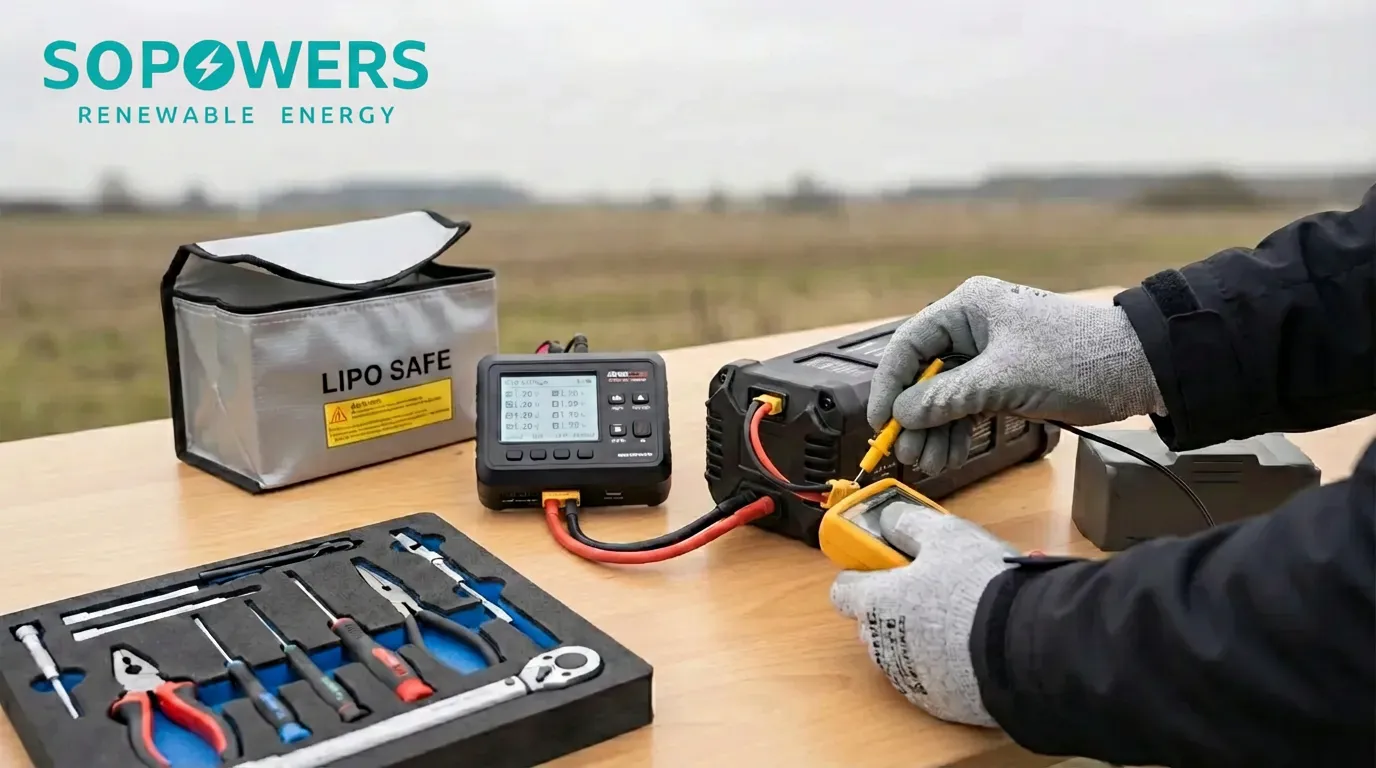
Why drone battery care directly impacts flight time, safety, and lifecycle cost
Most professional platforms use lithium polymer (LiPo) or related lithium-ion chemistries. These packs are energy-dense, but they are sensitive to three stressors:
- Over-charge and charging when too cold or too hot
- Over-discharge (deep depth of discharge, or DoD)
- Heat buildup from high current draw and fast charging
Over time, these stressors increase internal resistance (IR), which causes voltage sag under load. The result is a familiar pattern: the drone feels normal at takeoff, then hits low-voltage thresholds early, shortening usable flight time.
From a business perspective, good care practices reduce:
- Premature failures and warranty disputes
- Batch-to-batch performance confusion during incoming QC
- The likelihood of abnormal behavior that can complicate transport and safety documentation
Drone battery basics: the specs that determine how you should treat the pack
Not all packs want the same operating profile. Care guidelines start with matching chemistry and discharge capability to the mission (endurance vs heavy-lift vs FPV training).
Chemistry and mission fit (quick comparison)
| Battery type (common in drones) | Strength | Tradeoff | Typical best-fit missions |
|---|---|---|---|
| LiPo pouch | High power output, flexible form factor | More sensitive to mishandling, can age quickly when overheated | Multirotors, heavy-lift bursts, FPV training fleets |
| Cylindrical Li-ion | Higher energy density potential | Lower peak discharge capability | Long-range mapping, endurance-oriented platforms |
| LiHV (high-voltage LiPo) | Slight energy gain when charged higher | Requires correct charger mode and tighter discipline for longevity | When the platform explicitly supports LiHV |
| LiFePO4 (LFP) | High stability and cycle life | Lower energy density | Specialty systems where safety outweighs weight |
The key metrics that influence care
| Metric | What it means in practice | Care implication |
|---|---|---|
| Capacity (Ah) | How much charge is stored | Bigger is not always better; extra weight can reduce multirotor efficiency |
| Voltage / cell count (S) | Pack voltage level | Higher voltage can reduce current for the same power, lowering heat |
| C-rating | How much current the pack can deliver | Undersizing drives heat, voltage sag, and faster aging |
| Internal resistance (IR) | “Friction” inside the cells | Rising IR is an early warning sign for retirement planning |
| Depth of discharge (DoD) | How much capacity you use per cycle | Avoiding deep discharge is one of the biggest lifespan levers |
DoD vs cycle life (why landing earlier pays back)
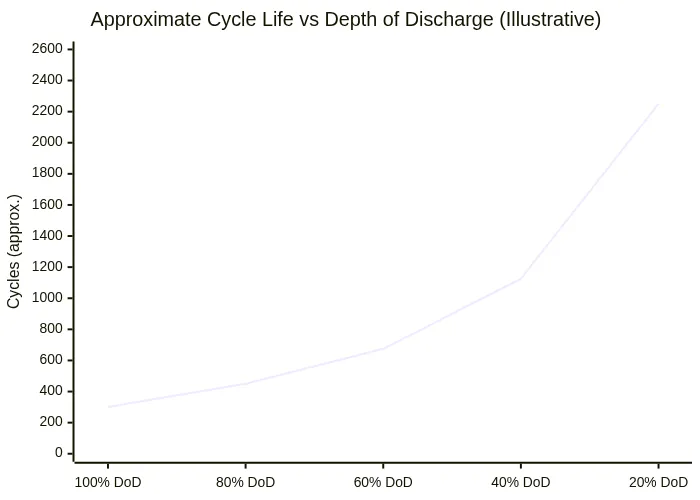
Interpretation for operators: if you routinely avoid “emptying” the pack (for example, landing with a meaningful reserve), you can materially extend usable life and stabilize performance.
A practical drone battery care workflow (charging, flying, cooling, storage)
The goal is repeatability. A pack that is always treated the same way is easier to evaluate, easier to troubleshoot, and safer to operate.
1) Charging: prioritize balance, temperature, and conservative rates
Recommended defaults for most LiPo-based systems:
- Use a balance-capable charger (or OEM smart charger) with the correct chemistry mode.
- Charge rate: target <= 1C unless the datasheet explicitly supports higher rates.
- Temperature rule: do not charge below 0 C, and avoid charging when the pack is still hot from flight.
- Charge location: non-flammable surface, away from flammables. Do not charge unattended. For broader lithium safety guidance, reference the MIT Environment, Health and Safety document on lithium batteries: Lithium Battery Safety Guidance (MIT EHS).
2) Flight use: prevent deep discharge and chronic overheating
Operational habits that protect both flight time and longevity:
- Set conservative alarms and landing thresholds. Many operators aim to land before the pack is deeply depleted, rather than relying on low-voltage cutoff.
- Avoid sustained operation near the pack’s true continuous limits. When peak current regularly pushes the pack hard, temperature rises, and IR grows faster.
- After landing, let packs cool down in shade and airflow before recharging or packing them tightly.
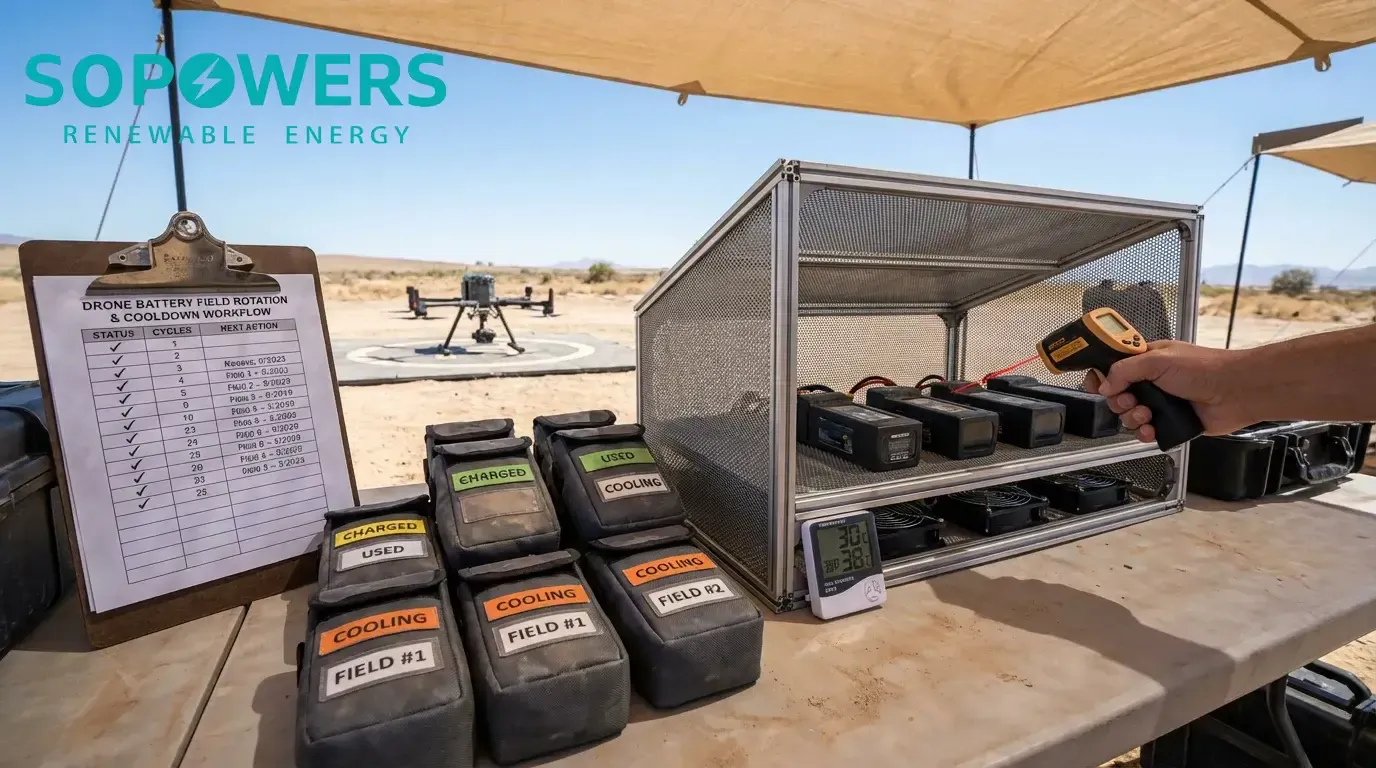
3) Storage: use storage voltage and avoid hot locations
Storage is where many packs quietly age fastest.
Best-practice storage targets:
- Voltage: about 3.7 V to 3.85 V per cell (storage mode on most chargers)
- Environment: cool, dry, out of direct sun
- Avoid: leaving packs fully charged or fully discharged for extended periods
Hot vehicles are a known risk multiplier for both aging and safety. If you need an operations policy reference, see: FAA lithium battery transport and handling overview.
Temperature management: cold-weather and hot-climate tactics
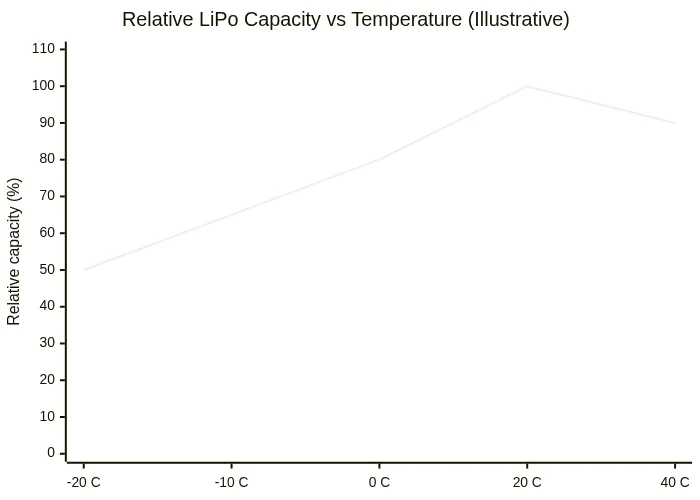
Temperature affects usable capacity immediately, and it affects aging over time.
What temperature does to usable capacity (illustrative trend)
Cold-weather operations (including low temperature battery planning)
If you fly in cold environments:
- Pre-warm packs safely (insulated case, controlled warming accessories) to approach room temperature before takeoff.
- Expect more voltage sag and shorter flight time; plan higher reserve margins.
- Never charge below 0 C due to lithium plating risk.
If cold missions are routine, specify low temperature battery options during procurement so the chemistry is designed to retain more usable capacity at sub-zero temperatures.
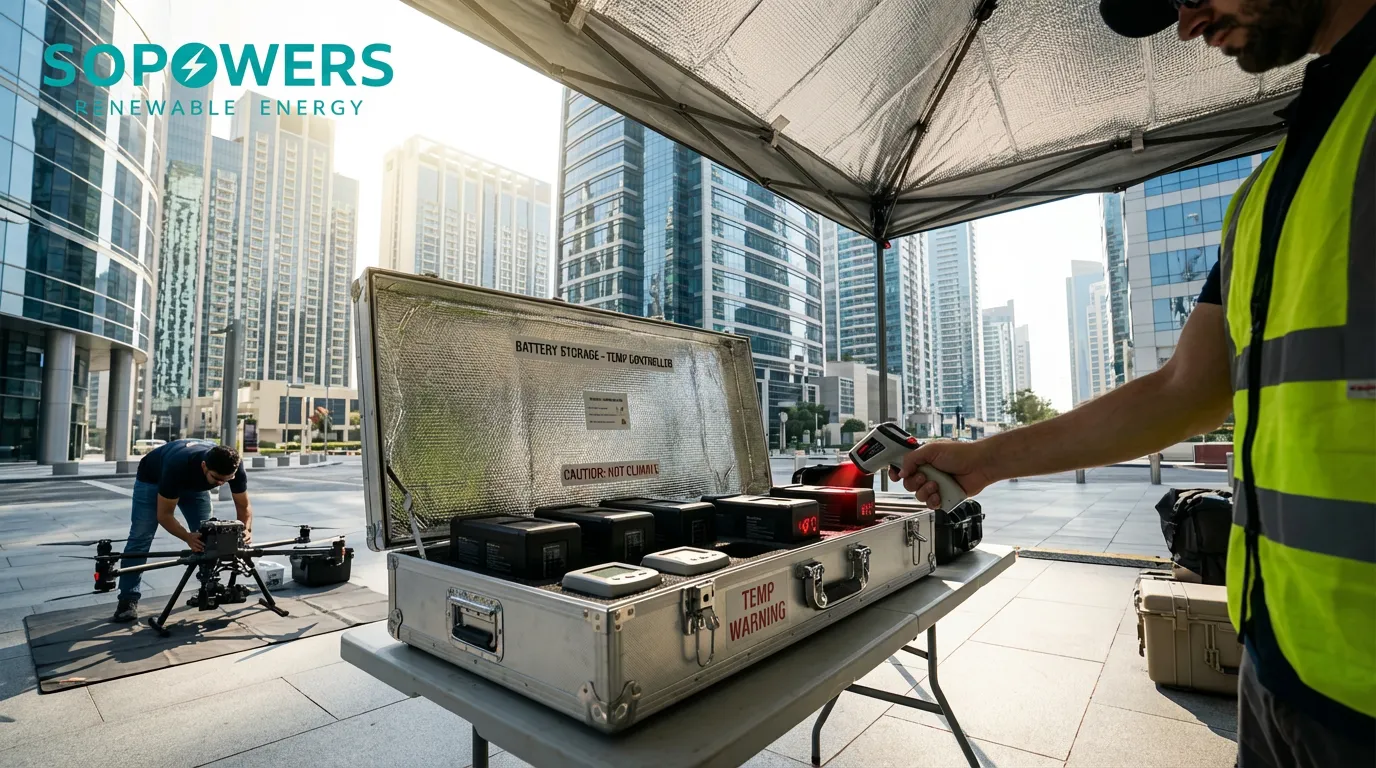
Hot urban climates (Dubai-style heat)
In high ambient heat:
- Keep packs out of direct sun on the landing pad.
- Do not store packs in parked vehicles.
- Treat “too hot to comfortably hold” after flight as an engineering signal: reduce load, increase pack headroom, or adjust flight profile.
Inspection, retirement, and compliance: reduce surprises for fleets and distributors
Routine inspection checklist (fast, repeatable)
Before each flying day:
- Visual: swelling, dents, torn shrink wrap, damaged leads, corrosion
- Smell/heat: any unusual odor or unexplained warmth at rest
- Cell balance: abnormal imbalance at rest is a warning sign
Retire immediately if you see swelling, leakage, or physical damage. Plan retirement when measured capacity drops materially from baseline, or when rising IR causes operationally significant voltage sag.
Export and safety standards (what technical buyers should track)
For global shipments and professional programs, two commonly referenced frameworks are:
- UN38.3 for transport testing and shipping readiness: FAA PackSafe lithium battery guidance
- IEC 62133 safety requirements for portable sealed secondary batteries: IEC 62133 overview (Intertek)
Stable, consistent batteries reduce the risk of surprises during documentation, incoming QC, and field use.
How Sopowers reduces risk beyond the spec sheet
Sopowers focuses on an end-to-end process that supports predictable outcomes:
- Pre-delivery solution matching and technical confirmation based on your application scenario (capacity, voltage, power rating, feasibility)
- During delivery, factory testing and consistency screening for stable performance
- After delivery, technical support and troubleshooting with root-cause analysis and optimization recommendations
For additional operational guidance from Sopowers, you can reference:
Summary
Maximizing drone battery flight time and lifespan is mainly about controlling DoD, temperature, and charging discipline, then reinforcing that with consistent inspection and retirement criteria. For distributors and fleet programs, this translates into fewer returns, more predictable replacement cycles, and clearer performance validation.


