
Commercial space conversations usually focus on launch vehicles and payloads. But from a power engineering perspective, the more decisive question is simpler: what keeps a satellite alive when sunlight disappears?
That answer is the satellite battery, a mission-critical element inside the satellite power system (also called the power subsystem or EPS). In my view, the satellite battery is one of the clearest examples of how extreme requirements force real innovation: not “better specs on paper”, but better control of degradation, safety, and reliability under conditions that cannot be serviced or repaired.
Why a satellite battery is fundamentally different from a ground battery
A spacecraft battery (space battery) does not fail gracefully. A single unexpected shutdown can mean total mission loss. That “no maintenance, no replacement” reality drives design choices that look conservative compared to consumer and even industrial markets.
Key space drivers called out repeatedly across satellite programs include:
- Vacuum & extreme thermal environment: No convective cooling in hard vacuum, plus large external temperature swings. The battery must rely on conduction paths and radiative thermal control, and must avoid hot spots that accelerate aging or trigger thermal runaway.
- Radiation effects (total ionizing dose, TID): Radiation can degrade cell materials over time and can be even more dangerous for battery management system (BMS) electronics via single-event effects. Mitigation often requires rad-tolerant components, watchdog logic, and redundancy.
- Mission-shaped life targets: LEO tends to demand extreme cycle life (high cycling in LEO). GEO tends to demand long mission life with low degradation (calendar life dominates).
For a practical reference point on how seriously qualification is treated for space-qualified lithium-ion battery cells and packs, NASA’s published work on cell and battery qualification is a useful anchor (see the NASA VL10ES qualification and evolutions paper).
LEO vs. GEO: eclipse operation, depth of discharge (DOD), and what “battery life” really means
Most people talk about battery life as “how many cycles”. In space, that is only half the story. Orbit selection changes everything: eclipse power needs, cycling frequency, and acceptable depth of discharge (DOD).
Mission profile comparison (what designers optimize for)
| Orbit type | Eclipse operation reality | Typical cycling stress | Common DOD philosophy | Dominant aging mode |
|---|---|---|---|---|
| LEO | Frequent eclipses each orbit | Often 15+ charge/discharge cycles per day, reaching 5,000 to 20,000+ cycles over mission life | Higher DOD is sometimes acceptable (often 40% to 80%) if thermal control and BMS are excellent | Cycle aging + thermal cycling fatigue |
| GEO | Eclipses mostly around equinox seasons | Only a few hundred total cycles across 15 to 20+ years | Deliberately shallow DOD (often 20% to 30% or less) to protect life | Calendar aging + slow impedance growth |
| MEO | Intermediate, mission-dependent | Several thousand to low tens of thousands | Moderate DOD | Mixed |
The opinionated takeaway: “Best chemistry” is the wrong question without orbit context. In LEO, cycle life at meaningful DOD is the headline requirement. In GEO, it is controlled operating window and low degradation over decades.
Market forecasts also reflect this diversity: space battery demand is expanding with constellations and payload power growth (see estimates from The Business Research Company and Coherent Market Insights, plus lithium-ion satellite battery-specific tracking from Valuates).
Chemistry choices in orbit: NiH2, space-qualified lithium-ion, LiPo, and the ASSB roadmap
Satellite battery evolution is not just “lithium wins.” It is “lithium wins, but only with tighter control.”
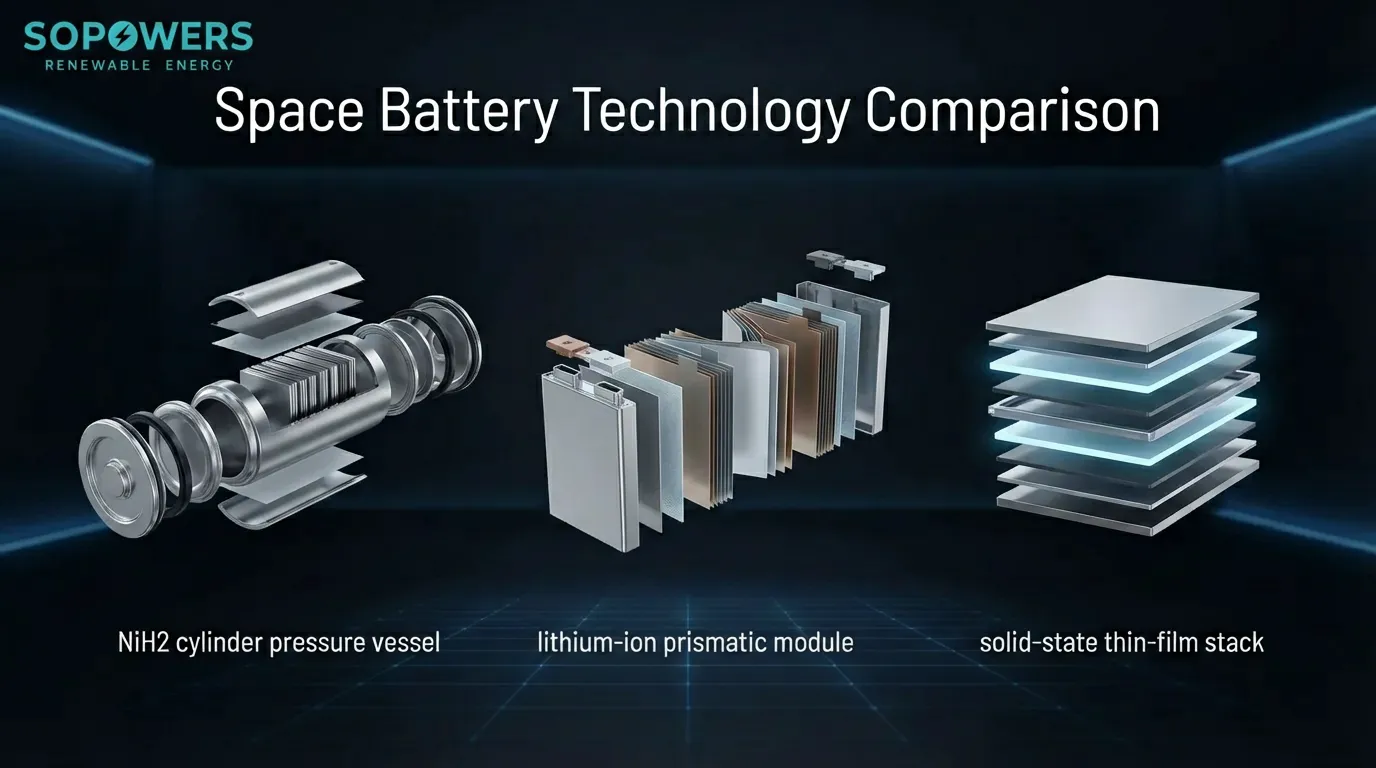
Nickel-hydrogen (NiH2) batteries: heritage reliability, low energy density
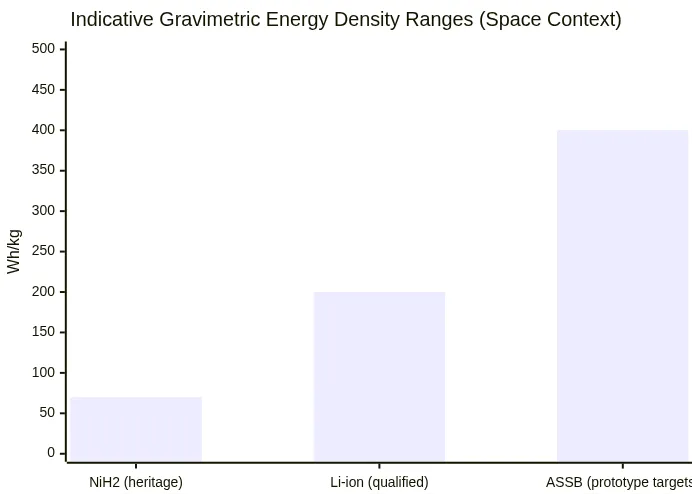
NiH2 batteries historically dominated many GEO communications satellites because they are robust and tolerate abuse well, with very strong cycle life heritage. The trade-off is energy density: roughly 60 to 80 Wh/kg is often cited, which is heavy in any launch economics discussion (see broader market context in Battery Tech Online’s space battery market insights).
Space-qualified lithium-ion batteries: the current standard, but with stricter rules
Over the last two decades, space-qualified lithium-ion battery solutions have displaced NiH2 for most new missions, largely because lithium-ion batteries deliver roughly 150 to 250 Wh/kg in flight-proven configurations, cutting mass dramatically. The cost is complexity: tighter thermal design, tighter voltage limits, and a more demanding BMS for reliability.
Within lithium-ion, lithium-polymer (LiPo) batteries (pouch format) are attractive for packaging flexibility and volumetric efficiency, but they demand careful mechanical protection, swelling/gas management planning, and disciplined thermal control in vacuum.
All-solid-state lithium-ion batteries (ASSB): promising, but not “next quarter”
All-solid-state lithium-ion batteries (ASSB) are a credible innovation path because a solid electrolyte can improve safety (no flammable liquid) and may enable higher energy density, with some analyses citing 300 to 500 Wh/kg potential in thin-film approaches over time (see Research and Markets on all-solid-state thin-film lithium-ion batteries). However, multiple reports also emphasize unresolved interface resistance, scale-up, and long-term cycling stability challenges, making broad satellite adoption more realistic in the 2030 to 2035 timeframe (see BIS Research on next-generation space batteries).
The real differentiator: BMS, thermal control, and reliability & redundancy design
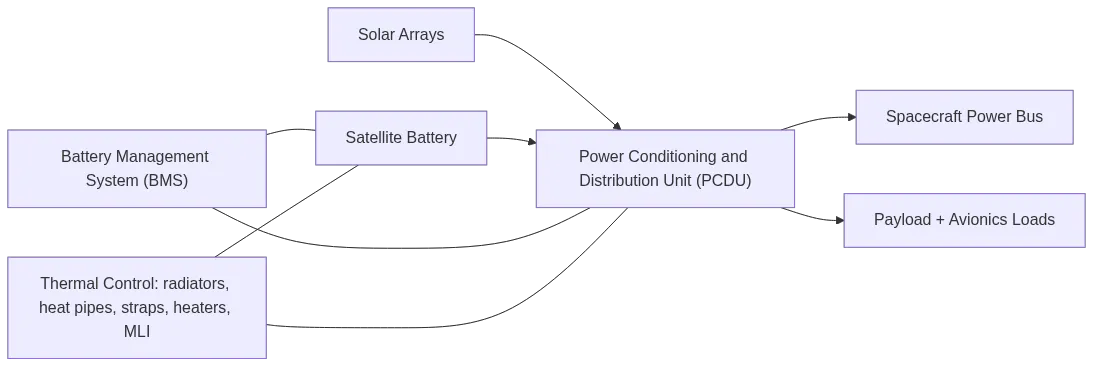
If chemistry is the foundation, integration is the mission saver. In space, a battery is inseparable from its satellite power system, including power conditioning, distribution, monitoring, and thermal hardware.
What the satellite power subsystem typically looks like
Below is a simplified view of how energy flows and where control loops live.
Space qualification and why it takes so long
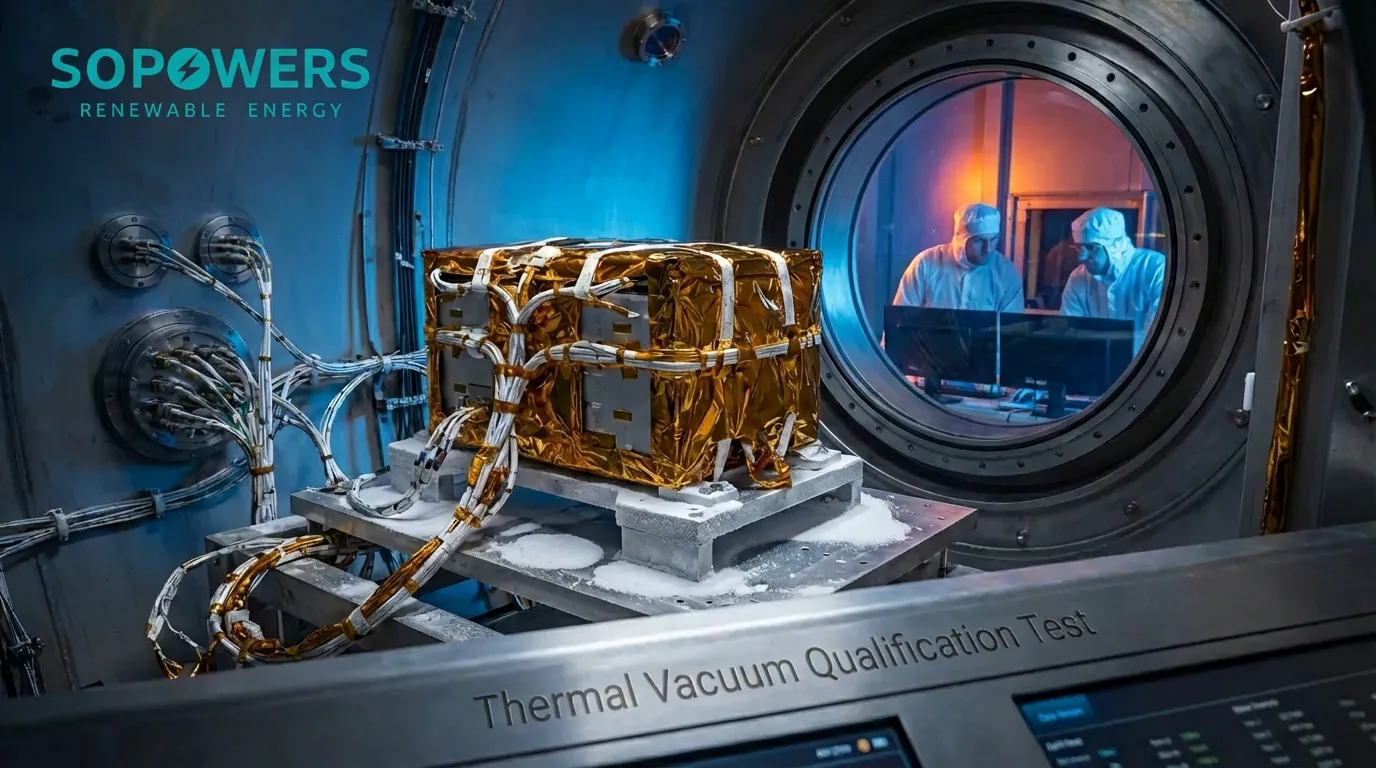
Space qualification (qualification testing) is not a single test. It is a campaign that typically includes:
- Thermal vacuum cycling to simulate vacuum and repeated temperature excursions.
- Vibration and shock to survive launch loads.
- Electrical characterization across temperature, plus long-duration cycle life and calendar life studies.
- Radiation testing (TID, and single-event effects for electronics).
This is why satellite programs are conservative with changes: even when a new cell looks better, proving it is better after thousands of eclipse cycles is a different problem than proving initial capacity.
What space battery thinking changes for industrial drone power buyers (and how Sopowers supports evidence-based packs)
Even if your product will never face TID or vacuum, space-driven engineering habits are increasingly relevant for high-reliability UAV programs: long-range mapping, BVLOS platforms, high-altitude cold environments, and payload-heavy missions where voltage stability and predictable degradation matter as much as peak discharge.
In my experience, the most transferable lessons are:
- Treat DOD as a design variable, not a marketing spec. Higher usable energy today can mean faster capacity loss tomorrow.
- Make thermal design explicit. If temperature cannot be controlled, cycle life claims are meaningless.
- Use a BMS for reliability, not just protection. Logging, balancing strategy, and fault handling are what turn cells into a system.
- Build around consistency screening. Variability between cells is often the hidden root cause of early pack failure.
Sopowers’ day-to-day business focuses on drone battery, LiPo battery, high discharge battery, low temperature battery, and high energy density battery supply for professional applications. The practical overlap with “space mindset” is the process discipline:
- Before delivery: solution matching and technical confirmation based on your application scenario (capacity, voltage, power rating, feasibility checks).
- During delivery: factory testing and consistency screening to support stable performance.
- After delivery: technical support and troubleshooting, including root-cause analysis and optimization recommendations.
If you are sourcing for a demanding UAV power project and want a pack that behaves predictably in real use (not just in a datasheet snapshot), start with a requirements-driven discussion.
Or reach the engineering team directly: Contact Us or Send Inquiry.


