

Winter icing pushes utility maintenance teams into one of the hardest UAV operating environments. Powerline and wind turbine de-icing missions combine heavy payloads, sustained hover, high current draw, gust response, and sub-zero temperatures. That is exactly why the right power system matters so much.
For buyers evaluating a powerline de-icing drone battery, the key question is not just nominal capacity. It is whether the pack can still deliver stable voltage, safe discharge, and predictable reserve margins when the mission shifts from a datasheet to an ice-covered asset in the field.
This guide explains how to choose the right battery architecture for powerline and wind turbine de-icing, what cold weather does to lithium systems, and how Sopowers approaches low-temperature UAV applications with transparent engineering and lifecycle support.
Why de-icing UAV missions are unusually demanding
De-icing drones are not flying simple photo missions. In real operations, they often need to:
- Carry mechanical tools, spray systems, heaters, or sensors.
- Hover close to conductors, towers, or turbine blades.
- Counter gusts and icing-related drag.
- Complete repeated sorties with fast turnaround.
- Maintain safe return reserves in low temperatures.
For powerline work, drones may approach conductors slowly, align precisely, and then hover or creep along the span while the tool breaks or removes ice. For wind turbine work, some platforms are tethered to ground power, while mobile battery-powered drones handle shorter, high-load passes.
That makes the ideal battery for these missions very different from a standard pack used in fair-weather inspection work.
What makes winter battery behavior harder to predict
Below 0 degrees C, lithium batteries experience higher internal resistance and slower ion transport. In practice, that means:
- Lower usable capacity.
- More voltage sag under load.
- Weaker peak power delivery.
- Greater risk of early low-voltage cutoff.
- Faster apparent flight-time loss under heavy payload conditions.
Industry guidance in winter UAV operations consistently points to pre-heating packs before flight, avoiding cold charging, and landing with larger reserves. In sub-zero field work, planning with a 30 percent to 40 percent reserve is often far safer than treating the battery like a summer pack.
How to select the right battery chemistry for de-icing drones
A wind turbine de-icing drone battery or powerline-focused pack should be selected around the actual mission profile, not around a headline spec. Chemistry choice affects energy density, low-temperature discharge, safety behavior, and life under repeated winter operations.
Quick chemistry comparison for de-icing applications
| Chemistry | Main advantage | Main limitation | Best fit in de-icing UAV work |
|---|---|---|---|
| LFP | High safety, stable abuse tolerance, long life | Lower energy density | Backup systems, robots, safety-first applications |
| NMC/NCA Li-ion | High energy density | Stronger cold sensitivity unless optimized | Main flight packs where endurance matters |
| Conventional LiPo | High discharge capability | Faster cold derating, less ideal in deep winter | Short high-power missions with tight thermal control |
| Low-temperature optimized Li-ion/LiPo | Better real winter output, discharge down to very low temperatures in specialized designs | Requires careful engineering and validation | Best overall choice for harsh winter industrial UAV missions |
Sopowers’ low-temperature portfolio is especially relevant here. According to the company’s published low-temperature battery materials, certain lines support discharge down to -50 degrees C and can retain around 70 percent usable capacity at -40 degrees C under specified conditions. For buyers comparing a cold weather drone battery against a standard industrial pack, this kind of data matters much more than nominal room-temperature capacity.
If you want to review Sopowers’ broader battery range first, you can jump to the product page. For background on low-temperature technology, Sopowers also explains the fundamentals in “What Are Low-Temperature Batteries and How Do They Work?” and in “Sopowers Low-Temperature Battery Solutions – Power That Survives the Extreme”.
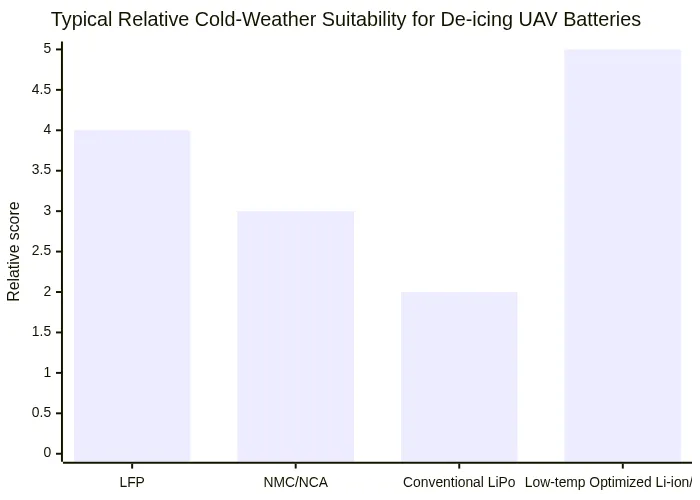
Practical rule: choose for winter output, not room-temperature marketing
For a low temperature UAV battery, ask suppliers for:
- Capacity retention at -10 degrees C, -20 degrees C, and -40 degrees C.
- The exact discharge rate used during testing.
- Cutoff voltage used for the published result.
- Peak and continuous current at low temperature, not just at 25 degrees C.
- Whether the pack requires pre-heating to achieve the claimed output.
If those details are missing, the published cold-weather claim is incomplete.

Mission-specific battery sizing for powerline and wind turbine de-icing
The best drone battery for powerline maintenance is not automatically the same as the best option for wind turbine de-icing. The mission shapes the battery.
1. Powerline de-icing: prioritize hover stability and reserve margin
Powerline de-icing missions typically involve:
- Repeated 10 to 20 minute sorties.
- Heavy continuous hover load.
- Close maneuvering near high-voltage assets.
- Gust compensation and fast transient power demand.
- Frequent battery swaps in cold conditions.
For this type of drone battery for powerline maintenance, buyers should prioritize:
- Strong low-temperature discharge performance.
- Enough continuous C-rate headroom to avoid excessive voltage sag.
- Stable pack consistency across fleet batteries.
- Reliable reserve planning, ideally landing with 30 percent to 40 percent remaining in winter operations.
A useful planning approach is to size around the worst-case segment, not the average mission. If the highest-load part of the sortie is hovering with the de-icing tool active, that segment should define the battery margin.
2. Wind turbine de-icing: distinguish tethered vs battery-powered systems
Wind turbine missions split into two common categories.
Tethered systems
- Battery is mainly for backup, transition, or controlled descent.
- Safety and reliability matter more than absolute energy density.
- Conservative design is often preferred.
Battery-powered mobile systems
- Need short, repeatable high-load flights.
- Benefit from high-capacity, low-temperature packs.
- Usually require more frequent swapping rather than oversized airframes.
For a wind turbine de-icing drone battery, the buyer should first decide whether the battery is the primary power source or a backup safety layer. That answer changes everything about pack sizing.
3. Mixed inspection plus de-icing missions
A UAV battery for infrastructure inspection and de-icing must support both efficient transit and demanding hover work. These mixed profiles often expose weak battery design because the pack must handle:
- Moderate-speed travel to site.
- Frequent camera and sensor adjustments during inspection.
- Hover-intensive payload use during treatment.
- Safe return despite colder, lower-voltage conditions late in the flight.
That is why industrial buyers should insist on mission-based validation, not only generic battery specs.
What Sopowers brings to de-icing battery projects
Sopowers is best positioned when the project needs solution matching, realistic performance validation, and post-delivery support rather than exaggerated headline claims. That approach aligns well with de-icing UAV work, where payload, voltage, discharge, and environment all interact.
Relevant Sopowers strengths for winter UAV operations
Based on the research report and Sopowers’ official content, the company can support de-icing programs with:
- Low-temperature battery solutions with discharge capability down to -50 degrees C in certain lines.
- High discharge battery options for demanding UAV power loads.
- High energy density battery configurations for endurance-driven platforms.
- Custom voltage and capacity matching for industrial UAV airframes.
- Factory testing and consistency screening before shipment.
- Post-delivery technical support and troubleshooting.
If your team is comparing a lithium battery for de-icing drones across multiple suppliers, Sopowers’ differentiation is not just chemistry. It is the engineering process around the pack.
Concrete reference 1: safety-focused LFP pack design
One notable Sopowers reference is the 15Ah-15S1P-48V AI robot battery pack:
- LFP chemistry.
- 5C rate capability.
- Designed with very high safety emphasis.
- Highlighted as resistant to explosion or fire even under severe impact conditions.
This matters because de-icing operations over critical infrastructure demand robust safety thinking. While not every flight pack will use LFP, the same system mindset applies to UAV battery design: conservative protection logic, strong mechanical structure, and application-based validation.
Concrete reference 2: 15-inch drone pack options with real flight data
Sopowers also provides a useful performance reference for a 15-inch drone platform using SPINR26105 10.9Ah cells:
| Configuration | Pack weight | Flight time | Compatible Platform | Total Weight | Payload |
|---|---|---|---|---|---|
| 12S2P | 3.59 kg | 19.47 min | 15-inch drone | 15 kg (frame + battery + payload) | 7.5 kg |
| 12S3P | 5.36 kg | 28 min | 15-inch drone | 15 kg (frame + battery + payload) | 7.5 kg |
This example is valuable because it shows a real trade-off that also applies to a high capacity drone battery cold weather project:
- The lighter 12S2P option supports better agility and lower pack mass.
- The 12S3P option extends endurance but increases battery weight.
- In winter, both figures must be derated for temperature and mission load.
A buyer looking for an industrial UAV battery for winter operations should ask for this kind of application-level comparison, not just a single theoretical runtime.
You can explore Sopowers’ general battery catalog through the product page and start a technical conversation through Contact Us.

A 6-point buyer checklist before choosing a de-icing UAV battery supplier
Here is a practical checklist for technical buyers, distributors, and integrators evaluating a powerline de-icing drone battery or related winter UAV solution.
1. Ask for temperature-based discharge data
Request:
- Capacity retention by temperature.
- Test C-rate.
- Cutoff voltage.
- Whether the pack was pre-heated.
2. Confirm continuous and peak current margins
A high discharge battery should have comfortable headroom above the expected operational load. If your mission needs around 3C continuous in winter, do not buy a pack with almost no buffer.
3. Verify pack-level thermal management
Check for:
- Pre-heating procedure.
- Insulation strategy.
- Temperature sensors.
- BMS protection logic.
4. Review documentation and export readiness
For distributors serving Europe and America, documents such as UN 38.3, MSDS, and transport-related compliance records are essential. Re-certification cost and time can become a major commercial bottleneck if SKUs are fragmented.
5. Ask about factory consistency screening
Cold-weather missions expose cell mismatch quickly. Sopowers emphasizes factory testing and consistency screening during delivery, which is important for stable fleet-level performance.
6. Confirm post-delivery support
If low-voltage alarms appear too early in the field, you need a supplier that can help analyze root causes from voltage sag, current draw, BMS behavior, and mission settings. Sopowers’ after-delivery support model is designed for that kind of troubleshooting and optimization.
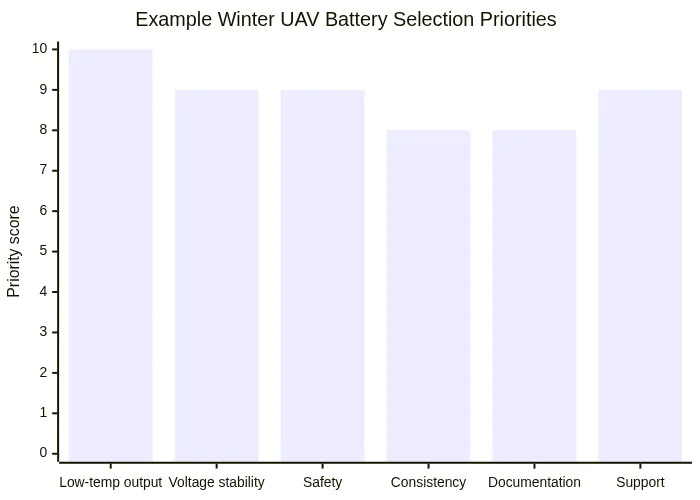
How Sopowers supports buyers from evaluation to deployment
For technical buyers, the battery itself is only part of the buying decision. The process around it often determines whether the project scales smoothly.
Sopowers’ service model for drone battery and low temperature battery projects includes:
- Before delivery: solution matching and technical confirmation based on application scenario, including capacity, voltage, power rating, and feasibility assessment.
- During delivery: factory testing and consistency screening to support stable performance.
- After delivery: technical support, troubleshooting assistance, root-cause analysis, and recommendations for optimization.
That is particularly relevant for applications such as a low temperature UAV battery, a drone battery for powerline maintenance, or a UAV battery for infrastructure inspection and de-icing, where real-world conditions can differ sharply from initial assumptions.
For more on low-temperature battery fundamentals, readers can also review Sopowers’ educational resources:
- “What Are Low-Temperature Batteries and How Do They Work?”
- “Sopowers Low-Temperature Battery Solutions – Power That Survives the Extreme”
Final takeaways
When choosing a powerline de-icing drone battery, the best supplier is rarely the one with the most aggressive headline spec. It is the one that can prove low-temperature performance under realistic load, match the pack to the airframe and mission, and support the project after deployment.
For winter utility work, focus on these fundamentals:
- Real low-temperature discharge capability.
- Adequate continuous and peak current margin.
- Safe reserve planning in sub-zero operations.
- Pack consistency across repeated sorties.
- Strong documentation and technical support.
Sopowers fits this requirement well by combining low-temperature battery capability, high discharge and high energy density options, application-based validation, and a structured support process from pre-sales matching through post-delivery troubleshooting.
If you are evaluating a cold weather drone battery, a wind turbine de-icing drone battery, or a custom industrial UAV battery for winter operations, the next step is simple: review the available solutions, then discuss your mission profile with the engineering team.


