

Battery choice is one of the most important decisions in any spraying drone program. The right agricultural drone LiPo battery affects coverage per sortie, turnaround speed, safety margin, battery rotation planning, and long-term operating cost. For distributors, integrators, and fleet operators, the challenge is not simply finding the biggest pack. It is selecting a battery system that matches payload, voltage architecture, current demand, field temperature, and daily work rhythm.
Most agricultural spraying platforms today rely on LiPo or related lithium chemistries because spraying missions combine heavy payloads, frequent takeoffs, sustained load, and tight turnaround windows. In practical terms, a poorly matched battery can reduce area coverage, increase swap frequency, raise overheating risk, and force larger battery inventories. A well-matched solution improves field productivity and lowers avoidable downtime.
If you are evaluating tailored drone battery solutions for spraying platforms, you can explore the Sopowers product portfolio first, then use the selection framework below to narrow the right configuration.
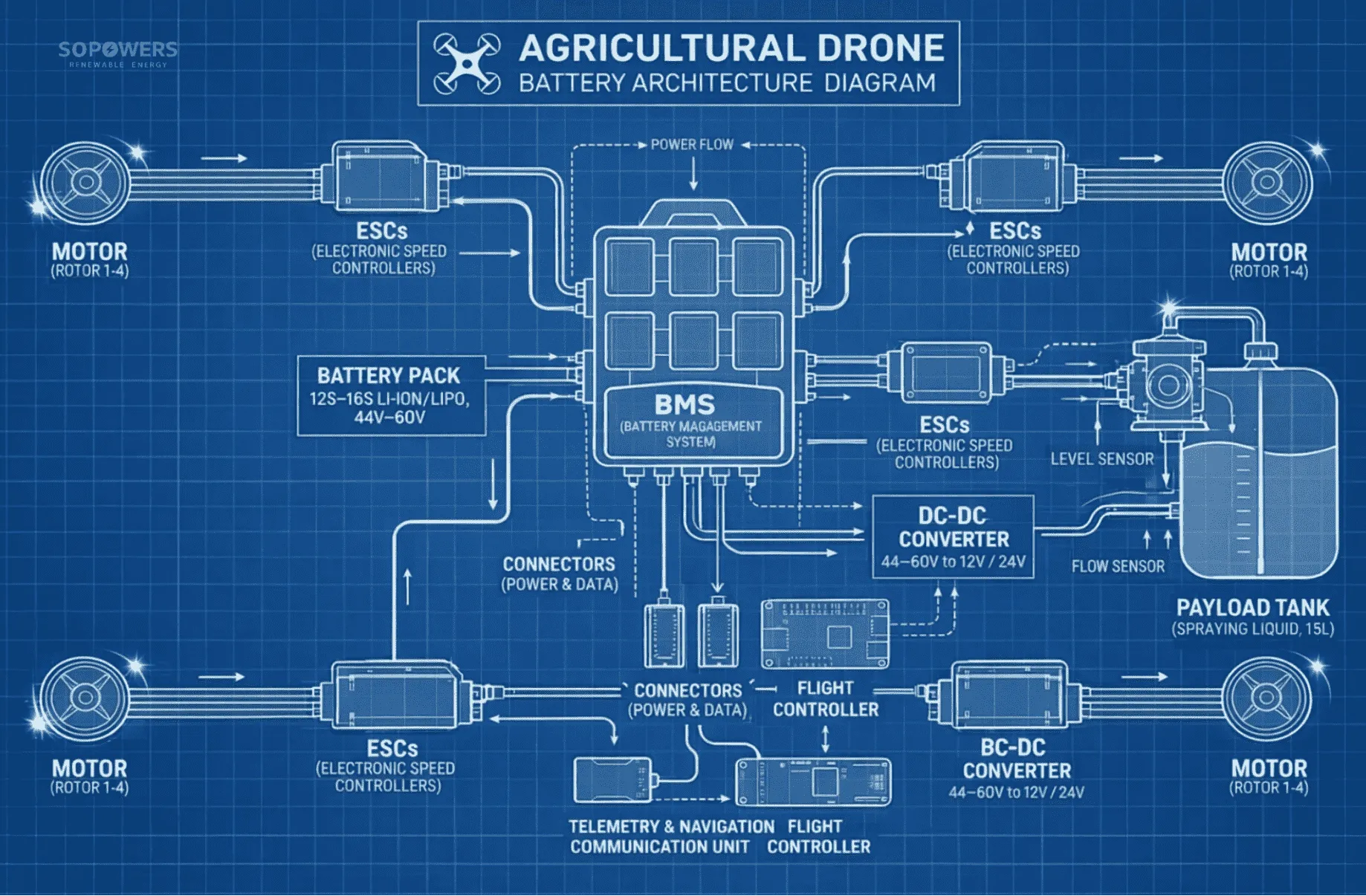
Why battery selection is a strategic issue for spraying drones
Agricultural spraying drones typically operate in 10 L, 20 L, and 30 L plus payload classes. As payload rises, the battery is asked to do more than deliver endurance. It must also provide strong discharge performance during full-tank takeoff, maintain voltage stability through sustained spraying, and tolerate repeated charge-discharge cycles in dusty, humid, and temperature-variable conditions.
Typical market references show that many spraying platforms use 12S to 16S systems, and in some cases even higher-voltage architectures, with capacities often in the 20 Ah to 50 Ah range. Real flight time for loaded spraying missions commonly falls around 10 to 30 minutes depending on payload, route, wind, and flight style. That means the agricultural spraying drone battery directly controls how often operators must land, refill, and swap packs.
This is why agriculture drone battery selection should be approached as both an engineering and operations decision. The battery influences:
- Flight time per sortie.
- Total takeoff weight and usable liquid payload.
- Peak-current headroom during climb and maneuvering.
- Number of battery sets required per drone.
- Charger and generator sizing in the field.
- Safety, maintenance, and replacement cost over time.
For a useful foundation, Sopowers also explains what a drone battery is and how it affects flight time, which supports the basic calculations discussed here.
The 5 battery parameters that matter most in agricultural UAVs
Choosing a UAV battery for agricultural spraying starts with five practical parameters.
1. Voltage and S-count
Voltage must match the drone platform, motor, and ESC design. Heavy-lift agricultural drones often use 6S, 8S, 12S, 13S, 14S, or 16S systems, with 12S being common for larger multi-rotor platforms because higher voltage reduces current at the same power level. Lower current means less stress on connectors, cabling, and power electronics.
2. Capacity and usable energy
Capacity is measured in Ah, while energy is measured in Wh.
Formula:
Energy = Voltage x Capacity
For example, a 12S 22 Ah pack is about 44.4 V x 22 Ah = 976.8 Wh nominal. In practice, not all of that energy is comfortably usable under real field conditions, especially under heavy load or in cold weather.
3. C-rate and current capability
This is critical for the best battery for spraying drones because crop protection missions are power-intensive. Maximum continuous current is estimated by:
Current capability = Capacity x C-rate
A 22 Ah pack rated at 20C theoretically supports 440 A. In the real world, engineering margin matters. Current capability should exceed actual demand comfortably, especially when battery aging and temperature effects are considered.
4. Battery weight versus payload
A high capacity battery for crop spraying drones can improve endurance, but it also adds mass. More battery weight may reduce allowable liquid payload or reduce efficiency gains. The goal is not maximum capacity in isolation. The goal is the best productivity balance.
5. Cycle life and environmental fit
Spraying operations often involve repeated daily charging, hot midday conditions, or cold early-morning starts. That makes chemistry choice, thermal behavior, and pack consistency highly important.
The table below summarizes the key metrics to review.
| Parameter | Why it matters | Typical importance in spraying drones |
|---|---|---|
| Voltage | Matches powertrain and reduces current losses | Very high |
| Capacity | Determines stored energy and sortie duration | Very high |
| C-rate | Supports full-load takeoff and sustained discharge | Very high |
| Weight | Affects payload and total takeoff weight | Very high |
| Cycle life | Influences replacement rate and TCO | High |
| Temperature performance | Affects cold-start and hot-weather reliability | High |
| Safety design | Reduces failure risk in harsh field use | Very high |
LiPo vs. Li-ion vs. LiFePO4: which chemistry fits best?
For most agricultural UAV power battery applications, LiPo remains the default choice because it balances power output and energy density well for loaded multi-rotor spraying. Still, it is important to compare the main chemistry options transparently.
| Chemistry | Pack energy density | Continuous discharge | Typical cycle life | Main advantage | Main limitation |
|---|---|---|---|---|---|
| LiPo | About 160 to 220 Wh/kg | About 15C to 50C | About 300 to 500 cycles | High power capability | Lower cycle life and stricter care needs |
| Cylindrical Li-ion | About 180 to 260 Wh/kg | About 5C to 15C | About 500 to 1,000 plus cycles | Better endurance potential | Lower peak power for heavy spray loads |
| LiFePO4 | About 100 to 160 Wh/kg | About 10C to 20C | About 2,000 to 5,000 cycles | Excellent safety and longevity | Heavier for the same energy |
In most full-load spraying missions:
- LiPo is often the strongest fit for high power, high payload, and repeated short sorties.
- Li-ion can be attractive for long flight time battery for agriculture drones when current demand is moderate and endurance matters more than peak thrust.
- LiFePO4 is best considered where safety and cycle life outweigh strict weight constraints.
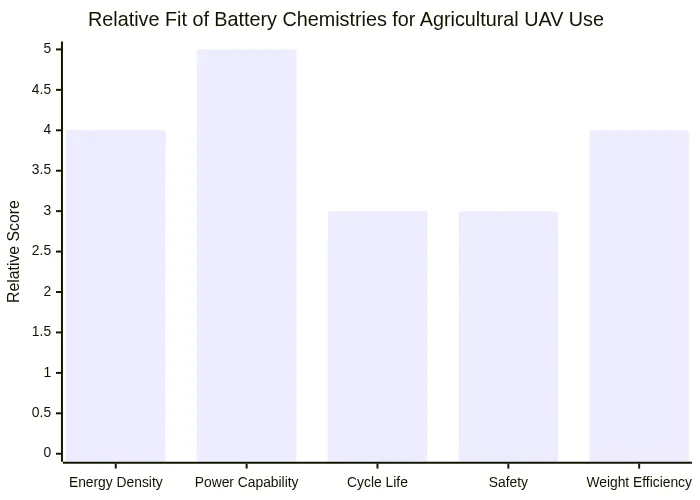
A more advanced selection process should also consider field temperature. Sopowers has published a comprehensive guide to choosing drone batteries by type and application, which is useful when comparing different mission profiles.
A practical 6-step framework for agriculture drone battery selection
The simplest way to approach agriculture drone battery selection is to use a step-by-step checklist.
Step 1: Confirm platform limits
Start with the drone’s actual powertrain requirements:
- Supported voltage range.
- Motor and ESC current limits.
- Propeller size and thrust targets.
- Maximum total takeoff weight.
Step 2: Define the mission clearly
Battery sizing depends on how the drone works in the field:
- 10 L, 20 L, or 30 L plus tank class.
- Target spray time per sortie.
- Wind exposure and terrain complexity.
- Daily coverage target.
- Number of sorties expected per day.
Step 3: Estimate energy demand
A useful rule of thumb referenced by Sopowers is:
Flight time approximately = Capacity x Voltage x 0.8 / Power x 60
This gives a theoretical baseline, not a guaranteed field result. Real agricultural loads often reduce practical flight time.
Step 4: Check discharge margin
For any lithium battery for agricultural UAV use, continuous current headroom should be conservative. A battery may look sufficient on paper but still sag under cold temperatures, aging, or repeated high-load cycles.
Step 5: Compare weight against productivity
A real Sopowers benchmark shows how battery scaling changes outcomes on a large drone platform using SPINR26105 10.9 Ah cells for a 15-inch drone with 7.5 kg payload and 14 kg total takeoff weight:
| Configuration | Battery weight | Flight time |
|---|---|---|
| 12S2P | 3.59 kg | 19.45 min |
| 12S3P | 5.36 kg | 28 min |
This comparison is especially useful for spraying drone buyers. Moving from 12S2P to 12S3P added about 1.77 kg and improved flight time by about 8.55 minutes. In a spraying drone, that extra weight might otherwise be available for liquid payload. This is the central trade-off in any high capacity battery for crop spraying drones decision: more endurance per sortie versus more payload per sortie.
Step 6: Include temperature, safety, and certification
Cold dawn missions, hot summer fields, transport requirements, and export certification can all change the final battery decision. This is where supplier engineering support becomes important.

Real-world expectations: what a good spraying drone battery should deliver
A good agricultural drone LiPo battery should not be judged only by headline capacity or C-rate. It should deliver stable, repeatable performance across an actual workday. Technical buyers should expect the following from a well-designed system:
- Realistic and testable performance claims.
- Stable voltage behavior under sustained load.
- Good cell consistency across the pack.
- Mechanical robustness for vibration and field handling.
- Reliable charging behavior and manageable thermal rise.
- Support for the target operating temperature range.
Typical loaded sortie time for many 10 L to 30 L class sprayers falls in the approximate 10 to 25 minute range, though larger or more efficient systems can go beyond that under suitable conditions. The right agricultural spraying drone battery is the one that achieves predictable field productivity, not the one with the most aggressive spec sheet.
This is also where Sopowers’ approach stands out. Before delivery, the team provides solution matching and technical confirmation based on the application scenario, including capacity, voltage, power rating, and feasibility assessment. During delivery, all batteries undergo factory testing and consistency screening to support stable performance. After delivery, Sopowers provides technical support and troubleshooting assistance to help identify root causes and optimize use in the field.
Safety, reliability, and total cost matter more than headline specs
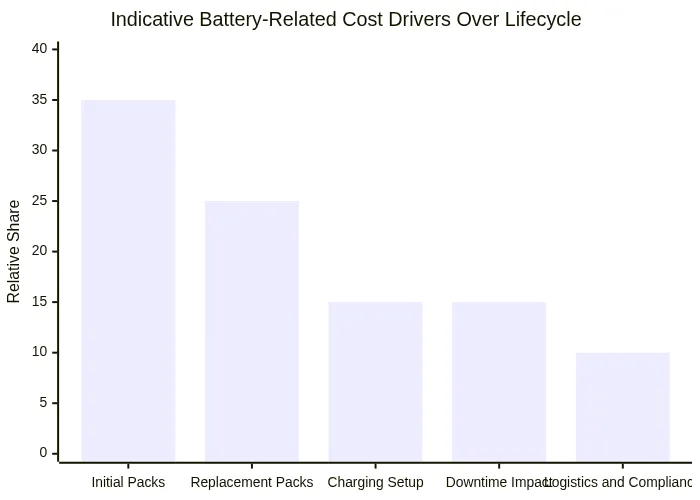
For battery distributors and industrial drone buyers, one of the biggest industry problems is exaggerated performance claims. That is why total cost of ownership should be part of every evaluation.
Battery-related costs include:
- Initial pack purchase.
- Spare and rotation inventory.
- Charger and field energy infrastructure.
- Downtime from overheating, imbalance, or early failure.
- Replacement frequency based on actual cycle life.
- Certification and shipping complexity.
Safety should also be reviewed through engineering evidence, not just marketing language. A relevant Sopowers cross-application example is its AI robot battery pack, specified as 15Ah-15S1P-48V LiFePO4 with a 5C rate. The pack is highlighted for very high safety and is designed not to explode or catch fire even when impacted at 120 km/h. While that product serves a different application, it demonstrates Sopowers’ conservative safety mindset and mechanical robustness in battery design.
For operators already seeing issues such as voltage sag, overheating, reduced flight time, or swelling, Sopowers also provides guidance on how to troubleshoot drone battery issues in the field.
How Sopowers supports agricultural drone battery projects
For technical buyers, the value of a battery supplier is not just in the pack itself. It is in the process behind the pack. Sopowers positions itself around solution matching, realistic performance, and full-process support.
Key strengths relevant to agricultural UAV projects include:
- Focus on drone battery, lipo battery, high discharge battery, low temperature battery, and high energy density battery solutions.
- Tailored technical validation based on application scenario.
- Assessment of capacity, voltage, power rating, and feasibility before production.
- Factory testing and consistency screening before shipment.
- Post-sales troubleshooting and optimization support.
- Experience across demanding UAV and robotics applications.
- Professional export support for multi-market battery projects.
For distributors and integrators, this matters because performance uncertainty, local compliance requirements, and replacement cost can all erode margins if the battery choice is wrong.
If you want to discuss a specific agricultural UAV power battery requirement, you can contact the Sopowers engineering team for configuration review and technical matching.
Operational checklist for better battery life in spraying work
A good battery selection still needs good field practice. The checklist below helps protect cycle life and reduce in-season failures.
| Stage | Best practice |
|---|---|
| Before flight | Inspect for swelling, damage, connector looseness, and cell imbalance |
| Cold operation | Pre-warm packs when needed before takeoff |
| During mission | Set return thresholds with reserve capacity, usually around 20 percent to 30 percent |
| Between flights | Let packs cool before charging again |
| Charging | Use proper balance charging and follow manufacturer limits |
| Storage | Keep packs around storage voltage, typically 40 percent to 60 percent state of charge |
| Rotation | Label and rotate packs evenly across the fleet |
| Replacement | Retire packs showing abnormal sag, swelling, or overheating |
These practices support longer service life and more predictable field output, especially when several battery sets are rotated daily.
In summary, the right battery for a spraying drone is rarely the lightest, largest, or cheapest option in isolation. The best choice is the one that matches the drone’s voltage architecture, current demand, payload class, environmental conditions, and business model. For many heavy-load applications, the agricultural drone LiPo battery remains the practical standard because it delivers the power capability needed for loaded spraying sorties. But the final decision should still weigh endurance, weight, safety, and total cost over time.
Sopowers supports this process with tailored solution matching, technical confirmation, factory testing, consistency screening, and post-sales troubleshooting. If you are comparing options for a new platform or fleet rollout, start by reviewing the Sopowers drone and battery portfolio, then send an inquiry for tailored battery solutions to discuss your project requirements.


