
Selecting the right aerial photography drone battery is no longer a simple matter of choosing the highest mAh number on a label. For technical buyers, UAV integrators, and battery distributors, the battery directly determines flight time, payload flexibility, voltage stability, safety margin, and logistics feasibility.
In real aerial filming work, advertised endurance numbers often look better than field results. A camera drone battery that seems ideal in a catalog may lose meaningful runtime once payload, wind, temperature, and aggressive flight profiles are added. That gap between specification and mission reality is where battery selection becomes an engineering decision rather than a purchasing shortcut.
This guide outlines how to evaluate an aerial photography drone battery for professional filming platforms, with practical comparisons, sizing logic, and real application data from the research report.
1. Why an aerial photography drone battery determines real mission performance
An aerial photography drone battery affects far more than airborne minutes. In professional filming, it influences the entire platform behavior:
- Flight time and usable shooting window
- Payload capacity for camera, gimbal, lens, and transmission systems
- Voltage stability during climbs, braking, and tracking shots
- Thermal performance in hot urban environments or cold-weather operations
- Certification and transport readiness for cross-border delivery
For smaller consumer and prosumer platforms, a smart camera drone battery often prioritizes convenience, BMS integration, and user safety. For heavier professional UAVs, the battery becomes a central design variable that must balance watt-hours, discharge capability, pack weight, and operating conditions.
A useful way to think about selection is this: the best drone battery for aerial photography is not the pack with the biggest label value, but the one that delivers the required energy and current within the real payload and safety limits of the aircraft.
You can also review Sopowers’ technical background on drone battery fundamentals and their guide on how to choose drone battery configurations.
| Battery factor | Why it matters in filming missions | Typical risk if underspecified |
|---|---|---|
| Energy capacity | Extends sortie time and shot count | Early landing, interrupted takes |
| Voltage platform | Lowers current for the same power | Higher losses, hotter wiring |
| Discharge capability | Handles throttle spikes and wind correction | Voltage sag, unstable flight behavior |
| Weight | Affects thrust demand and payload margin | Reduced net payload or poor endurance gain |
| Thermal behavior | Protects performance in heat or cold | Capacity drop, shortened cycle life |
| Certification support | Enables legal shipping and market access | Delays, re-testing costs |
2. How to compare aerial photography drone battery chemistries and pack architectures
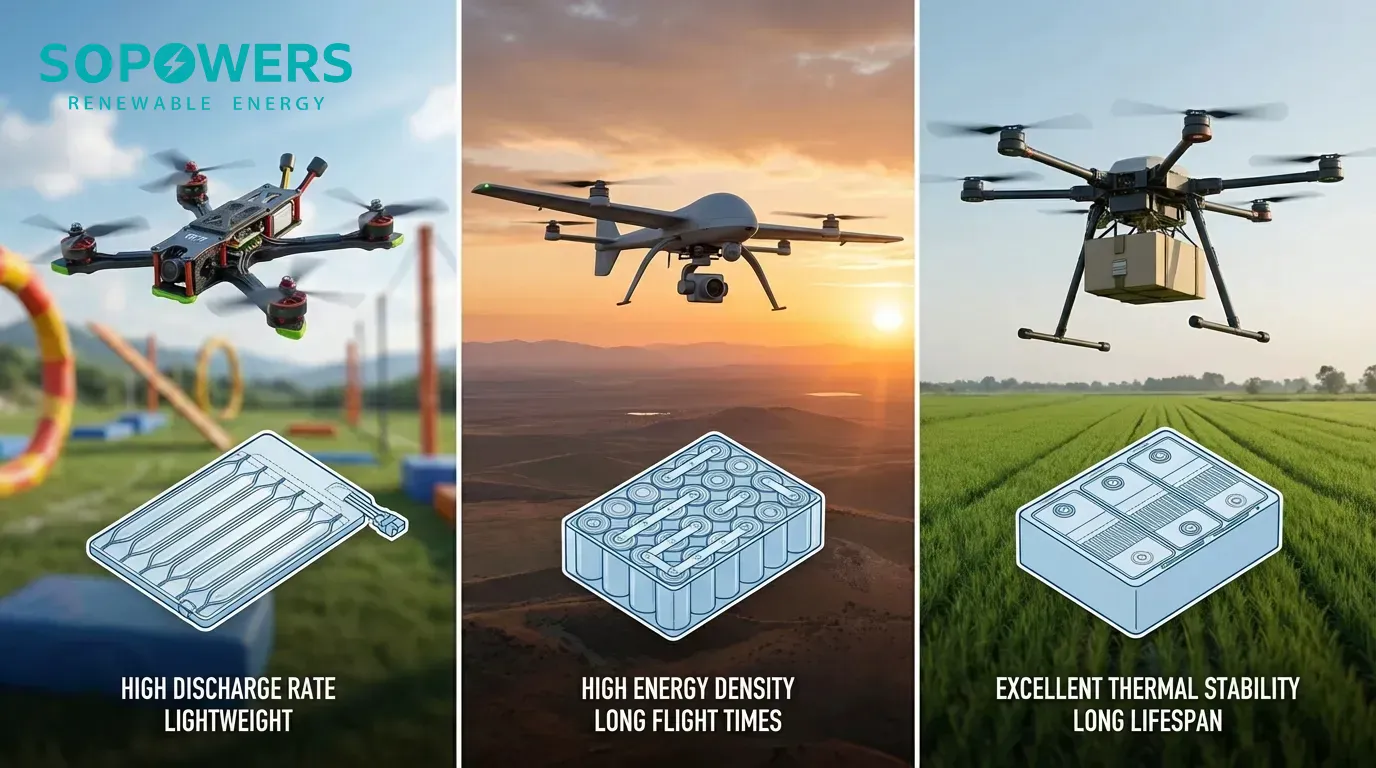
The most common options for an aerial photography drone battery are LiPo, Li-ion, and LiFePO4. Each has a distinct role depending on whether the priority is discharge, endurance, or safety.
LiPo
LiPo remains the standard for high response and higher discharge demand. It is widely used where punch, agility, and fast power delivery matter, especially for dynamic filming profiles.
Best fit:
- FPV chase drones
- Cinewhoops
- Mid-sized filming drones needing rapid throttle response
Typical strengths:
- Strong discharge capability
- Flexible pack shape
- Good fit for high discharge battery applications
Trade-offs:
- Lower effective cycle life under hard use
- More careful handling requirements
- Greater stress sensitivity than LiFePO4
Li-ion
Li-ion is often the strongest choice for a long flight time camera drone battery when the system has moderate current demand and values higher energy density.
Best fit:
- Professional filming UAVs
- Mapping and inspection platforms with camera payloads
- High capacity UAV battery for filming applications
Typical strengths:
- Strong energy density
- Better cycle life than high-stress LiPo
- Good balance of endurance and stable delivery when correctly sized
Trade-offs:
- Lower peak C-rate than aggressive LiPo packs
- Requires proper sizing to avoid sag under transient load
LiFePO4
LiFePO4 is heavier for the same energy, but excels in safety and stability. In aerial applications, it is usually chosen only when safety margin outweighs flight-time sensitivity.
Best fit:
- Training and education platforms
- Specialized high-safety systems
- Ground and robot applications sharing battery design philosophy
A useful safety benchmark from the research report is the 15Ah, 15S1P, 48V AI robot battery pack using LiFePO4 chemistry. It delivers a 5C rate and was validated not to explode or catch fire even under a 120 km/h impact. While that pack is not a filming UAV battery, it demonstrates the level of validation possible when safety is engineered as a priority.
| Chemistry | Typical use in aerial photography | Key advantage | Main trade-off |
|---|---|---|---|
| LiPo | Dynamic filming, FPV, responsive camera platforms | High discharge capability | Lower cycle life under stress |
| Li-ion | Professional filming and endurance UAVs | Better energy density balance | Lower peak current than LiPo |
| LiFePO4 | High-safety specialized systems | Excellent thermal stability and safety | Higher weight for same Wh |
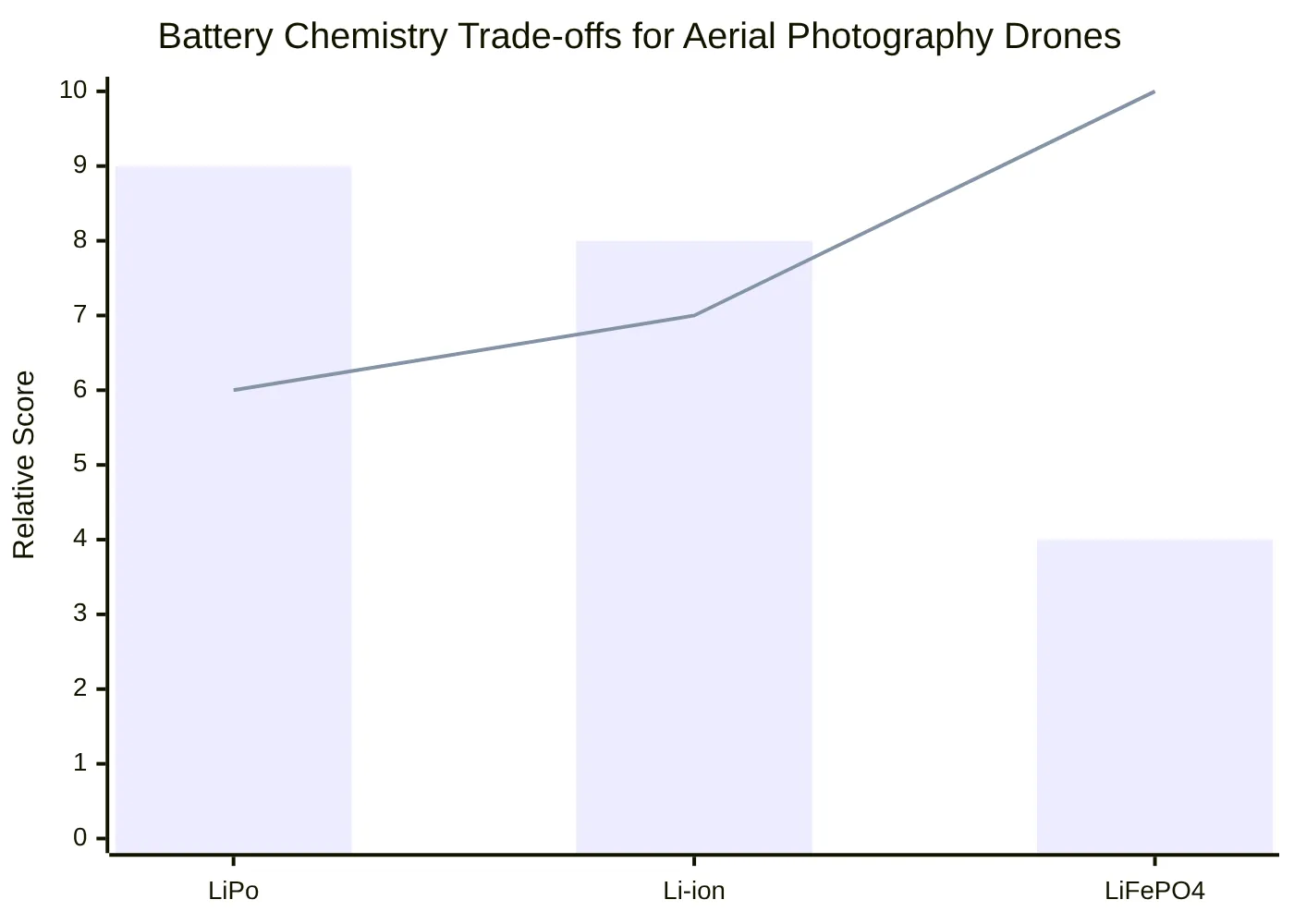
In the chart above, the bar series can be read as power and energy suitability for filming use, while the line series reflects relative safety. It illustrates why LiPo and Li-ion dominate most aerial photography drone battery decisions, while LiFePO4 is reserved for cases where safety is the primary design constraint.
For related application context, Sopowers also covers low-temperature battery engineering and broader high-performance drone battery solutions.
3. How to size an aerial photography drone battery for flight time, payload, and voltage stability
Battery sizing should begin with mission profile, not with a catalog list. For a drone battery for aerial photography, the main questions are:
- How long must the effective filming window be?
- What is the total payload mass?
- What current peaks will the aircraft see?
- What reserve state of charge is required for safe landing?
A simple starting formula is:
Flight time approximately equals usable energy in Wh divided by average power draw in W.
In practice, usable energy is always lower than label energy because professional operators preserve reserve capacity and avoid deep discharge.
Real case: 12S2P vs 12S3P for a 15-inch filming drone
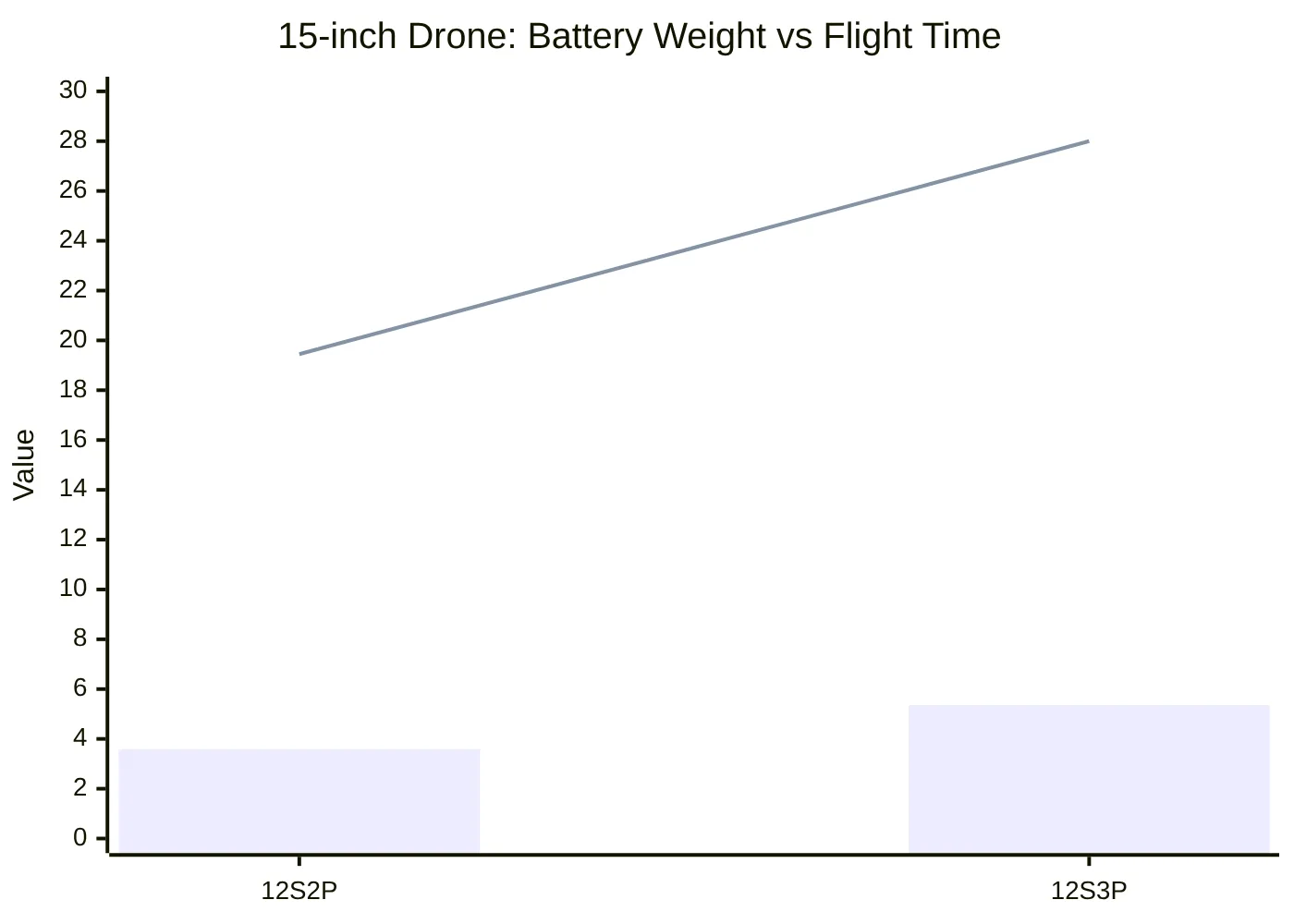
The research report provides a strong example using SPINR26105 10.9Ah cells on a 15-inch drone carrying a 7.5 kg payload with a 14 kg total takeoff weight.
| Configuration | Battery weight | Flight time | Best fit |
|---|---|---|---|
| 12S2P | 3.59 kg | 19.45 min | Shorter missions, more payload flexibility |
| 12S3P | 5.36 kg | 28 min | Longer continuous shooting and stronger reserve margin |
The 12S3P option adds about 1.77 kg but gains roughly 8.55 minutes of flight time. That is a meaningful increase for complex cinematography work, especially when battery swap opportunities are limited.
For selection:
- Choose 12S2P when payload flexibility matters most and missions are short.
- Choose 12S3P when long takes, fewer landings, and stronger reserve planning matter more.
This is exactly where a professional drone battery pack should be matched to the aircraft and use case rather than purchased on advertised capacity alone.
Why voltage stability matters as much as flight time
A battery for filming drones must tolerate current spikes from:
- Rapid climb-outs
- Sudden braking
- Lateral tracking moves
- Gust compensation around buildings or coastal wind corridors
If internal resistance is too high, voltage sag can trigger low-voltage alarms early, reduce effective flight time, or in extreme cases create brownout risk for control and payload systems. A high discharge battery with low internal resistance helps maintain predictable system behavior through demanding maneuvers.
4. Why aerial photography drone battery temperature, safety, and certification cannot be ignored
Cold weather and logistics requirements often break projects before battery capacity does.
Temperature performance
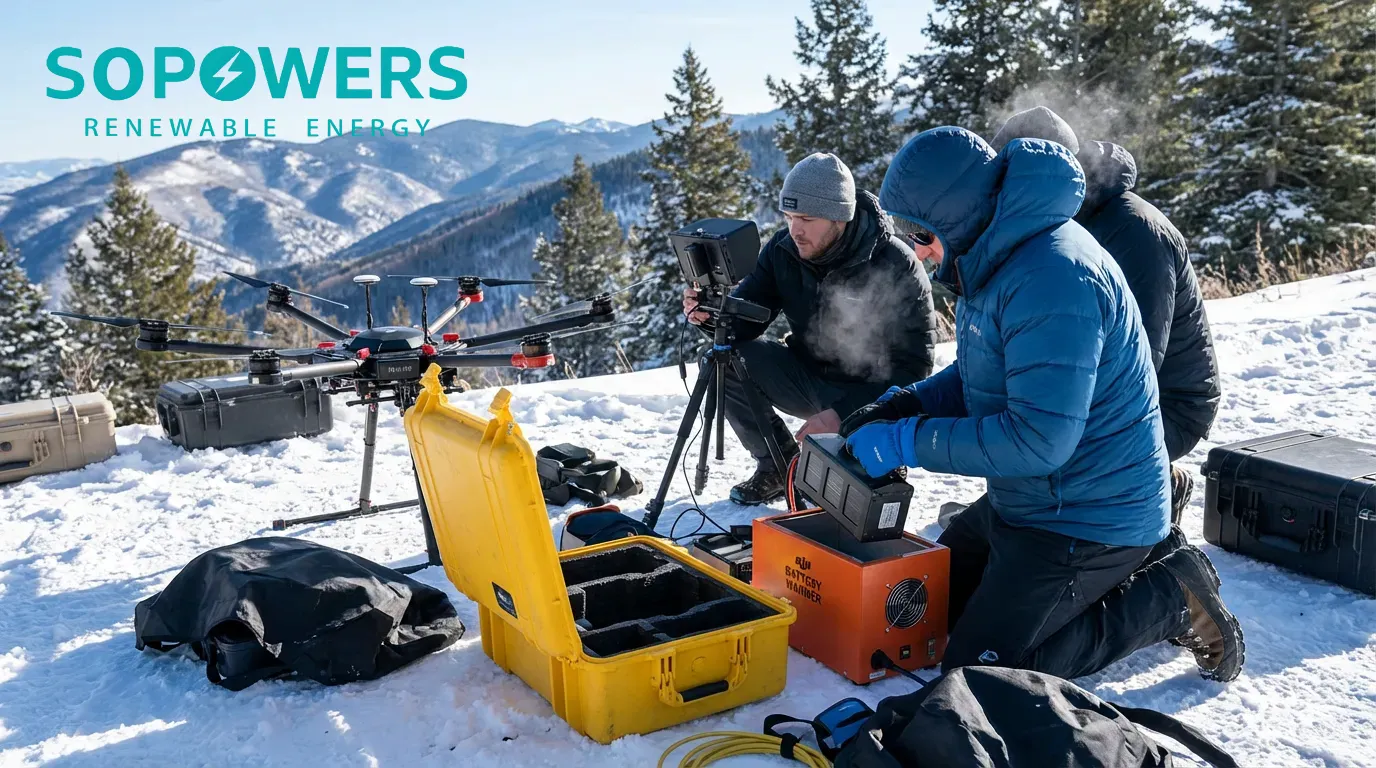
Standard LiPo and Li-ion packs can lose substantial usable capacity at low temperatures. Around 0 C and below, operators often see shorter flight times, higher internal resistance, and more voltage sag. That makes low temperature battery design highly relevant for year-round filming, mountain work, and winter operations.
The research report highlights a practical comparison:
- Standard cells may retain only about 40 percent of room-temperature capacity at -20 C under realistic conditions.
- Engineered low-temperature cells may retain around 70 percent under the same conditions.
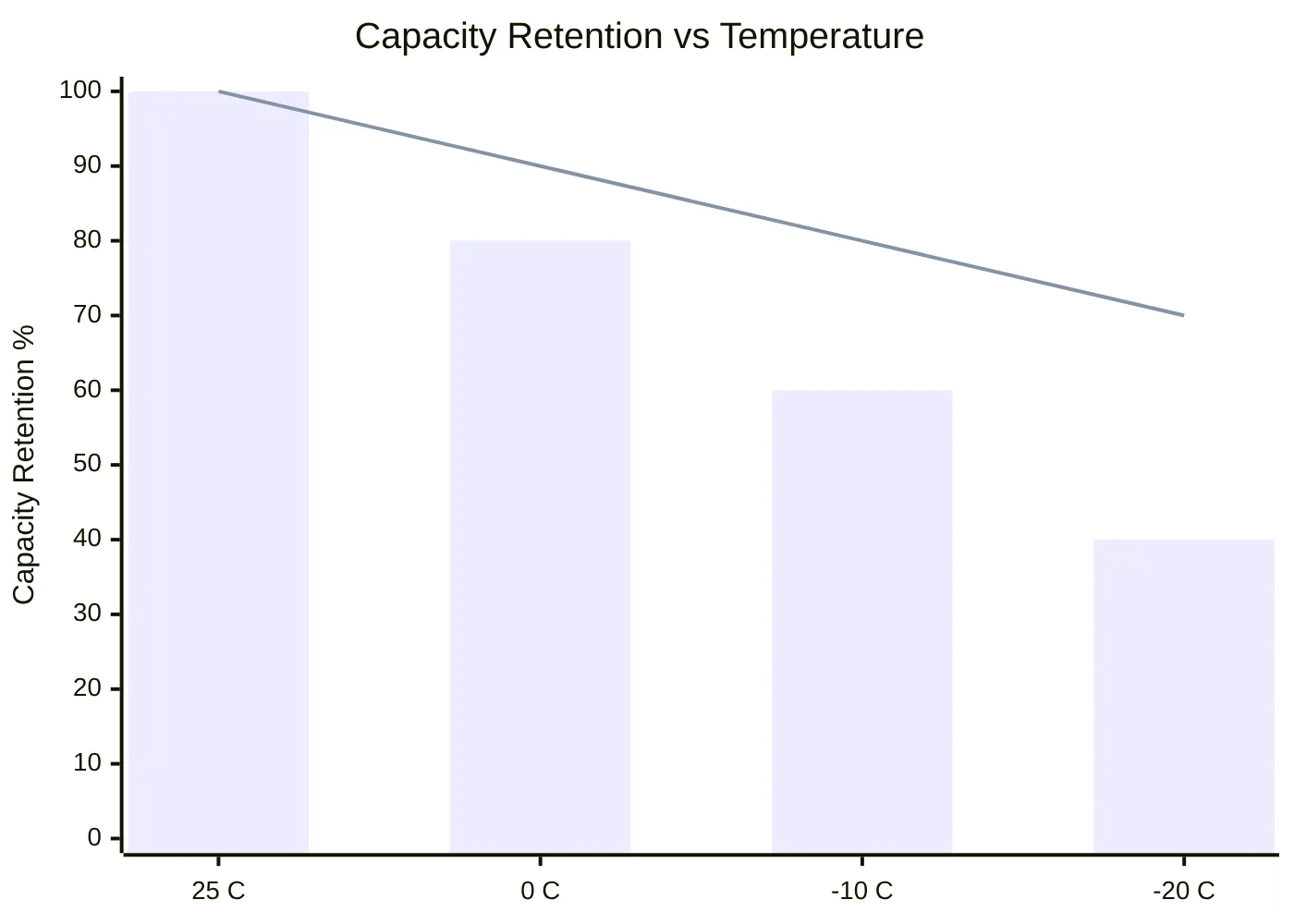
This is why a UAV battery for aerial photography should be evaluated against the actual filming climate, not only laboratory room-temperature ratings.
Safety and validation
For a lithium battery for aerial filming drones, safety includes:
- Electrical protection
- Mechanical robustness
- Thermal design
- Consistent cell matching
- Controlled manufacturing and testing
A professional supplier should not rely on marketing claims alone. According to the client requirements, Sopowers emphasizes:
- Solution matching before delivery, including capacity, voltage, power rating, and application feasibility confirmation
- Factory testing and consistency screening during delivery
- Technical support and troubleshooting after delivery
This approach directly addresses a major market pain point: buyers often do not know whether performance claims are realistic until they complete their own field testing.
Certification and transport
Aerial photography battery procurement also depends on compliance support. The report identifies these key frameworks:
- UN38.3 certification overview
- UN38.3 testing summary from Intertek
- IATA lithium battery shipping guidance
For distributors and OEM buyers, documentation quality matters almost as much as pack quality. Re-certification delays, incomplete paperwork, and poor shipment preparation can disrupt launch schedules and inventory planning.
5. How to choose the best aerial photography drone battery with a practical supplier checklist
To choose the right aerial photography drone battery, technical buyers can use the following shortlist.
Selection checklist
- Define the filming mission clearly
- Hover-heavy cinematic work
- Dynamic chase shots
- Long continuous takes
- Cold-weather or hot urban operation
- Confirm aircraft electrical architecture
- Required voltage platform
- Peak and continuous current
- ESC and connector compatibility
- Match chemistry to use case
- LiPo for response and high discharge
- Li-ion for endurance and high energy density battery goals
- LiFePO4 only where safety dominates weight concerns
- Size for real, not advertised, endurance
- Keep landing reserve
- Consider payload growth
- Validate expected power draw from flight logs if available
- Check environment and storage conditions
- Need for low temperature battery capability
- Thermal management in airframe
- Storage voltage and transport handling
- Evaluate supplier process
- Application-specific solution matching
- Cell screening and consistency testing
- Batch traceability and documentation support
- After-sales troubleshooting capability
What Sopowers brings to the process
Based on the research report and client inputs, Sopowers positions itself as a technical partner rather than a simple catalog seller. Their workflow includes:
- Pre-delivery solution matching and technical confirmation
- Tailored assessment of capacity, voltage, power rating, and application feasibility
- Factory testing and consistency screening for stable performance
- Post-delivery technical support and root-cause analysis
- Support across drone battery, lipo battery, high discharge battery, low temperature battery, and high energy density battery solutions
For buyers evaluating options, these resources are the most relevant next steps:
You may also find these related Sopowers articles useful during evaluation:
- What Is Drone Battery and How to Instantly Improve Your Flight Time
- How to Choose Drone Battery: 2025 Comprehensive Guide for Every Drone Type
- How to Troubleshoot Drone Battery Issues
- What Are Low Temperature Batteries and How Do They Work
- High-Performance Drone Batteries for Major Brands
In summary, the right aerial photography drone battery is the one that meets mission time, payload demand, voltage stability, environmental conditions, and compliance requirements with realistic margins. For technical buyers, that usually means choosing a supplier that can validate the whole application, not just ship a pack.


