
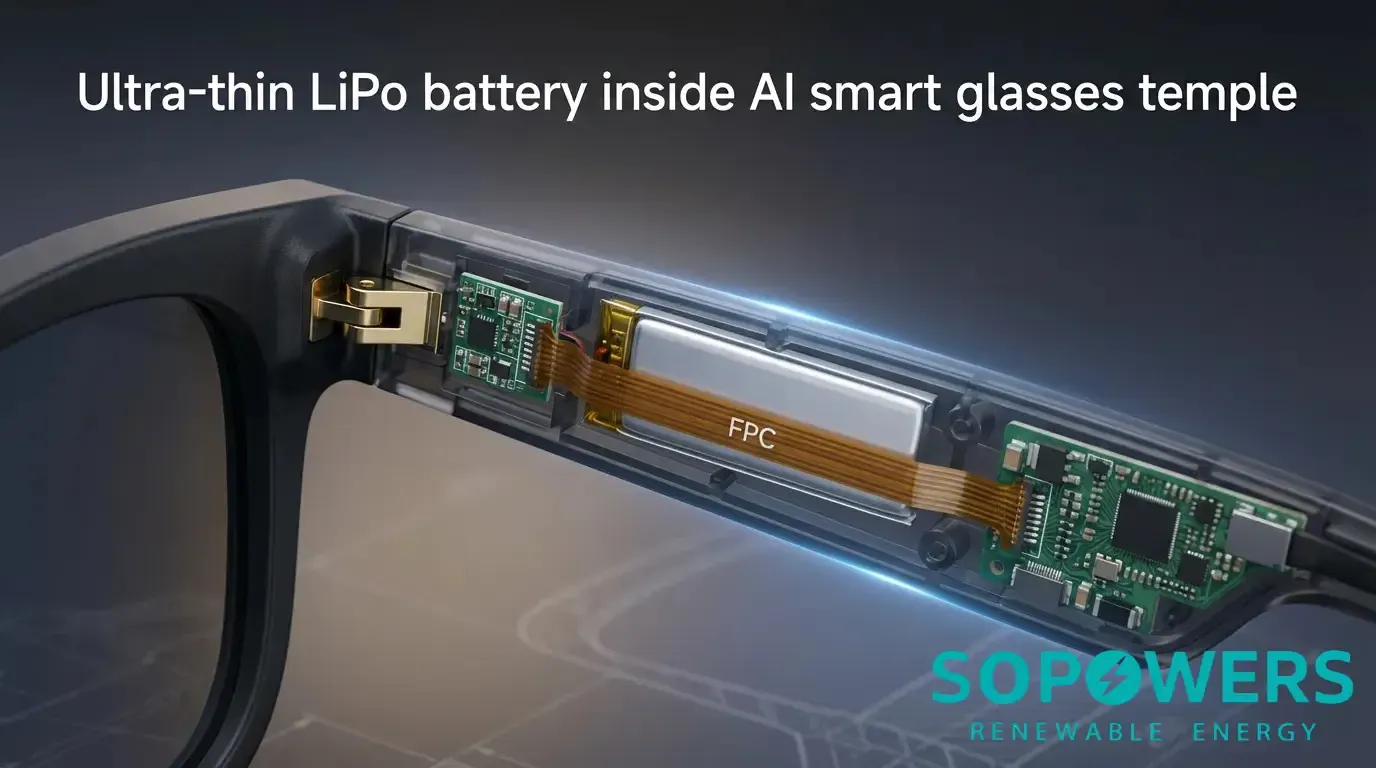
AI smart glasses are moving fast from “cool demo” to real products: camera streaming, on-device assistants, and always-on audio all raise expectations for all-day usability. The constraint is still the same: energy must fit into a temple or headband that is only a few millimeters thick, while remaining safe against drops, sweat, and daily charging.
For most lightweight eyewear, the practical answer is an ultra-thin lithium polymer battery, typically a single 3.7 V LiPo battery pouch cell (often split across two temples). Below is a buyer-friendly, engineering-focused listicle that helps you size capacity and C-rate, and avoid the most common safety and certification pitfalls.
1) Why smart glasses batteries are harder than they look (space, heat, and honesty)
A battery for AI glasses is not “just a smaller battery.” You are designing for:
- Severe geometry limits: temple thickness often leaves only about 1 to 3 mm for cell + insulation + structure + an ultra-thin PCM.
- Peak loads: cameras, radios, and on-device AI can create short bursts that drive voltage sag and localized heat.
- Skin-contact risk: eyewear sits against the head, so thermal hotspots and mechanical damage tolerance matter more than in many handheld devices.
- Buyer pain point: exaggerated claims: distributors and OEMs often cannot confirm real performance until they run their own tests, which slows launches and increases cost.
Market momentum also means higher compliance pressure. IDC projects AR/VR headsets plus display-less smart glasses shipments reaching 14.3 million units in 2025 and 43.1 million units in 2029, so logistics and certification readiness are becoming “table stakes,” not optional.
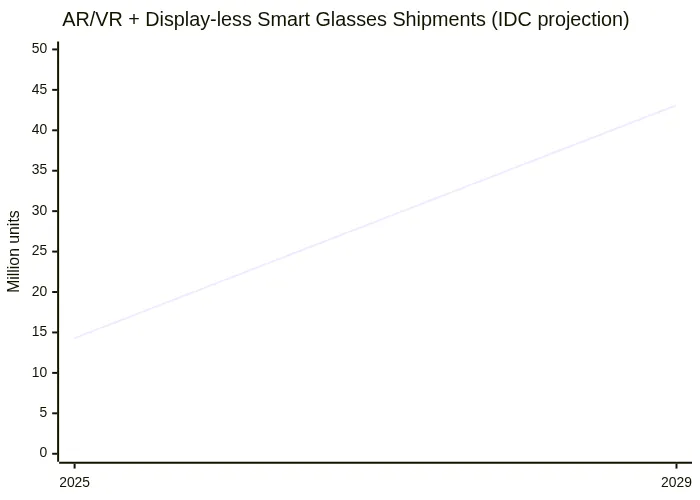
Sources: IDC AR/VR market insights
2) The realistic spec window for an ultra-thin lithium polymer battery in AI glasses
For slim AI smart glasses, typical usable energy is roughly 0.3 to 1.5 Wh per side, often translating to about 80 to 400 mAh at 3.7 V depending on power budget and comfort targets. Continuous discharge is commonly in the 0.2 C to 1 C range, with short peaks of a few C for camera and compute bursts (design-dependent).
A useful “reality anchor” is the Echo Frames teardown showing a 0.589 Wh LiPo cell (about 159 mAh at 3.7 V), paired with a product claim of roughly a day of intermittent use or around 3 hours of continuous audio (at specified conditions).
Sources: iFixit Echo Frames teardown (video)
Typical ranges by device type (selection cheat sheet)
| Device category | Typical pack architecture | Typical energy budget | Practical note |
|---|---|---|---|
| Audio + assistant smart glasses | 1S, often split L/R | ~0.4 to 1.2 Wh total | Comfort-first; charge case often used |
| AI glasses with camera bursts | 1S, higher peak current | ~0.8 to 2.5 Wh total | Peak planning matters more than “nameplate mAh” |
| AR/XR headsets | Multi-cell, sometimes external pack | 10 to 20 Wh and beyond | Weight distribution drives architecture |
For XR devices, battery life expectations commonly land around a few hours of active use (examples include Apple Vision Pro battery life statements and HoloLens 2 battery life guidance).
Sources: Apple Vision Pro specs, Microsoft HoloLens 2 hardware
3) A 9-step list to size capacity and C-rate (without overspecifying)
When selecting a battery for a wearable device, focusing on load profiles is critical. Here is a practical sizing list used in real projects:
- Define Usage Modes: Categorize the device’s operational states, such as:
- Idle: Microphones and Bluetooth Low Energy (BLE) active.
- Typical: Audio playback, sensor engagement, and intermittent AI processing.
- Peak: Camera activation, data uplink, and intensive AI bursts.
- Determine Average Power Consumption (Watts):
- Prioritize actual measured values if available.
- If estimating, adopt a conservative approach and clearly document all assumptions.
- Establish Target Runtime:
- Specify desired operational duration, e.g., “4 hours of continuous audio + AI” or “all-day intermittent use.”
- Calculate Required Energy (Watt-hours):
- Utilize the formula: Energy (Wh) = Average Power (W) × Runtime (hours).
- Convert Energy to Capacity (mAh at 3.7 V):
- Apply the conversion: Capacity (mAh) = (Energy (Wh) / 3.7 V) × 1000.
- Account for Margin (20-30%)
- This buffer helps compensate for factors such as temperature fluctuations, battery aging over time, and variations in manufacturing.
- Calculate Continuous and Peak Currents
- Continuous Current (I_cont): This can be estimated by dividing the average power (P_avg) by the nominal battery voltage (typically 3.7V).
- Peak Current (I_peak): Identify the maximum short burst current required, usually during the most demanding operations like camera usage or intensive AI processing.
- Determine the Appropriate C-rate for the Lithium Battery
- Required Continuous C-rate: Estimate this by dividing the continuous current (I_cont) by the battery’s capacity.
- Required Peak C-rate: Calculate this by dividing the peak current (I_peak) by the battery’s capacity.
- Avoid Overspecification: Opting for an excessively high C-rate chemistry can lead to compromises in energy density and a reduced cycle life for the battery.
- Validate thermals in the actual frames
- Skin-contact wearables must stay comfortable; the housing and insulation strategy is as important as the cell.
Quick example (common request: “4 hours”)
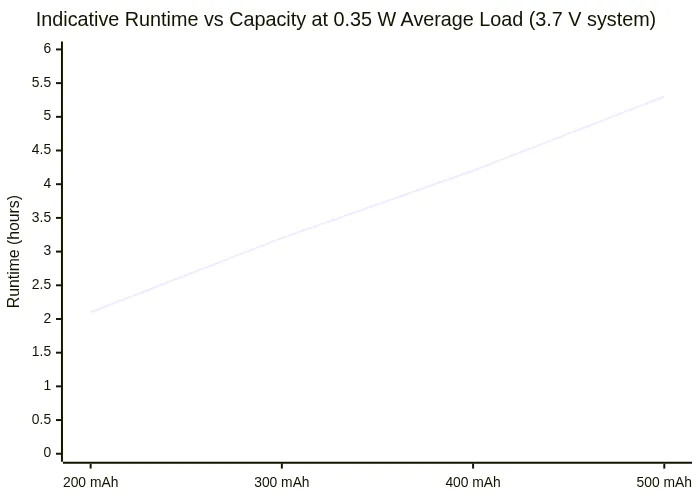
If average power is 0.35 W and target runtime is 4 hours:
- Energy = 0.35 x 4 = 1.4 Wh
- Capacity approx (1.4 / 3.7) x 1000 approx 378 mAh
- With margin, design target is often ~450 to 500 mAh total, possibly split across both temples.
To help non-battery teams visualize the trade, the chart below shows indicative runtime versus capacity at a fixed average power (example only).
4) Safety and certification checklist: UN38.3, CE alignment, and protection circuitry
For export and air logistics, a UN38.3 certified battery is not negotiable. For Europe/EMEA products, CE requirements typically push teams to align with recognized safety standards such as IEC 62133-2 (portable Li-ion safety) and IEC 62368-1 (AV/ICT equipment safety), alongside system-level EMC and radio compliance.
The buyer’s checklist (save this for RFQs)
Transport and documentation
- UN38.3 test coverage for the specific cell/pack design
- UN38.3 Test Summary ready for logistics and customs
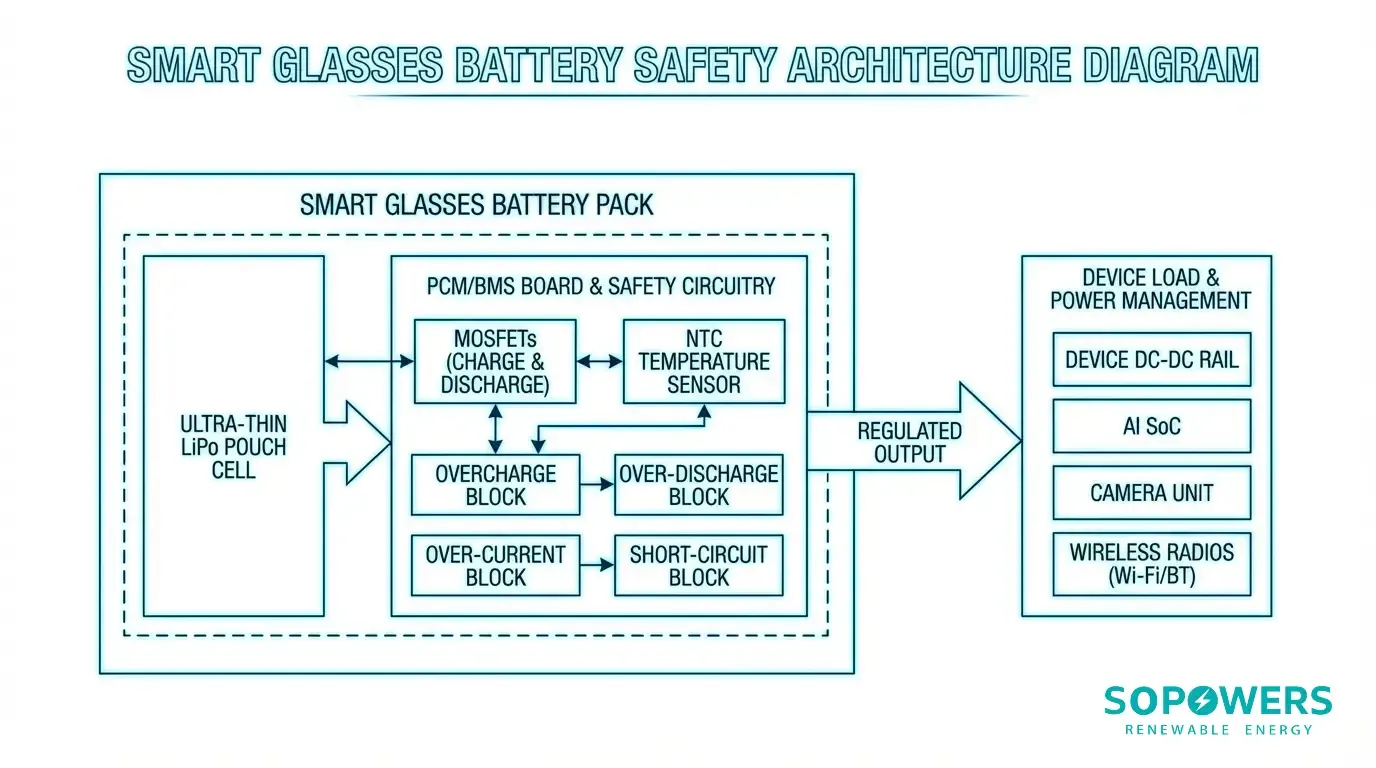
Electrical protection (smart glasses battery protection circuit)
- Overcharge protection battery thresholds (charge cutoff around 4.2 to 4.25 V, design-dependent)
- Over-discharge cutoff (commonly around 2.75 to 3.0 V, design-dependent)
- Over-current and short-circuit protection
- Temperature sensing (NTC or IC sensor) with charge/discharge limits
Wearable-specific mechanical safety
- Pouch cell anti-puncture strategy: no sharp edges, controlled bend radius, reinforced hinge area
- Insulation stack-up between cell and outer shell (especially near metal parts)
- Moisture and sweat risk review (seals, coatings, or barriers)
Why this matters for distributors
- Inconsistent documentation slows shipments.
- Missing protection details increases re-test cost at the device level.
- Wearable failures have higher brand risk due to skin-contact proximity.
5) Custom pack design for AI glasses: what to specify, and how Sopowers supports validation
For most programs, you are not just buying a cell. You are specifying a compact battery pack design that must survive assembly, daily wear, and charging habits.
RFQ inputs that prevent surprises
Provide these upfront to a custom lithium battery manufacturer:
- Electrical
- Nominal voltage (often 3.7 V LiPo battery, 1S)
- Capacity target (mAh) and minimum acceptable at end-of-life
- Continuous and peak current targets (C-rate lithium battery requirement)
- Charging method and max charge current
- Mechanical
- Max thickness, width, length, and keep-out zones (hinges, speakers)
- Cable exit direction, connector type, strain relief requirements
- Need for curved geometry or split left/right packs
- Environment
- Operating and storage temperatures
- Sweat/moisture exposure assumptions
- Drop and torsion expectations for frames
- Compliance
- UN38.3 documentation requirements for shipping
- CE-aligned product targets (device-level standards planning)
How Sopowers applies drone and robotics discipline to wearables (without hype)
Sopowers’ core business is drone battery, high discharge battery, low temperature battery, and high energy density battery solutions. The transferable value to AI wearable battery projects is the process discipline:
- Pre-delivery: solution matching and technical confirmation
- Capacity, voltage, power rating, and application scenario feasibility are confirmed before sampling.
- Realistic performance expectations are set early (no exaggerated claims).
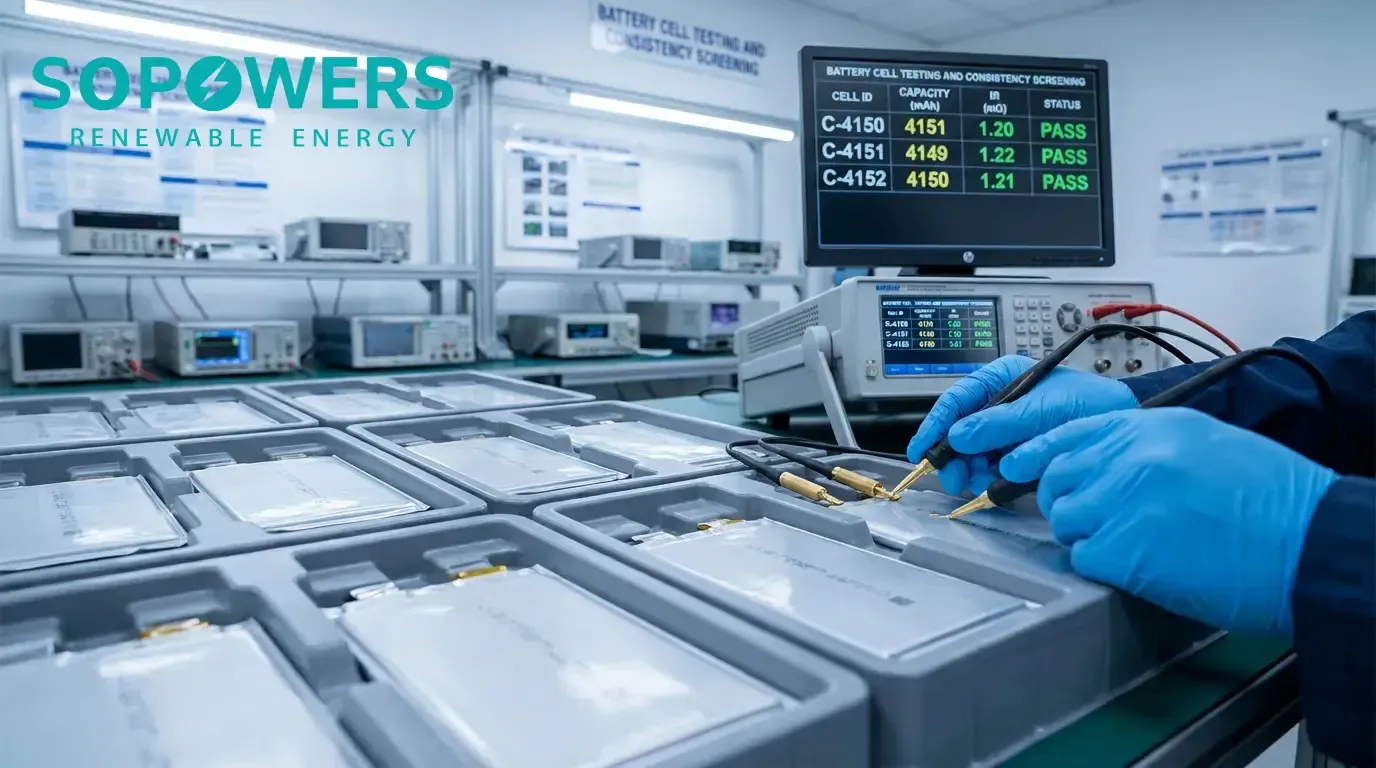
- During delivery: factory testing and consistency screening
- Batch-level consistency checks help ensure labeled capacity and internal resistance match real-world performance.
- Post-delivery: troubleshooting and optimization
- If you see voltage sag, unexpected heating, or cycle-life degradation, the team supports root-cause analysis and proposes practical adjustments (capacity margin, PCM thresholds, or current capability).
This same engineering approach is used in Sopowers projects like high-demand UAV packs and robust robotics packs, where safety margins and measurable outcomes matter more than marketing numbers. For reference, you can explore Sopowers’ existing product and engineering context here:
- Sopowers product page
- Solid state and high energy density portfolio
- Low-temperature battery challenges and solutions
- Sopowers blog
If you are specifying an ultra-thin lithium polymer battery for AI smart glasses, and want capacity sizing, C-rate validation, and export-ready documentation support:
Jump to Product Page
Send Inquiry
Contact Us
A short, complete inquiry typically includes: target mAh, max thickness, peak current estimate, and a simple duty-cycle description (idle, typical, peak).


