
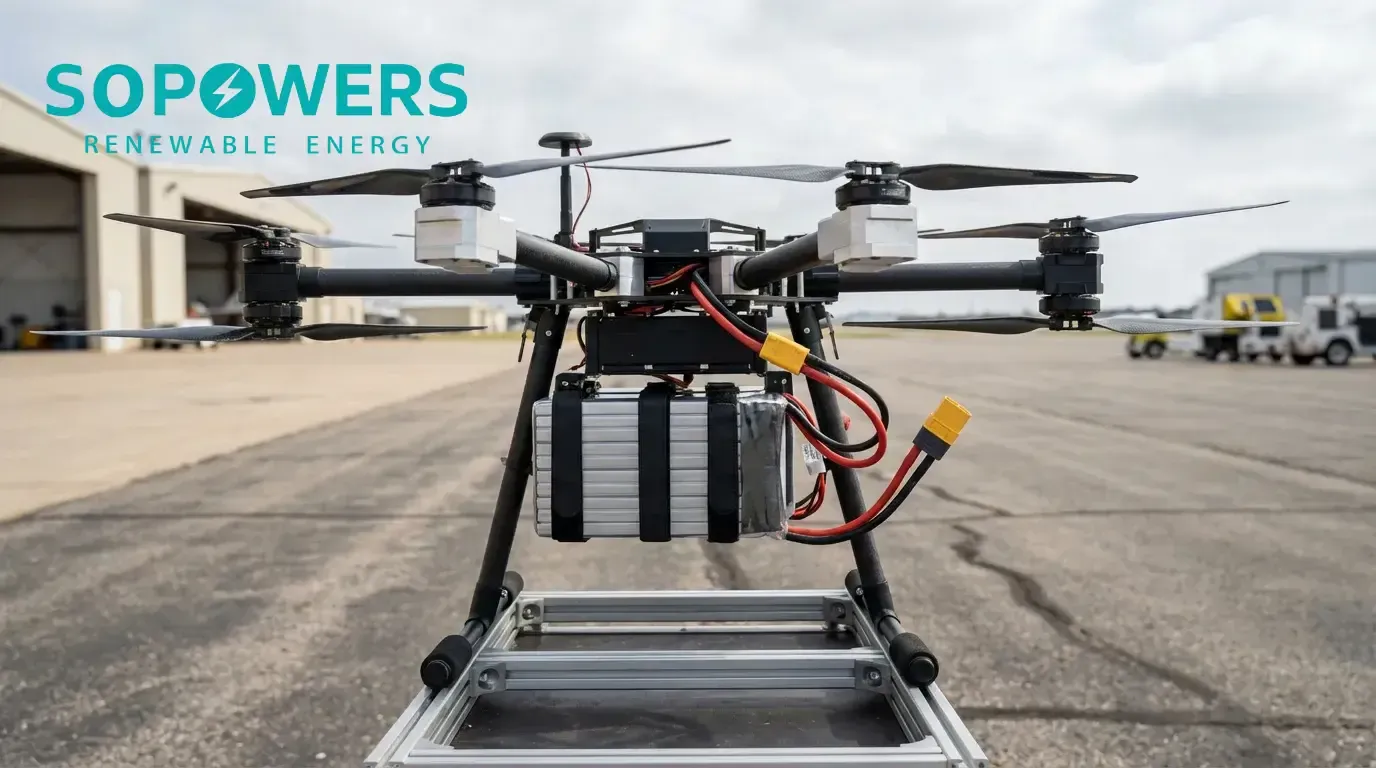
Industrial 15-inch multirotor platforms sit in a narrow window where payload, endurance, and thermal margin all compete for the same weight budget. That is why 12S power architecture (nominal 44.4 V class) is widely used in this size range: it helps keep current manageable at multi-kilowatt power levels, reducing stress on ESCs, connectors, and wiring while maintaining stable voltage under load.
Why 15-inch heavy-lift drones depend on 12S power systems
A 15-inch drone typically targets payload-class missions such as inspection, mapping, and sensor carrying where total takeoff weight often lands in the 5 kg to 10 kg band. In this segment, 12S systems are popular because higher voltage allows the same power output at lower current.
A simple power takeaway for technical buyers:
- At the same power, doubling voltage roughly halves current.
- Lower current reduces I2R losses and heat in the powertrain.
- Lower current can also simplify harness design and improve connector reliability over long duty cycles.
12S2P vs 12S3P: what changes in a Li-ion drone battery pack
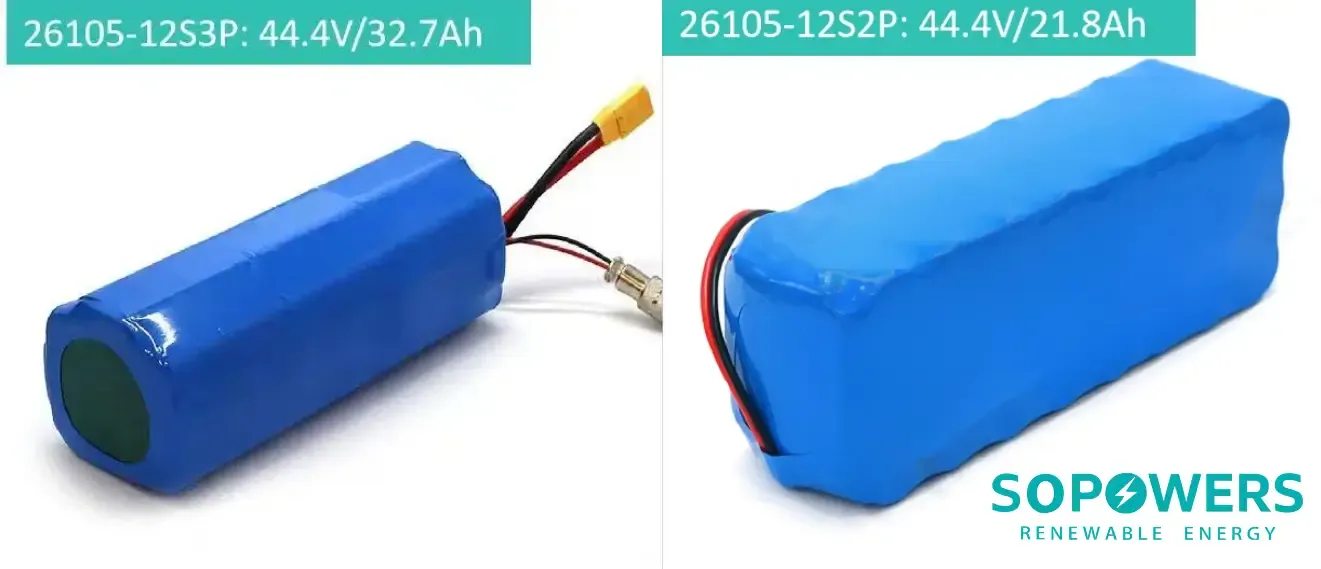
For a 12S Li-ion battery pack for drone applications, the “S” (series) sets voltage, while the “P” (parallel) sets capacity and current sharing:
- 12S2P Li-ion battery pack for drone: lower weight, less total energy, higher per-cell load at the same power.
- 12S3P Li-ion battery pack for drone: higher capacity and endurance, lower per-cell C-rate, typically cooler operation and more voltage margin late in the flight.
What parallel count changes most in real operations:
- Endurance: more parallel capacity generally increases flight time, but with diminishing returns because added battery weight increases hover power.
- Thermal headroom: higher parallel count reduces per-cell current, which can reduce heating and help stability in hot weather or gusty conditions.
- Aging buffer: as packs age, internal resistance rises and voltage sag increases. A lower per-cell load usually preserves usable performance longer.
Case study: 15-inch drone results with SPINR26105 10.9Ah cells (real numbers)
Sopowers application data for a 15-inch drone using SPINR26105 10.9Ah cells, with a 7.5 kg payload:
Two battery configurations:
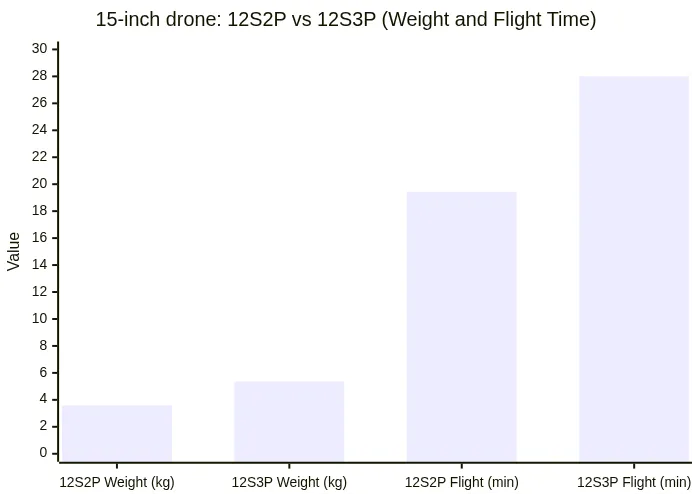
- 12S2P (24 cells):
- Pack weight: 3.59 kg
- Flight time: 19.45 minutes
- 12S3P (36 cells):
- Pack weight: 5.36 kg
- Flight time: 28 minutes
Side-by-side comparison table (given + derived)
| Parameter | 12S2P | 12S3P |
|---|---|---|
| Pack weight (given) | 3.59 kg | 5.36 kg |
| Flight time (given) | 19.45 min | 28 min |
| Weight change vs 12S2P | Baseline | +1.77 kg (+49%) |
| Flight time change vs 12S2P | Baseline | +8.55 min (+44%) |
| Estimated average power draw (approx.) | ~2.95 kW | ~3.07 kW |
| Estimated per-cell average C-rate (approx.) | ~3.1 C | ~2.0 C |
Key interpretation for a 15-inch quadcopter battery pack:
- The 12S3P configuration adds meaningful endurance, but it also adds mass, so “minutes gained per kg added” is not linear.
- The lower per-cell C-rate in 12S3P is often the hidden win for industrial reliability: cooler cells and more voltage margin typically translate to more consistent missions and less performance uncertainty.
Weight vs flight time visualization
How to choose 12S2P or 12S3P for a 15-inch drone (selection checklist)
If you are deciding how to choose 12S2P or 12S3P for 15 inch drone platforms, use a requirement-first approach. For distributors and OEM buyers, this avoids “spec-sheet shopping” and centers on measurable mission targets.
Choose 12S2P when the system is weight-limited
Typical fit:
- Your minimum viable endurance is around the ~18 to 20 minute band under payload.
- You prioritize agility, faster climbs, or tighter thrust-to-weight performance.
- You expect frequent landings and battery swaps, and want a lighter pack to reduce mechanical stress.
Operational note:
- With higher per-cell load, pay closer attention to heat, voltage sag near end-of-flight, and long-run consistency.
Choose 12S3P when the mission is endurance- or margin-limited
Typical fit:
- You need 25 to 30 minutes class endurance under payload, and landings are costly (downtime, access constraints, or workflow inefficiency).
- You operate in hotter environments or sustained wind where power draw spikes.
- You want more safety margin and better long-term stability (lower per-cell stress tends to help).
Quick buyer-facing decision table
| Buyer priority | Recommended direction | Why it typically works |
|---|---|---|
| Lightweight drone battery pack goal | 12S2P | Lower battery mass supports agility and payload flexibility |
| High capacity drone battery pack goal | 12S3P | More energy and typically lower per-cell load |
| 12S Li-ion battery pack weight vs flight time focus | Compare both | 12S3P adds endurance but with diminishing returns per added kg |
| Best battery for 15-inch heavy lift drone (productivity-driven) | Often 12S3P | Longer sorties, more margin in real missions |
Integration and reliability: BMS, validation, and Sopowers support
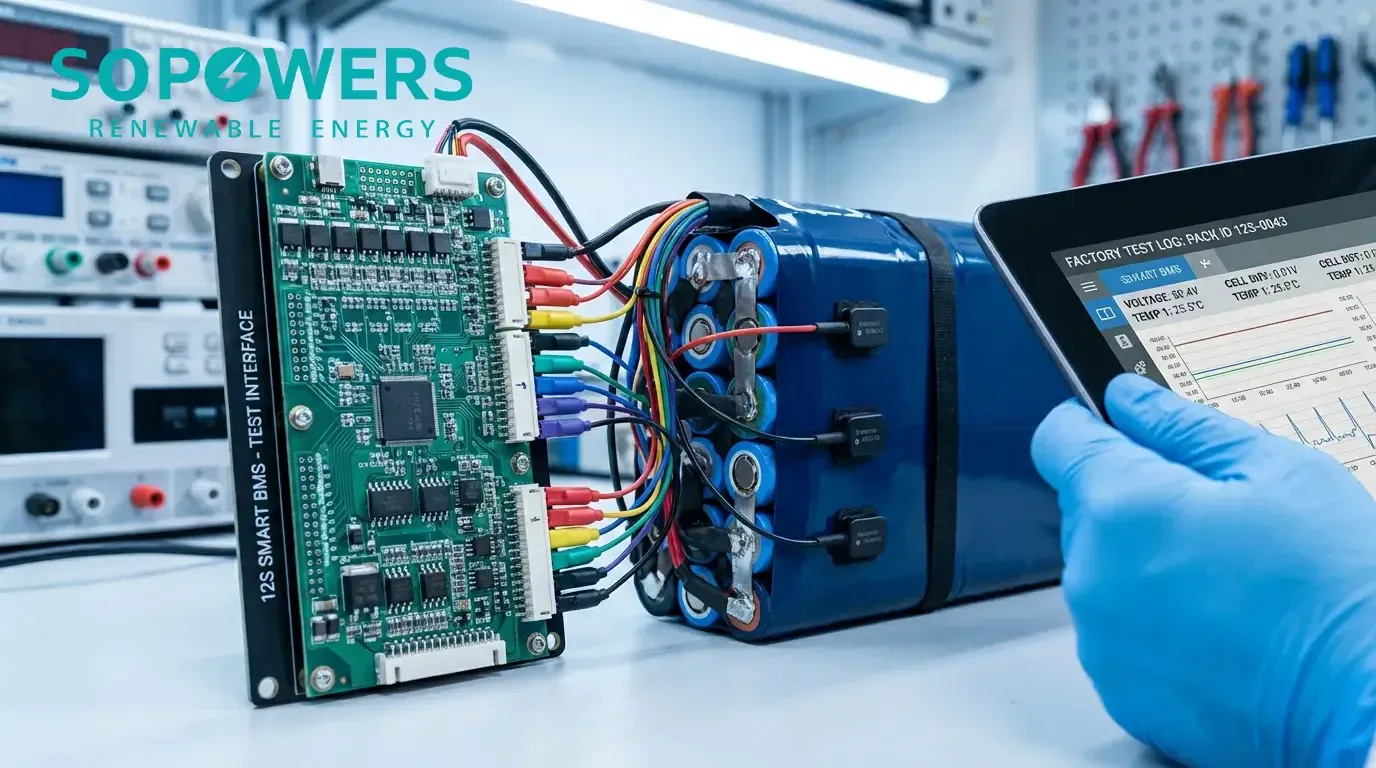
For industrial UAV programs, a 12S drone battery pack with BMS / smart BMS is less about “features” and more about risk control:
- Protection thresholds (over/under-voltage, over-current, temperature)
- Balancing strategy to keep a 12S string consistent over time
- Data visibility for troubleshooting and fleet maintenance (SoC, SoH, cycle count, event logs)
Sopowers also brings a process designed to reduce performance uncertainty (a common pain point in the battery channel):
- Pre-delivery: solution matching and technical confirmation based on your application scenario (capacity, voltage, power rating, feasibility).
- During delivery: factory testing plus consistency screening to ensure stable performance.
- After delivery: technical support and troubleshooting, including root-cause analysis and optimization recommendations.
If you are sourcing beyond drones, Sopowers also develops safety-centric packs for other platforms. One example from the application side is an AI robot battery pack designed as 15Ah, 15S1P, 48V LiFePO4 with a 5C rate, highlighting robust safety behavior even under severe impact conditions. This kind of application-driven design mindset carries over when specifying a custom 12S Li-ion pack for industrial UAV programs.
Where to view Sopowers product families (no guesswork links)
- Sopowers catalog for drone and related battery lines: Jump to Product Page
- Pack-level solutions (including high energy density pack approaches): Sopowers Pack Battery
- Drone-focused overview and capability context: Sopowers Consumer Drone
Summary for buyers and distributors
- Neither 12S2P nor 12S3P is inherently “better” or “worse”; the optimal choice depends on specific application requirements.
- 12S2P is often the practical choice when the mission prioritizes weight savings, agility, and payload flexibility.
- 12S3P is typically favored when endurance, thermal stability, and long-term reliability are paramount.
- The ideal configuration hinges on factors such as required mission duration with payload, environmental conditions (temperature, wind), and the desired margin for pack aging.


